

Ever since Amol Muzumdar took charge as head coach of the Indian Women’s team, he has not concealed his love for all-rounders: players who can provide their side with the cushion of at least two skills. Funnily, the team sheets for the Indian team against Sri Lanka in December last year had just two designated bowlers.
That push made several batters roll their arms (remember Smriti Mandhana’s quirky action?) and also nudged specialist bowlers to get out of their one-dimensional path and learn to have a wider utility for the side, across both white-ball formats.
The 2024 T20 World Cup in the United Arab Emirates – for all the positivity and hype around India’s preparations for that tournament – was anticlimactic. While the batting order’s failures took centre stage, India opted to go with six bowling options in that tournament. A nation known to produce prodigious spinners, India’s pace attack took quite a beating when Pooja Vastrakar found herself stuck in the injury web once more. Deepti Sharma was expensive then, as she has been of late. Radha Yadav was left out, reduced to a glorified fielding sub.
ALSO READ | How has rain impacted the World Cup in the past?
The 2025 ODI World Cup triumph pulled India out of several delusional patterns: batting wasn’t everything, and the side needed variety with the ball.
Amanjot Kaur’s efficacy reinforced the need to bolster the bowling allrounder pool. Kashvee Gautam followed, a player of similar mould – both now out of action due to injury. The tweaker’s pool has several promising talents knocking on the doors, generously aided by the well-oiled assembly line of the Women’s Premier League. Injuries remain a concern, but at the very least, this isn’t an avenue of development scribbled illegibly in the footnotes of the Indian coach’s diary anymore.
That said, no big-picture talk has much use for the anxieties facing the Indian think tank today, with barely a few days to go for the 2026 Women’s T20 World Cup opener against Pakistan. India played two warm-up fixtures – a 26-run win against West Indies and a six-run loss to England – hoping to lock its bowling order. But it is left with more questions than answers.
India decided to go without Deepti Sharma, Nandni Sharma, and Arundhati Reddy for both games. Shreyanka Patil and Radha Yadav were fielded, as was Renuka Singh Thakur. When fully fit, given the swing on offer in the British Isles, Renuka is a sure starter on paper. But modern cricket has stopped being gracious about such sureties. Usually a liability in the field and of little use with the bat, the T20 World Cup has no IPL-esque impact substitute rule that can help India maximise on what she’s good at without having to worry about her deficiencies.
Renuka’s prodigious swing bowling abilities were on display in both games, more so against England. So much so that she even struggled to contain the movement she was getting on the ball sometimes, especially given that she opted to stay full early on.
Her standout delivery was the one that dismissed Danni Wyatt-Hodge. After allowing batters space, she tightened the line to produce a jaffa that outfoxed the England opener. Richa Ghosh, standing up to the stumps (something that she has done prolifically to the pacers), did well to pouch the faint edge.
Renuka is not a bowler that teams usually save for the death. Her utility lies in being able to maximise on the early swing with the new ball. India curiously handed that first over to Shafali Verma.
The explosive Indian opener regularly bowls in the domestic setup but this skill took center stage in the ODI World Cup final when she dismissed Sune Luus and Marizanne Kapp in back-to-back overs to set up an eventual triumph for the Women in Blue. In both warm-up games this past week, Shafali was handed the ball for the opening over and did commendably, giving away six runs against West Indies (eventual figures of 0/9 in two overs) and nine runs against England (1/18 in two overs). Her loopy, almost lazy action is not a big mystery, but that she is relatively new to essaying this skill internationally means she can surprise the batter who might want to score some quick runs off her.

Shafali Verma the bowler took center stage in the ODI World Cup final when she dismissed Sune Luus and Marizanne Kapp in back-to-back overs to set up an eventual triumph for the Women in Blue.
| Photo Credit:
Getty Images

Shafali Verma the bowler took center stage in the ODI World Cup final when she dismissed Sune Luus and Marizanne Kapp in back-to-back overs to set up an eventual triumph for the Women in Blue.
| Photo Credit:
Getty Images
On one hand, should this be perceived as tentativeness with Renuka? At the other end, with Shafali herself, she was given an over closer to the death, where she maintained fair control over the run flow. Renuka was also tried out in the second half. Against the West Indies, she gave away 15 runs in the 18th over to allow the Windies to put up a decent total. Against England, she was given the 20th over and got taken to the cleaners by Danielle Gibson, conceding 19 runs.
ALSO READ | India’s T20 World Cup 2026 Squad Analysis: Concerns linger over lack of pace-bowling all-rounder and lower-order muscle
Watching along in that pace pool are Arundhati Reddy and Nandni Sharma. Not giving Nandni game time in the warm-ups, if India was serious about using her services during the World Cup, seems a little odd. Three games against England yielded four wickets. She went for runs when introduced within the first 10 overs, but whipped out her variations in the middle phase and the death, including her trademark back of the hand slower ball.
India’s pace pool’s performance in the 1-2 series loss to England
| Bowler | Overs bowled | Wickets | Economy | Average |
| Nandni Sharma | 11 | 4 | 9.27 | 25.50 |
| Arundhati Reddy | 12 | 2 | 7.66 | 46.00 |
| Kranti Gaud | 8 | 4 | 8.00 | 16.00 |
In the recently concluded bilateral T20I series against England, Arundhati, too, was guilty of leaking runs in the death (remember that 24-run 20th over in the 2nd T20I in Bristol) and didn’t strike as often as she would have liked. Kranti Gaud was expensive against the Windies, going wicketless for 43 runs, but fought back quite remarkably against England, giving away just 17 runs in her three overs against the host.
Of the two, Arundhati has a more striking match to look back on, a three-wicket haul against the arch rivals in the 2024 Women’s T20 World Cup for just 19 runs.

Will Nandni Sharma make her T20 World Cup debut this weekend?
| Photo Credit:
X/BCCI Women
Will Nandni Sharma make her T20 World Cup debut this weekend?
| Photo Credit:
X/BCCI Women
The seam bowling musical chairs is an important decision for India. Given the skewed rivalry between the two nations, does India choose to blood Renuka anyway (she has fond memories of creating havoc in Birmingham from the 2022 Commonwealth Games) so she can find her rhythm against a ‘weaker’ side? Or, will India err on the side of caution, keep the still rusty Renuka on the bench, and test eager youngsters instead?
In 24 T20Is played in this cycle, India has lost five wickets or more 14 times. Of that, it has lost seven or more wickets nine times. This means there is an onus on the bowling contingent to find a way to keep the scoreboard ticking for as long as possible. Renuka has no proven record with the bat, but Arundhati and Kranti can strike the ball and are adept at running between the wickets. Nandni, too, comes from a cricketing education that prioritises all-round skills. So there is a choice to be made for the Indian think-tank on which way it leans with its seam pool decisions.
ALSO READ | Sacrifices, silence, and a shot at glory: Everything we learnt from the Women’s T20 World Cup Captains’ Day
That batting column triggers second thoughts in the spin pool as well. Veteran offie Deepti Sharma occupies an important position in the lower-middle order, but her strike rate has left much to be desired. But in the bilateral series against England, her 13-ball 22 in Chelmsford (SR: 169.23) and a 24-ball 32 in Taunton (SR: 133.33) proved vital in staying competitive in those respective fixtures.
But with the ball, the story has been worrying. It’s not every day that India goes into a series with someone other than Deepti as its go-to spinner.
Now, that player is left-arm spinner N. Sree Charani. Deepti has been Harman’s go-to PowerPlay strike tweaker. Slowly, that role has gone to Charani, too.
India’s World Cup squad spinners in 2026 (in all T20s)
| Bowler | Matches | Wickets | Economy | Average |
| Deepti Sharma | 19 | 16 | 8.94 | 34.18 |
| Shreyanka Patil | 15 | 20 | 8.56 | 22.05 |
| Radha Yadav | 14 | 12 | 6.47 | 19.41 |
| Sree Charani | 20 | 27 | 7.88 | 21.81 |
| Shafali Verma | 21 (10 innings) | 4 | 8.68 | 34.75 |
More than a drying tap of wickets, it is Deepti’s economy rate that has been concerning. Since the turn of the year, in all T20s, she has conceded almost nine runs per over. With variable conditions in England, her giving India four tight overs is what Harmanpreet Kaur needs. But can Shreyanka Patil and Radha Yadav make a case for selection over her?
The Indian think tank rested Deepti for the warm-ups and gave Shreyanka and Radha game time, with the pair claiming four and three wickets respectively against West Indies and one and two wickets respectively against England. But neither used their opportunities with the bat as well as they would have liked. Radha managed a crucial 9-ball 16 against England, but India needs longer, more impactful stays from her for that spot to bear her name on it.

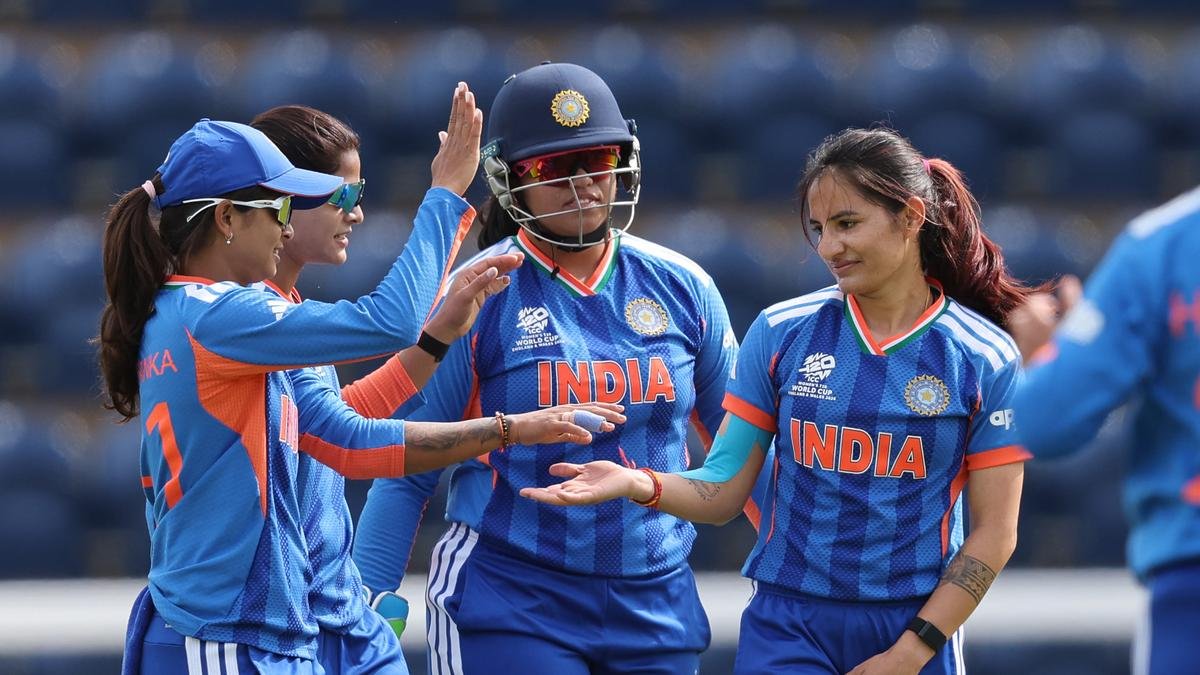
If old habits are anything to go by, experiments only happen in the run-up to events. Once the stage arrives, the leadership group often goes to seasoned warhorses.
| Photo Credit:
X/BCCI WOMEN
If old habits are anything to go by, experiments only happen in the run-up to events. Once the stage arrives, the leadership group often goes to seasoned warhorses.
| Photo Credit:
X/BCCI WOMEN
Shreyanka was imperious against Pakistan, India’s first opponent at this year’s T20 showpiece, when the sides clashed in the 2024 edition in Dubai, claiming two wickets for just 12 runs in a spell that featured 14 dot balls and a maiden over. Her career has since been marred by injuries, a loop she has just gotten out of. Her returns with the bat have been dismal, which is a shame given that she burst onto the scene in Royal Challengers Bengaluru colours with her quirky strokeplay and ability to access areas behind the keeper to give her side a healthy run rate. India will need some of that from the 23-year-old in England.
India has two relatively comfortable fixtures to start its campaign off with – the opener at Edgbaston on June 14 and against the Netherlands at Headingley on June 17 – before Australia comes calling. In Group A, featuring three heavyweights vying for two spots, India needs to start hoarding comprehensive wins so the math becomes favourable if it comes down to that.
If old habits are anything to go by, experiments only happen in the run-up to events. Once the stage arrives, the leadership group often goes to seasoned warhorses, sometimes banking on experience over form. It remains to be seen if the warm-up games and auditions from those usually on the bench mattered and if India is brave enough to bear some discomfort in its pursuit of the white-ball double.
Published on Jun 12, 2026
