

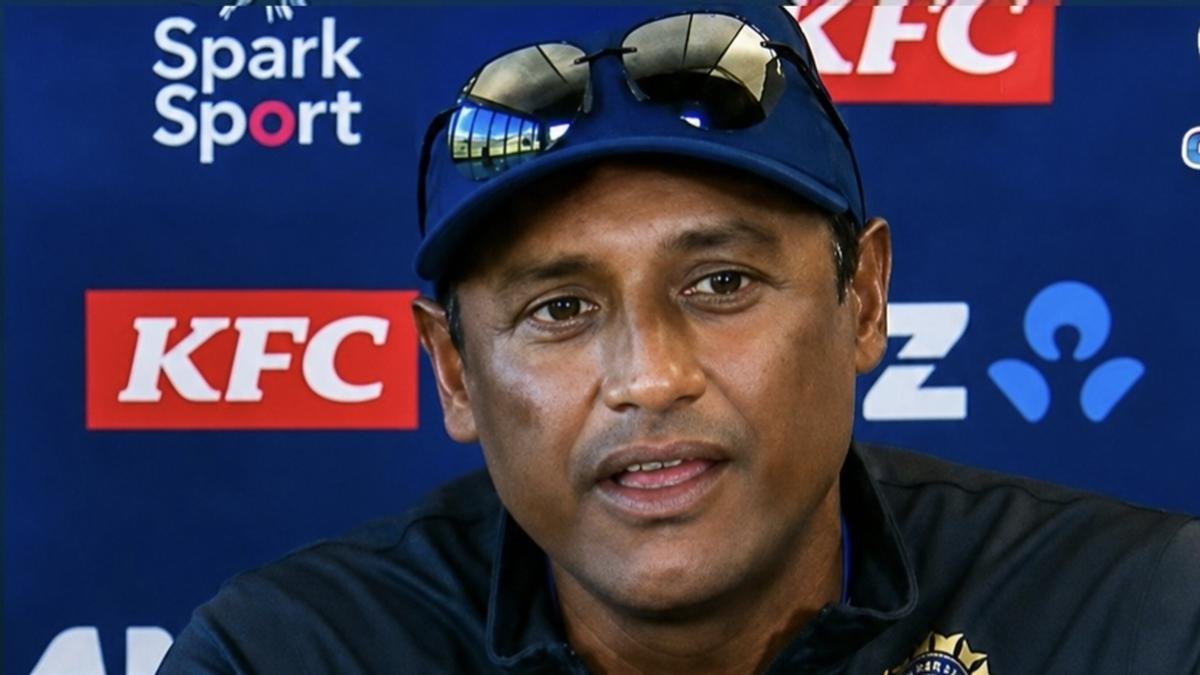
The Indian dressing room has always had room for celebrated names. Former captains, legendary cricketers, World Cup winners – they naturally grabbed attention when they walked in.
But Subhadeep Ghosh isn’t one of them.
Ghosh replaces T. Dilip as India’s fielding coach ahead of the Test tour of Sri Lanka. It won’t be the arrival of a decorated former international. Instead, it will be recognising a domestic coach who has quietly risen through the ranks.
There are no grand stories attached to Ghosh’s playing career. He represented Assam and Railways in domestic cricket, featuring in 17 First-Class matches, scoring 316 runs with two fifties. He also scored 307 runs in 17 List A games before playing his last domestic match in 2005, Assam’s National One-Day Trophy fixture against Jharkhand.
Like many before him, Ghosh realised his future lay elsewhere.
Known in the circuit by his nickname ‘Joy’, he continued playing club cricket in Kolkata for Dakshin Kolkata Sansad (DKS). After hanging up his boots, he moved on to coaching, organising small camps for budding cricketers.
Over the last decade and a half, he has quietly built a reputation as one of the sharpest fielding minds in Indian cricket.
“Joy’s work ethic is unbelievable. Before every session, he does his research. He studies how a player moves, what his strengths are, what he needs to improve. Nothing is random with him,” former Bengal cricketer and coach Sourasish Lahiri, who has worked alongside Ghosh at the BCCI’s Centre of Excellence in Bengaluru, told Sportstar.
Lahiri believes Ghosh’s biggest strength lies in understanding that no two players require the same approach.
“He always assesses the situation first. He doesn’t just walk in and conduct a generic fielding session. He tailors everything to the players he’s working with, and that’s what makes him different,” Lahiri said.
Players who have worked with him often speak of Ghosh as a coach who notices everything. “People think fielding coaches only organise catching drills. Joy looks at the bigger picture. His idea is always to add value to the side, not just improve one skill,” he said.
Ghosh has moved through almost every layer of Indian cricket — the National Cricket Academy, India A, the women’s team and the IPL. At Kolkata Knight Riders and later Delhi Capitals, he worked with established internationals and youngsters alike, including Gautam Gambhir, who is now India’s head coach. Those stints helped him build a reputation through meticulous preparation.
Recently, he travelled to Sri Lanka as India A’s fielding coach and managed the team, which had stars like Tilak Varma, Ruturaj Gaikwad, Vaibhav Sooryavanshi among others. And, they all had a word of praise for Ghosh.
That tour appears to have strengthened his case.
When Ghosh walks into the Indian dressing room, he will be the oldest member of the coaching staff. He turns 58 in November, and predictably, there have been murmurs over whether someone of his age is the right fit for a role that demands long hours on the field, sharp reflexes and constant movement.
Those who backed his appointment are confident. The BCCI hierarchy believes Ghosh’s biggest strength lies in the trust he has built with India’s leading cricketers over the years. Many of them have already worked with him extensively and swear by his methods.
As one senior BCCI official put it, reputation alone doesn’t carry much weight in today’s dressing room. Modern cricketers spend most of the year with specialists from across the world and are quick to judge what works and what doesn’t. Coaches survive only if players are convinced they add value. Ghosh, the board believes, has already earned that respect.
“He has worked with Rahul Dravid, VVS Laxman and across different levels of Indian cricket. He’s been part of that set-up for years, and he’s done a fantastic job. This opportunity has come because he’s earned it,” Lahiri said.
His appointment also says something about where Indian cricket is headed.
Rather than looking at big names, the BCCI, it seems, now wants to hire domestic coaches who have that sort of experience. While it was a stop-gap assignment for him, Ghosh made an impact with India’s women’s team, too, earning praise from Smriti Mandhana, Harmanpreet Kaur among others.
A senior member of that side recalled how Ghosh paid close attention to movement patterns, anticipation, throwing mechanics and boundary awareness, ensuring intensity never dropped through a game.
India’s fielding has slipped in patches over the last year. The dropped chances in England proved costly, and there was a growing feeling within the system that fresh ideas were needed. Ghosh now walks into a role where every missed opportunity will be scrutinised.
Outside Indian cricket, Ghosh remains an unfamiliar name. However, those who know him believe his promotion has been a long time coming.
Published on Aug 01, 2026
