

For the best part of two hours, the fading warrior looks every one of his 39 years and 51 days. But suddenly there’s a fizzing forehand, a delicate drop shot, hope. There are cries of “Nole! Nole!” Claps and cheers. And from nowhere Centre Court resembles a revivalist meeting.
He couldn’t, could he? Novak Djokovic might be two sets down. Jannik Sinner might be outslugging him and pushing him back. But the greatest returner in tennis history has his first break point at last, and Wimbledon is desperate for an old-time miracle.
At the other side of the net, Sinner wipes his face as Djokovic bites on his lower lip. Then comes the crack of racket on ball – and the sound of that hope being extinguished. After a 125mph ace flies down the T, Djokovic looks to the heavens and shrugs. Someone shouts something indecipherable. “Ten years ago maybe,” he says, with another smile.
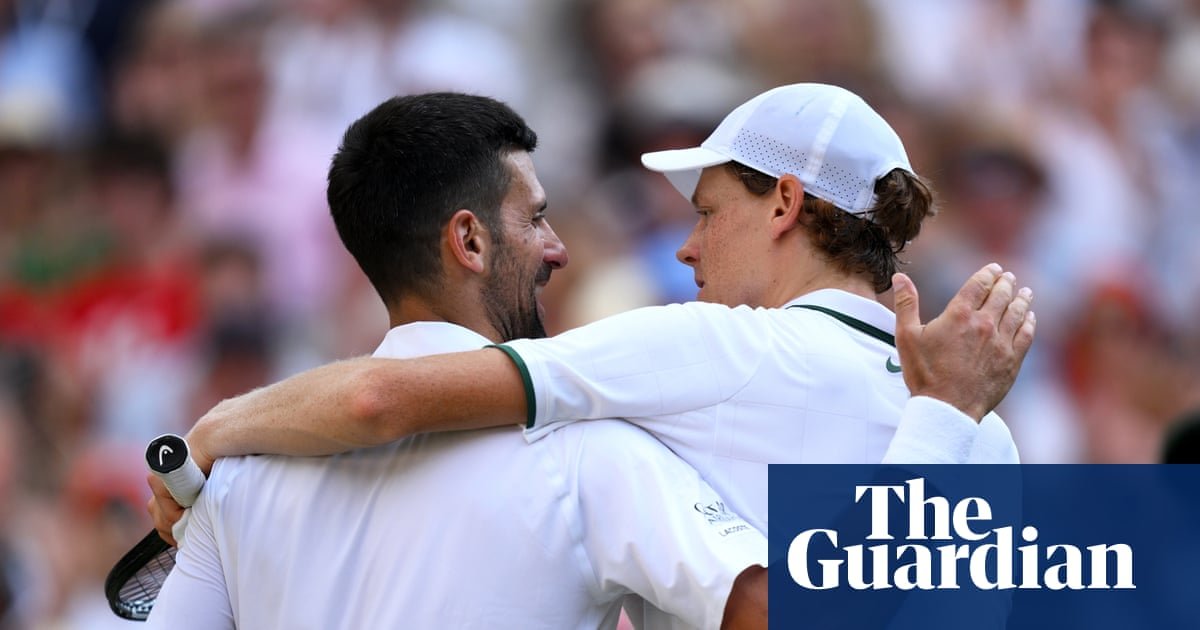
Quickly Sinner pummels another 132mph ace out wide to hold serve. Before long he is also whispering words of encouragement into Djokovic’s ear, having dispatched him 6-4, 6-4, 6-4 to reach his second Wimbledon final.
This week Pat Cash, the 1987 champion here, suggested that the grass courts at Wimbledon are the slowest he has ever seen. Tell that to Sinner, who won 45 out of 51 first-serve points, a staggering 88% success rate, in this one-sided demolition.
You can only imagine the damage that serve would have done on those slick, low-bouncing grass courts in the 90s. Especially as he also hit 16 aces.
No wonder Djokovic was scratching his head in admiration. “You cannot attack his first serve,” he said. “You can try to read it, chip it, block it, get it back in play. It’s a very unpredictable serve, great variety, great balance, great pop.
“He’s using his height extremely well. Also second serve very deep in the box. A lot of rotation. He can go for speed. He doesn’t make many double faults. He’s just super solid. He backs it up with the first aggressive shot.
“If you play a shorter return, you’re, again, on your back foot. It’s really, really tough to play him.”
What was going to stop Sinner here? Not the heat. True, it was 30C (86F) when play began at 4.20pm. But that was four degrees cooler than earlier in the week. And, better still for the Italian, the clouds were covering the sun and there was even a breeze across Centre Court.
And not Djokovic either. Some had also questioned whether Sinner’s groundstrokes might face a stern test, especially given he hadn’t played a single seed in getting to the semi‑finals. But he passed that exam too, striking 40 winners to just 15 unforced errors.
after newsletter promotion
“It was a good old blowout,” Djokovic confessed later. “I was just half a step late in any shot. It’s as simple as that. I was not sharp enough, not reactive enough, not balanced enough to play him. He was just at cruising speed and I couldn’t catch him.
“I’m not upset with myself. I don’t think I’ve done too much wrong. I was just a level or two worse than he is. He was playing so solid from all ends.”
There was still a final act of defiance as he forced Sinner to serve it out. But really there was little he could do when faced with a near-faultless display. The only thing you could fault Sinner with was the fact he took just three of 13 break points.
On this evidence, it is hard to see Alexander Zverev, who Sinner will meet in Sunday’s final, being able to live with him. The serve looks impregnable. And now he has found his groove on the ground too.
What about Djokovic? Well, as usual, his press conference afterwards was compelling listening. Because while being generous to Sinner, he was also insistent that he could still win grand slams in the future.
How to square that circle? Partly it is down to the fact that Djokovic believes he still has a chance to beat anybody – as his 5hr 15min marathon against the No 3 seed Felix Auger-Aliassime, the longest quarter-final in Wimbledon history, proved.
Partly it is because, as he revealed afterwards, for the first time in a couple of years he was leaving a tournament without feeling beaten up or injured.
Mostly, though, Djokovic can still see a path – however small – to a 25th grand slam. Who knows when Carlos Alcaraz’s wrist injury will allow him to play again? Perhaps New York in September will be a blast furnace, and he will be on the other side of the draw against Sinner?
And if he can reach the later stages with something left in the tank, he will believe again. Having been on court nearly 17 hours at this year’s Championships before this semi‑final, compared to 13 and a half hours for Sinner, that wasn’t necessarily the case here.
But would he have a favourite’s chance of beating Zverev here if Sinner had, say, suffered heat stroke? Yes, he probably would. And that’s why Djokovic fights on.
