

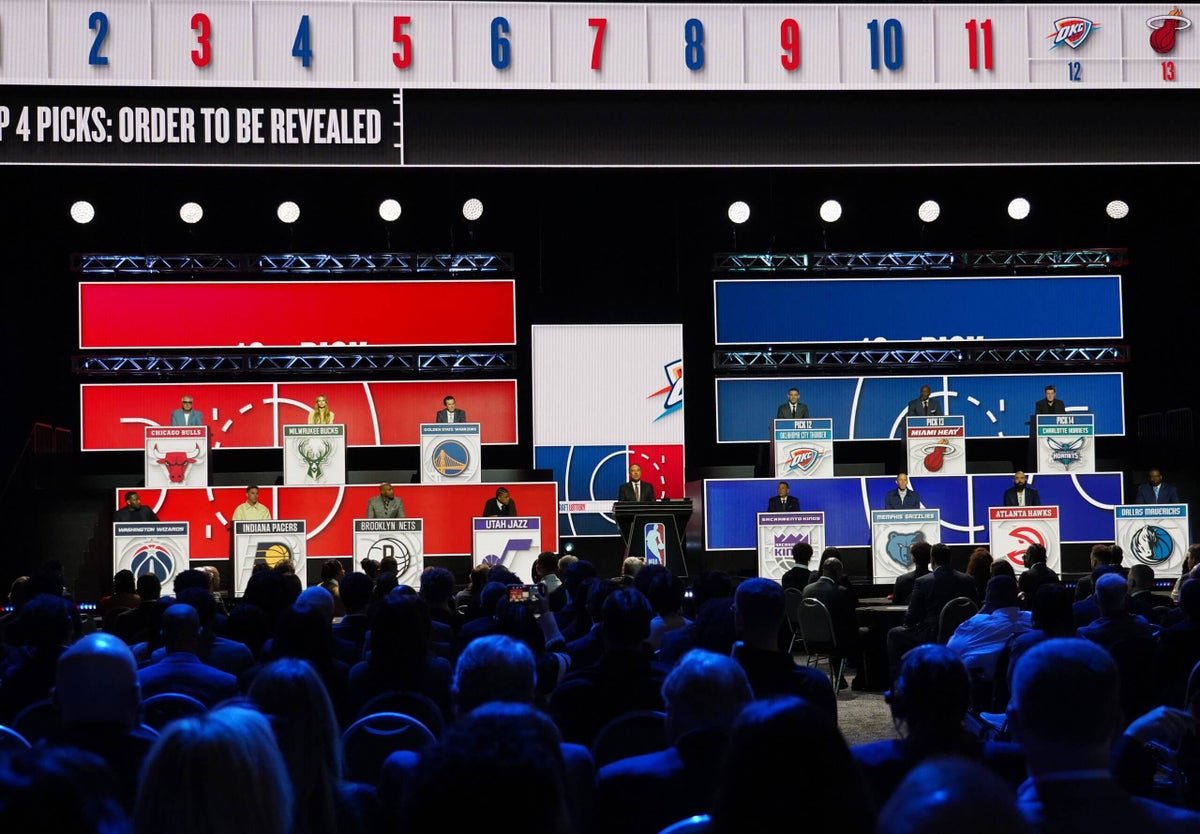
After a 2025-26 season in which tanking became more widespread than ever, NBA Draft lottery reform is here.
As with any reform, however, the devil is in the details, and some of those details still had fans and league insiders asking questions. In the wake of Thursday afternoon’s approval of the league’s “3-2-1” proposal, three league representatives discussed some of those details and their ramifications on a conference call with reporters.
While the outlines of the logic behind the new system were clear a long time ago — “We had to do something, and do something strong,” Byron Spruell, the NBA’s president of league operations, said — this is the first time we’ve heard league officials speak on the record about some of the particulars, especially a few that had initially escaped scrutiny.
Here then, is a quick rundown of the major questions, along with the league’s logic:
Why weren’t traded picks grandfathered?
The biggest debate surrounds the unprotected 2027 pick the Memphis Grizzlies own from the Utah Jazz* as a result of February’s trade of Jaren Jackson Jr. to Utah.
(* — technically, the most favorable pick belonging to Utah, Minnesota or Cleveland, but the Utah part is the one that matters here).
That’s because the league’s proposal added restrictions that prohibit teams from having their pick land in the top five in three straight years, or winning the lottery in consecutive years. This restriction travels with the pick rather than with the team, so a future pick that now belongs to another team could still be restricted on lottery night.
Thus, the pick Memphis acquired, initially unprotected, is now top-five protected by virtue of the Jazz landing in the top five in the 2025 and 2026 lotteries.
Given that the Grizzlies were unaware of this restriction when they acquired the pick, wouldn’t it have made sense to grandfather this pick and others like it (such as the unprotected 2029 Phoenix Suns pick owned by the Houston Rockets) from such a restriction?
The league did not want to do this, however, because it would have created the potential for the Memphis pick to benefit from restrictions on other picks without it being restricted itself. Consider, for instance, an example where the Washington Wizards win the 2027 lottery but, by rule, cannot pick first and thus get pushed down. What if Utah were the next name drawn?
“It essentially becomes a windfall to the teams that own those picks, because unlike other picks, they would benefit from the upside of the restrictions without any of the downside,” said Evan Wasch, the league’s executive vice president, head of basketball strategy and growth.
“If you were to grandfather traded picks, you essentially differentiate those picks as being more valuable than all other picks. … That didn’t feel like a systematically fair way to go about this.”
The league informed teams before the draft lottery that this was the case. It could have affected other teams besides Memphis, depending on how the lottery turned out.
For instance, if the Dallas Mavericks had landed in the top five, it would have affected a 2027 top-two protected pick they traded to the Charlotte Hornets. If Brooklyn had finished in the top five, it would have affected the unprotected Nets pick swap the Rockets own in 2027.
Note that several other future picks are potentially affected by this mechanism, although the likelihood of any one getting dinged is unlikely. For one notable example, the Portland Trail Blazers own the Milwaukee Bucks’ first-round picks outright in 2029 and via swap in 2030, although the current system sunsets after the 2029 draft and would have to be reauthorized by the league.
Why not have pick restrictions tied to the team rather than the pick?
To use the Memphis example above, some asked why the restriction wouldn’t be that Utah couldn’t land in the top five in 2027 regardless of whose pick it owned. Surely the rule was never designed to stop the Grizzlies from picking there.
As multiple general managers told The Athletic long before this rule was adopted, however, this created asymmetries in the market that likely would have resulted in teams of roughly equal talent just trading picks with each other. Teams could also sidestep trade restrictions by agreeing long beforehand to make trades immediately after the draft.
“That was the system that we felt was most ripe for manipulations, because there are both timing elements and arbitrated elements,” Wasch said. “Teams could theoretically agree to trade right after the draft, skirting the restriction that way, or trade in advance to avoid the restriction and extract value some other way.”
To use the example of the Memphis pick in 2027, “Any other team would have valued that pick far more than Utah, there would have been a market inefficiency, and it would have undermined the integrity of the rule,” Wasch said.
Why do the reverse lottery order for second-round picks?
One lightly reported detail of the league’s lottery reform is that the order of the draft’s second round will change. In all recent drafts, the second round has gone in reverse order of win-loss record, with no lottery and ties settled by a coin toss. That will no longer be the case for picks 31 through 46, which will now be ordered in reverse order of the lottery drawing. Thus, a team that wins the lottery will have its second-round pick slotted 46th, and the team picking 16th will also have pick 31.
Two pieces of logic drove this, according to Wasch. First was to “counterbalance to the luck of the draw in the first round” by at least giving the poor sap whose ping-pong ball was drawn last a better second-round pick.
Secondarily, however, the league wanted to guard against the scenario — one officials acknowledged was unlikely — whereby teams deep in the relegation zone started to tank to land the 31st pick. One can argue this incentive still exists for a team that has already traded its unprotected first-round pick, as going from three balls to two means better odds of being drawn later and a higher second-round pick. But such teams had the same incentive in the previous system.
Why couldn’t the league just hammer teams that tank?
One challenge the league ran into this year was that the mechanisms for investigating and enforcing tanking weren’t sufficient to the task and weren’t enough to deter tanking.
“Having done a lot of these investigations and inquiries with teams, when you get to the place of investigating your way to an outcome, it’s really hard to say that it’s just not coaching error, bad player performance or some underlying basketball (thing),” said James Jones, the league’s executive vice president and head of basketball operations. “It’s all subjective.
“We want to be in a place where no matter the outcome of the game, you don’t feel like you’re better off if you lose. You can’t punish your way to that.”
He added: “The value of these picks and players is exponential. If it’s a $10 million fine, is it worth it to just take the fine?”
In other words, the league no longer wants to be in the business of fining people for playing Cody Williams and John Konchar in the fourth quarter, or listening to other GMs whining about it.
The league included language that gives commissioner Adam Silver broader powers to enforce tanking penalties, but this was designed more as a fail-safe against egregious behavior that wasn’t foreseen by this mechanism, especially regarding the extra ball that teams receive for finishing ninth instead of eighth or 11th instead of 10th.
“The consensus was that teams would not want to do that for one lottery ball, (but) that’s why they added additional disciplinary pieces as a fallback,” Wasch said.
