

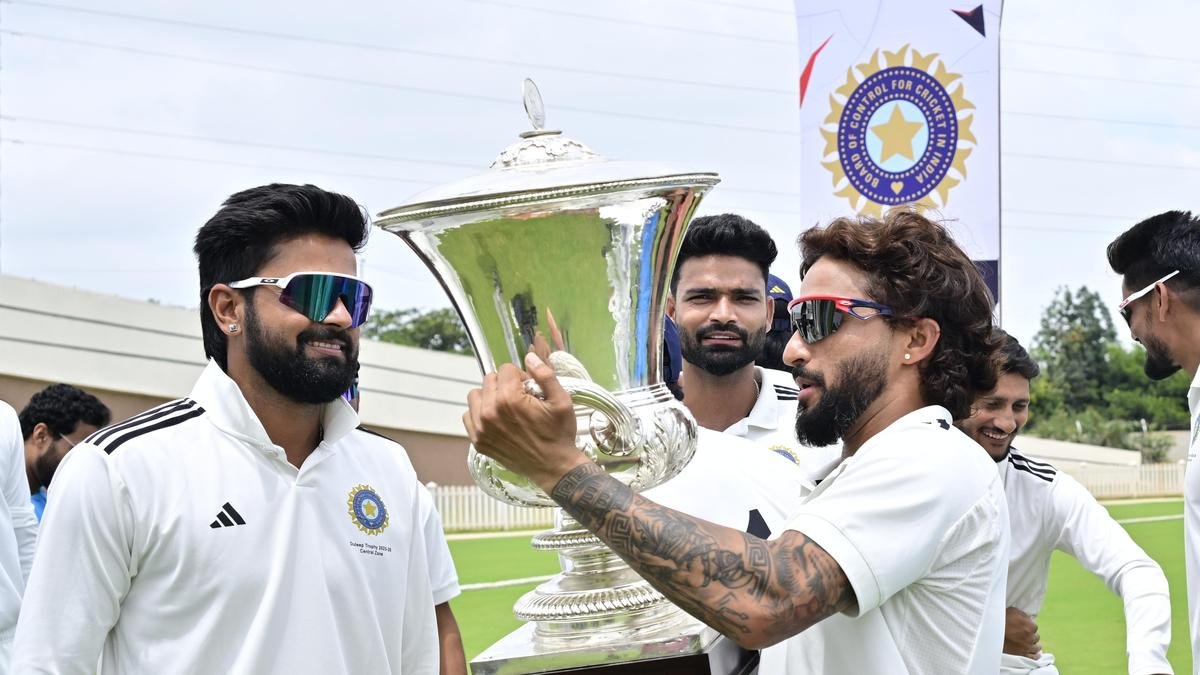
The biggest talking point ahead of this year’s Duleep Trophy isn’t a batter who scored close to 950 runs in the Ranji Trophy or a fast bowler who picked 60 wickets over the last two domestic seasons.
It’s, instead, a 15-year-old vice-captain.
The East Zone selectors’ decision to appoint Vaibhav Sooryavanshi as deputy to Ishan Kishan has dominated the build-up to the tournament.
Not because the teenager isn’t good enough. In fact, few youngsters have captured the imagination quite like the Bihar batter has over the last year. If the selectors see him as a long-term India player, there is every reason to expose him to bigger stages early.
But even then, it has revived an old debate.
For decades, the Duleep Trophy represented the highest reward for sustained excellence in domestic cricket. Leadership roles, too, generally went to players who had spent years proving themselves in the Ranji Trophy. Sooryavanshi’s elevation doesn’t diminish his credentials, but it does reflect how the conversation around selection has evolved.
There is plenty to look forward to on the field as well.
Rajat Patidar leads Central Zone after another productive domestic season. Ruturaj Gaikwad captains a formidable West Zone side. Ishan returns to red-ball cricket as East Zone skipper, while Karun Nair, fresh from a prolific domestic campaign and back in the national reckoning, headlines South Zone. Prithvi Shaw and Harsh Dubey are among several players with plenty to play for.
The tournament also comes at an important time for the selectors.
India has a packed Test calendar ahead, and several places below the established core remain open. Fringe internationals, India A regulars and domestic performers all have another opportunity to strengthen their case.
There are openings at No. 3, in the middle order and even for a fast-bowling back-up. Patidar, Karun and Gaikwad are among the contenders, while seasoned campaigners such as Shardul Thakur have an opportunity to push for a comeback. With the selectors also investing in youngsters such as Sooryavanshi, it is a chance for the experienced players to stamp their class across formats.
There was a time when the route to the Test team seemed almost predictable. A prolific Ranji Trophy season earned a place in the Duleep Trophy. Success there led to India A. A good India A tour often resulted in an India cap.
That isn’t quite how it works anymore.
These days, the selectors weigh domestic performances alongside India A tours, overseas assignments, fitness reports, workload management, technical assessments and long-term planning. The IPL has also become an important scouting platform, particularly for identifying players with exceptional upside. It is also worth remembering that the Duleep Trophy squads are now selected by zonal selectors, who do not necessarily share the same priorities or assessments as the national selection panel.
The Duleep Trophy has also thrown up some interesting stories over the years. In 1991, two teenagers made their debuts against each other in Guwahati – Sachin Tendulkar, 17, scoring 159 for West Zone and Sourav Ganguly an unbeaten 124 for East Zone. Both would go on to become India greats.
Irfan Pathan’s breakthrough came through the tournament too. He took 22 wickets in the 2002 edition and 19 the following year before making his India debut on the 2003-04 Australia tour. Yuvraj Singh’s 208 in the 2003 final was another statement, followed by his Test debut weeks later.
VVS Laxman’s 121 in the 1995-96 semifinal was an important step towards his India call-up, while Jasprit Bumrah’s 2014 performances for West Zone showed that his white-ball skills could translate into First-Class cricket. Gautam Gambhir, meanwhile, used the tournament as both a launchpad early in his career and a route back into India’s Test side in 2016.
The list is long and revealing. The Duleep Trophy has often been where future India players first made a serious case for themselves.
Nobody is saying domestic cricket doesn’t matter. It clearly does. But it has left many in the circuit wondering where sustained First-Class performances fit into the equation. Last season’s Ranji Trophy offered enough evidence to keep the debate going.
Karnataka’s Smaran Ravichandran finished with 950 runs. Delhi’s Ayush Doseja scored 949. Mumbai’s Siddhesh Lad averaged over 77, while Bengal’s Sudip Kumar Gharami produced another prolific campaign, amassing 797 runs. Harsh Dubey continued his remarkable consistency with the ball. Auqib Nabi, after another outstanding season, finally earned his maiden India call-up.
For Rajasthan fast bowler Aniket Choudhary, the priorities have changed over the last decade.
“Back in 2011-12, making the India A team was the biggest motivation for a domestic cricketer. Tours to New Zealand or the West Indies taught you a lot. They prepared you for international cricket,” Choudhary says.
“Now, the IPL has become the biggest focus. Even state associations seem to be following that mindset. Players with strong T20 records often get the first opportunity, but four-day cricket is a completely different format. You can’t judge a player’s red-ball ability on what he does in T20 cricket…”
Choudhary insists the distinction between formats should remain clear.
“Four-day cricket tests your patience, temperament and skill over long spells. It deserves to be viewed separately from T20 cricket. The two formats require different skill sets,” he says, pointing to Nabi’s journey as an example.
“It isn’t easy to be as consistent as he has been over the last couple of seasons. He was always in the mix, but perhaps never the first choice. As a domestic player, that makes you wonder what more you need to do. The BCCI should reward sustained performances in red-ball cricket.
“There are so many fast bowlers in the domestic circuit consistently bowling at 140 kmph. The talent is there. Players need to know that if they perform in four-day cricket, those performances will be recognised.”
That perception isn’t confined to one dressing room.
Several former domestic cricketers believe the selection ecosystem has become far more layered than it was a decade ago, with Ranji Trophy and Duleep Trophy performances now competing for attention alongside India A tours and the IPL.
Paras Dogra has seen that change from close quarters. After nearly two decades in domestic cricket, the Jammu and Kashmir captain believes the route has become far less straightforward.
Dogra, who still missed out on a North Zone berth for the Duleep Trophy despite leading J&K to its maiden Ranji Trophy title, says, “There are only one or two players who get picked purely on the back of domestic cricket now. The IPL seems to get preference.”
“Earlier, IPL squads were bigger and there were more opportunities, even for rookies. Now, only one or two new players make it into the playing XI because most franchises stick with their core. That has reduced opportunities for domestic players,” he adds.
He also believes team performances increasingly shape individual opportunities.
“Look at Nabi. He took around 60 wickets, and Jammu & Kashmir also had an excellent Ranji Trophy season. It’s a similar case with Saransh (Jain). He’s getting opportunities because he has been consistently performing and, at the same time, his team (Madhya Pradesh) has been doing well. We have also seen players miss out on the Duleep Trophy or India A despite scoring heavily because the team they represented didn’t have a successful season.”
There is another side to it: money.
“The opportunities are becoming narrower with the IPL’s growing dominance. Most domestic cricketers come from humble backgrounds, and this is their only pathway. Those who make it to the IPL earn financial security. Those who don’t continue to struggle,” Dogra points out.
Lad agrees with parts of that argument, but also sees encouraging signs.
While he lauds the selectors for picking a 33-year-old Jain, sending the message that age is not a deterrent to making it to the Indian team, Lad also believes such instances can’t be one-offs.
“There are encouraging signs that domestic cricket is getting its due. Take Saransh, for example. He’s 33 and has finally earned recognition after years of consistent performances. It’s well deserved. Every now and then, selectors do reward domestic cricketers, and that’s a positive sign,” Lad says.
“At the same time, it can feel unfair when a player goes straight from a handful of good IPL performances to the India team. The IPL is a fantastic tournament, but the grind of a full First-Class season is very different.”
Growing up, Lad saw his father, Dinesh Lad, groom several young cricketers, most notably Rohit Sharma, who went on to become stars.
That, Lad feels, happened because domestic performances were never neglected.
“A Ranji Trophy season lasts four to five months, and your preparation starts two or three months before that. You’re constantly in that red-ball mindset and rhythm. You play on different surfaces, in different conditions and against different bowling attacks. That prepares you for the highest level,” Lad says.
“Players who come through a full domestic season are match-ready. They understand how to build an innings, how to bowl long spells and how to adapt to changing conditions. Those are qualities that are difficult to replicate in a shorter format…”
With the focus shifting towards white-ball cricket, the idea of preparing sporting wickets at the domestic level has also changed, which invariably has an impact on the national team.
“If you look at India’s recent struggles on turning tracks at home, it’s not because our players don’t have the skill. We have plenty of quality. The issue is that we don’t play enough First-Class cricket in those conditions anymore. There is no substitute for that kind of experience,” Lad says.
As the players gear up for another gruelling season, the Sooryavanshi appointment sits at the heart of this discussion, not because he isn’t deserving, but because it represents a changing philosophy.
For years, leadership in the Duleep Trophy was almost an acknowledgement of years spent performing in First-Class cricket. Sooryavanshi’s appointment suggests Indian cricket is increasingly willing to reward potential as much as performance.
East Zone selector Pravanjan Mullick’s explanation is straightforward. “We want him to grow, and maybe one day he could even captain India,” he says. Many in the domestic circuit, however, aren’t convinced.
Their argument isn’t against Sooryavanshi. It is about the message such decisions send to players who have spent years grinding through First-Class cricket.
The Duleep Trophy has never been short of quality. This season, it also finds itself carrying an unusual burden of proving that it can still shape careers as much as it showcases them.
Published on Aug 22, 2026
