

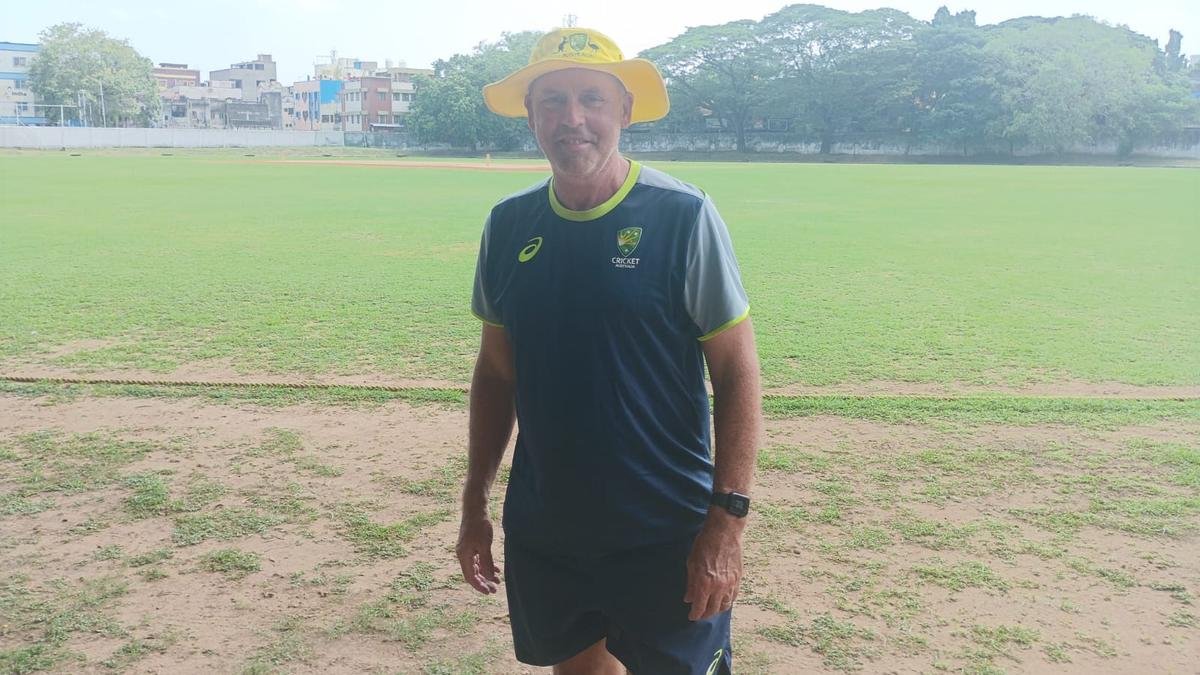
It’s going to be a busy year for the Australian men’s cricket team.
Across the next 12 months, it is scheduled to play up to 21 Tests, including a Border-Gavaskar Trophy in India, an Ashes series in England, and its first tour to South Africa since the ball-tampering scandal, as well as the 2027 ODI World Cup shortly after.
Australia’s Test schedule for the next 12 months
Bangladesh (H) – 2 Tests – August 13 to 26
South Africa (A) – 3 Tests – October 9 to 31
New Zealand (H) – 4 Tests – December 9 to January 8
India (A) – 5 Tests – January 21 to March 3
England (H) – 150th Anniversary Match – March 11 to 15
World Test Championship final (subject to qualification) – June 9 to 13
England (A) – 5 Tests – June 18 to August 2
In that context, Sportstar sat down with Australia selector Tony Dodemaide, who is in Chennai with an Australia development side at the MRF Academy, for a chat about selection, succession planning, and navigating the complex maze that is the global cricket calendar.
To begin with, what is the role of development tours like the one happening right now?
We’ve been doing these tours for some time now. The concept is that we play so much of our important cricket in Asia, particularly India, Sri Lanka, and Pakistan, and whenever we come, we generally get very dry pitches conducive to spin. Quite simply, at home, we don’t really have any comparable surfaces. Sydney Cricket Ground (SCG) used to be renowned as a spinners’ wicket, but that’s probably less so in recent years.
We find that younger players coming through have quite a narrow band of experience in terms of the conditions that they play in. So, to come over for 11-12 days at a time, have a couple of matches, have some training sessions really just broadens the guys’ experience about different methods that they need to employ when the tracks are turning quite fiercely.
We know that they’re not going to work it out in only one or two trips, but it is something which we think is important to their education as cricketers.
Coming to the upcoming block of 21 Tests in the next year, what does the planning process for this kind of schedule look like?
The planning process has happened a long time ago. We know the schedule, often five years out, as long as the Future Tours Programme is set out. So, we knew that there was an intense period coming up here, and we had a similar stretch in 2023, which included a tour of India, the Ashes, and World Test Championship, followed by a World Cup. So that was very taxing, as we knew.
It started a long way out when we started to plan out the sort of resources that we needed, the number of bowlers that we might need, the venues that we were playing at, and then mapping out scenarios of how historically the matches at those venues had gone and things like how many overs would bowl by spin versus fast bowlers, etc.
Then we started to work out roughly how many overs we would need, and therefore how many bowlers that would potentially go through. The thing that you don’t know, of course, along the way is how many short Tests there are and how many go the distance for five days. Injuries are always a factor.
But like any planning process, you try and work out a strategy of how you think you might get through that period and be consistently successful, and then you’ve got to work out how you resource those.

Australia is set to play 21 Tests till the end of 2027, starting with two matches against Bangladesh.
| Photo Credit:
AFP

Australia is set to play 21 Tests till the end of 2027, starting with two matches against Bangladesh.
| Photo Credit:
AFP
How much of that planning process is data-driven vs leaning on local resources?
Certainly, in recent times, it’s quite heavily data driven. I can only speak from my experience in the past five years that I’ve been a selector, but all three selectors are very sort of science orientated. Having data which can give you insights is really valuable.
That’s not to say that it’s everything, you don’t just make every decision based on that. But experience and hard data doesn’t lie. It’s there for a reason, things that happen in a particular venue in a particular country over time generally hold. That is what you can expect.
We’ve got a very fine analyst called Thomas Body, and he challenges us. We ask him questions and he comes up with answers which are totally based on what he sees on paper with no other prejudice. That’s very valuable for us.
You’ve recently had to replace a couple of high-profile batters in David Warner and Usman Khawaja. How do you evaluate Sheffield Shield cricket in a process like that, and what are the things you value highly in players?
These are full-time roles for us, so that gives us the opportunity to see every ball of every game. We obviously look for runs as the most valuable currency. So those that have developed their game and are scoring consistently, then clearly that is a major factor for consideration.
The style of play that players exhibit is something that we look at as well. For instance, those that put pressure back on the bowlers – sensibly. Now we have Travis Head there, he’s a very good exponent of that.
But for instance, Jake (Weatherald) and Travis had quite a bit of chemistry going during the course of the last Ashes series. Usman Khawaja was supposed to obviously play early and then got injured, and Travis stepped up.
In that sense, our strategy was to take the initiative at the start of the innings and get it ahead of the game if we could, which worked. But that may not necessarily be valid for every circumstance, on every tour.
We very much see each tour as an isolated example, and we try to plan accordingly for that. Things that work in Brisbane and Perth may not necessarily work in Galle or Nagpur or Lord’s. So, we look at how we think the game will be played in those conditions and then we try to match the skill sets and styles accordingly.
There has recently been some chatter about why there are not as many batters compiling massive runs in Sheffield Shield cricket recently. One of the reasons discussed was that pitches have become much tougher to bat on. Do you think that is fair?
The data would suggest that. In the last couple of years, the averages have come down per wicket. If you look at the top dozen or so run-scorers in the Sheffield Shield last year, the top average is 37. Perhaps in past seasons you would have expected some to be 40-50.
Similarly with the bowlers, the top dozen wicket-takers, a lot of them were seam-up bowlers and not necessarily express pace. They just got movement hitting the seam, and a lot of those bowlers averaged under 20.
So, when you put those two things together, it would suggest that the bowlers had the ascendancy. The other factor which was clear was the number of overs bowled by spin was vastly reduced.
So in that sense, it’s fair to say that it has been tougher for the batters.
It’s perhaps unfair to compare average directly with those of 10-20 years ago, but what can give you an indication is the percentage of runs scored for the team. The individual scores might not be as high, but it’s a percentage of the team totals. That’s a data point you can look at and say, “well, actually, even though it was 60, it was significant in the game.”
There’s different ways of looking at data as well, not just in the traditional sense, but we try to challenge ourselves to look through the data and look at the stories underneath.
As a selector, how does one weigh up giving players time and consistency against being clinical and focussing on results?
What we look for are players that have class. They’ve exhibited that they can perform at the level over a period of time.
Someone like Marnus Labuschagne has scored a lot of runs over time, you know that he can do that. Cameron Green, for instance, is another one there that has played a fair bit of cricket in Australia. And ideally, you’d want them to carry through into the next generation.
They’re relatively young, but you know, it’s a hard game. International cricket is a hard game. And so when you know that the players are doing that, it’s a combination of what sort of further developments — whether it’s mental, tactical, technique – that they need to progress and find that consistency that you hope for.
There’s also a question of who’s putting pressure on them for a similar spot behind them. Clearly, there’s a balance to say you can’t do that forever, but that’s part of the art of selection, when to, how long to keep going.
Someone like Marnus offers a lot in the field as well. Cameron Green is an all-rounder, bowls very impactful overs and is a great catcher as well. So it’s a package of skills that the players bring.
But one thing with this stretch of matches that we’re trying to convey is that there’s a lot of incentive for younger players in Sheffield Shield ranks just to really put their hand up and differentiate themselves through their performances, because undoubtedly, there will be opportunities. Even if not in the next 12 months, certainly from then on, there’s going to be lots of opportunities.
So, we’re encouraging players to really set themselves apart and perform, to demand selection.

Cameron Green is expected to take carry the next generation of Australian cricket.
| Photo Credit:
REUTERS
Cameron Green is expected to take carry the next generation of Australian cricket.
| Photo Credit:
REUTERS
How much emphasis do you place on a young player’s potential versus their immediate returns?
That’s part of the art of selection as well, where you have players that you know have talent. But in history, what we find is a lot of the great players that have played for Australia, and if not other countries, might have those introductions early then struggle, go back, and try again that had great careers.
Matthew Hayden, Justin Langer, even Don Bradman was dropped after his first Test. Steve Waugh was out of the team for a bit then came back and became a great player.
So that’s part of the process. If someone has talent it doesn’t necessarily mean they have a straight line towards success. They will have times when they will struggle, learn about their games, and improve. It’s about how the talent is refined, how you work your way through challenging situations, and handle the pressure of being an international cricketer.
The ideal case is obviously when the players you know have talent find the consistency to perform and win matches. That’s ultimately what I’m looking for.
The bowling group is starting to reach the backend of their careers, and ahead of the upcoming Bangladesh series, there were some questions about whether some new faces could have been given a chance. For these 21 Tests, is the focus ensuring that this group plays together as much as possible?
There’s always the balance over 21 Tests. In a perfect world, they’d play the majority of those games together, but it’s not a perfect world, cricket isn’t a perfect scenario. There will be times when injury, when players aren’t as sharp.
Australia’s been playing Test cricket for 150 years, and of the top 10 wicket-takers, we have four of them (Mitchell Starc, Josh Hazlewood, Pat Cummins, and Nathan Lyon) in the same team at the same time, which is just extraordinary. We’re blessed and we’re lucky at the moment. But those players can’t go on forever.
So that’s where we have tried to build up a running line of resources underneath. Scott Boland has come in and proven that he’s a fine international bowler. Michael Neser has had to wait a long time, but he performed tremendously well during the Ashes series and is a fabulous cricketer.
We’ve had other players that have had opportunities, Brendan Doggett has had a couple of opportunities. Jhye Richardson had a couple of opportunities. Lance Morris is someone who’s identified as having terrific airspeed, but unfortunately he’s had back issues for the last couple of years and he’s coming back from a major operation now.
But again, inevitably we’re going to need a lot of resources to get through these 21 Tests. And so the encouragement is there for bowlers in state cricket to really set themselves apart.
There are some terrific examples of guys that are pushing pressure on by getting wickets at that level, and we have some young talent too that it’s just coming through the youth from Under-19 2021 batch, like Callum Vidler, Mahli Beardman, and Tom Straker.
They’re terrific young bowlers, but they’re only starting their journey. So, whether they, whether they can stay on the park and get opportunities, or whether there’ll be opportunities for those guys in the middle there that are, that are now more hardened, First-Class cricketers.
And we’ll pick bowlers that we think are right for the conditions, not just because they’re the next in line. You’re not going to bring, you’re not going to bring five fast bowlers to India, for instance, and play them there. Perhaps in the middle of that stretch of the 20 Tests, there might not be so much workload on the quicks during the Indian series as such.
So they might get a break and therefore recharge and be ready for the Ashes. That’s a hope.
But it’s not an exact science. There’s going to be things that surprise us just like there were during the Ashes last year. We started the series hoping that Starc, Hazelwood, Cummins, Lyon would factor. Josh didn’t play at all in the series. Pat only played one Test.
So, Brendan Doggett, Michael Neser came in, Scott Boland played all five Tests, which is sort of unprecedented for him. And conditions were such that we felt we could leave out a spinner and play just all-rounders.
So, we’ll have our broad plans, but then as more information comes to hand about particular series and particular games, venues, conditions, we’ll refine our plans to pick the best people available. That’s all we can do and hope that we get more right than wrong.

The quartet of Josh Hazlewood, Nathan Lyon, Mitchell Starc, and Pat Cummins has been the major reason for the success of the Test side.
| Photo Credit:
AP
The quartet of Josh Hazlewood, Nathan Lyon, Mitchell Starc, and Pat Cummins has been the major reason for the success of the Test side.
| Photo Credit:
AP
What does the day-to-day process of tracking that player pool looks like?
Because we’re full time now, we have the opportunity to watch lots of games. We have players all around the world at the moment.
For instance, you know, Nathan McSweeney has played a full season for Northants. He’s got five 50s in his last seven innings in 50-over cricket, which is terrific. He’s another one that has had a taste of Test cricket, and he’s a fine young player who is developing all the time. Hopefully he can come and press for selection as well.
There’s so many competitions around the world now in county, in franchise T20s. It’s a battle sometimes to keep track of who is where.
We’re coming back here in a month’s time to play a series against India A in Puducherry. We know that India A always turns out high quality teams, so that will be another great opportunity for that next layer of players that we can identify to see how they go over here against high-quality opposition. That’s a great opportunity for them in the season to start putting the performances on the board and pressing us for selection.
Are there examples you look at in terms of best practice with regards to talent development and maintaining a strong pool of players?
I think it’s essential to have curiosity. So, we’re always looking outside. And I know that Andrew (McDonald) and George (Bailey) are very big on asking if someone is doing things differently, and better in talent identification and development. And, to what depth sports or industry might go in data to get more, even in AFL football.
We’re very closely aligned with AFL football. Andrew was on the board of Geelong Football Club. He’s a director of that club and spends a fair bit of time there. They’re a very successful operation.
Even Formula One. Through Andrew, we have some relationships with McLaren in Formula One, and we had an opportunity to spend a day there on a recent tour of England, which is fantastic because we can see the depth and say, how do you handle this? They way they look for 1% edges, just minor differences is something that inspires us to say, well, what else could we do? You know, it’s a strive for perfection.
We know we haven’t got it all right. We’re never going to get it all right, but we can get closer. So how do we do that? Who is leading the way? What can we learn from that? So, and I think that’s a very healthy approach. No one’s pretending that we know it better than anybody.
If you keep learning, you’re more of a chance to improve than if you just stay the same and hope that things work out.

Head coach Andrew McDonald works closely with other sports as well to learn new things and apply them in cricket.
| Photo Credit:
Getty Images
Head coach Andrew McDonald works closely with other sports as well to learn new things and apply them in cricket.
| Photo Credit:
Getty Images
Coming to India for an away Border-Gavaskar Trophy always necessitates a discussion about spin depth. Last time around, Australia brought the relatively inexperienced Matthew Kuhnemann, who ended up winning a Test in Indore. How do you evaluate spinners?
Performances and wickets in domestic cricket are important of course, but we have to have the context of the conditions being that spinners don’t necessarily bowl a lot of overs in domestic cricket.
In that sense, we look at the attributes of spinners, the style of spinners. Left-arm orthodox was identified as something that was really effective. Finger-spin has been quite effective here in India.
And so Nathan has led the way, but Todd Murphy was a fine emerging young player. He got his chance when we were here last time in 2023 and got seven wickets in his first innings in Test cricket. He’s an exciting young player.
So, what we do is we look for attributes, as in styles of bowling, but also how players can problem solve, work their way through different conditions and scenarios, and how resilient they are.
And we can get more information sometimes not as much through Sheffield Shield as through A tours, which is why we’ve got two four-day games next month. We played in Lucknow last year, four-day games in Lucknow, which was a tremendous experience.
Todd played in that one. Corey Rocchiccioli from Western Australia is a very promising young, tall off-spinner. He played in that series as well. So we’re looking forward to those games now in conditions that, again, may allow us to play more spin bowling against very good opposition.
So that’s very rich information for us. And sometimes you have to take a bit of a punt, like we did with Matthew and Todd, but what we found was that the players were excited by the opportunity, weren’t phased and took the opportunity with both hands and were successful.
Sometimes you don’t know unless you give someone a go as well, but both of those players exhibited the type of resilient mentality that I think is essential when you play, particularly in India.

Border-Gavaskar Trophy: Australia will tour India for a five-match Test series early in 2027.
| Photo Credit:
K.R Deepak
Border-Gavaskar Trophy: Australia will tour India for a five-match Test series early in 2027.
| Photo Credit:
K.R Deepak
Given how packed this year is with the busy Test schedule, the ODI World Cup, and the IPL, there will be a push and pull on players’ availability. How do you find navigating the calendar now?
Yes, it’s not easy to do that, but you work closely with the players. They have great opportunities with the IPL, and it’s also good for us because that’s the best T20 league in the world. The players that develop there and are familiar with the cutting edge of T20 cricket are valuable for us.
But each player is different and so we’ll evaluate their own circumstances, the workload that they’ve had and work closely with the players to determine what’s best for us.
You’ve also been a cricket administrator for a long time with Victoria, Western Australia, and the MCC. What do you feel about the current state of the global cricket calendar?
It is obviously very busy but in terms of the push and pull on international cricket versus franchise cricket, how do you evaluate that? It’s very dynamic. The rise of the T20 leagues has probably been, in this generation, the most significant development in the game.
You can’t deny that there’s opportunities there, that there’s money there, the players have been drawn to that, the crowds are drawn to that as well.
I think what’s been evident there for us is that players still make their brand and make their reputations in international cricket.
While that’s the case, someone like Cooper Connolly – who has been a really exciting young player, another one that probably got opportunities in international cricket before he really excelled in First-Class cricket – there’s a tremendous amount of talent there.
But he did well for Australia and then he got the opportunity in the IPL as a result of that. So I think there is still a place for international cricket. Our young players coming through desperately still want to wear the badge, they want to play for Australia.
While that’s the case, we also know that it’s a different market now. We just can’t assume that they’ll play for Australia, we have to provide a value proposition to those players, a good environment, somewhere where they’re going to develop their skills, that’s going to be good for us and them.
That’s the goal now, and we’re very pragmatic and realistic. The feedback is that the players still want to come back, Tim David still wants to come back and play Australia when he’s available, so that’s a great comfort for us.
We’re now seeing that there are fewer and fewer three-format players. Do you think that’s a trend that will continue?
In practice you have to prioritise for those players. For example, Pat is our 50-overs captain, but he hasn’t played very much since the last World Cup. For us and him that makes sense. He has to have the opportunity to invest back into his body and stay healthy enough that when the real priority times come, like Test cricket or the World Cup, he will be fit and firing.
It doesn’t make sense to play every game you’re available for, because that will shorten your career by a good amount. The other thing that gives us is space to introduce new players in those series. Lance Morris has had a couple of games; Xavier Bartlett has an outstanding record in white-ball cricket. Those spaces are invaluable to get them in and around world class cricketers.
We also brought back Billy Stanlake and Riley Meredith, they can be really useful bowlers for us in international cricket, and we’re also looking for those who can step into more permanent roles when those players retire.
There has been a fair amount of talk about where the Big Bash League sits in the Australian summer, and there are currently talks about it potentially privatising. What is the relevance of the BBL to you?
I think it’s vitally important to Australian cricket. It’s something we established many years ago when we established that T20 cricket was a serious cricket product. It’s been really successful in opportunities for young Australian players, for drawing particularly families to cricket, for introducing young kids to cricket where Test and 50-over cricket was a little out of reach.
Like the whole cricket world, it has to evolve and so the privatisation debate is ongoing. I don’t have a firm view either way, but those that have the inside view will know, but around the world it seems privatisation has been, by and large, a good thing.
So, whether and when it comes in will be important, because you can only sell something once, so you have to find the right time for that and still have money that can come back and produce more young cricketers.
Unlike India, where cricket is 30x more popular than any other sport, it’s a small population and very competitive in Australia. AFL football, rugby, rugby union, A-League soccer, basketball, everybody is fighting for talent. So we need to keep our game as an attractive proposition for young people who are multi-talented, for which we need investment, and to generate money through international cricket and Big Bash cricket.
What impact do you think bringing the BBL opener to Chennai?
It’s a bold move, coming over here. A couple of teams are looking at private ownership, but hopefully people here come and enjoy it. It’s good for the brand of the BBL, hopefully the weather holds off and people watch it.
I guess BBL is more recognised in India as being a good competition. You’ve got The Hundred, CPL, MLC, LPL, SA20, so it’s important that the BBL fights for space and recognition in that. So, it’s an experiment, and I hope it works well.
Finally, at the end of these 21 Tests and the ODI World Cup, how will you evaluate your own success?
It’s a good question. Success will be important, we haven’t won in India or England for a long time. We’re the current holders of the 50-over World Cup, but that’s so competitive as well.
I think it’s got to be a balance between the success we have on-field but also how the team is placed to move forward as well. It’s not just the finish line. Australian cricket goes on after that, so how we can continue to introduce new players so that they can stand up and take more of a role going forward.
We want to be successful into 2028 and beyond, so if we have a thriving team with exciting new talent as well as players going on with more petrol in the tank, I think that would be nice.
Published on Aug 12, 2026
