

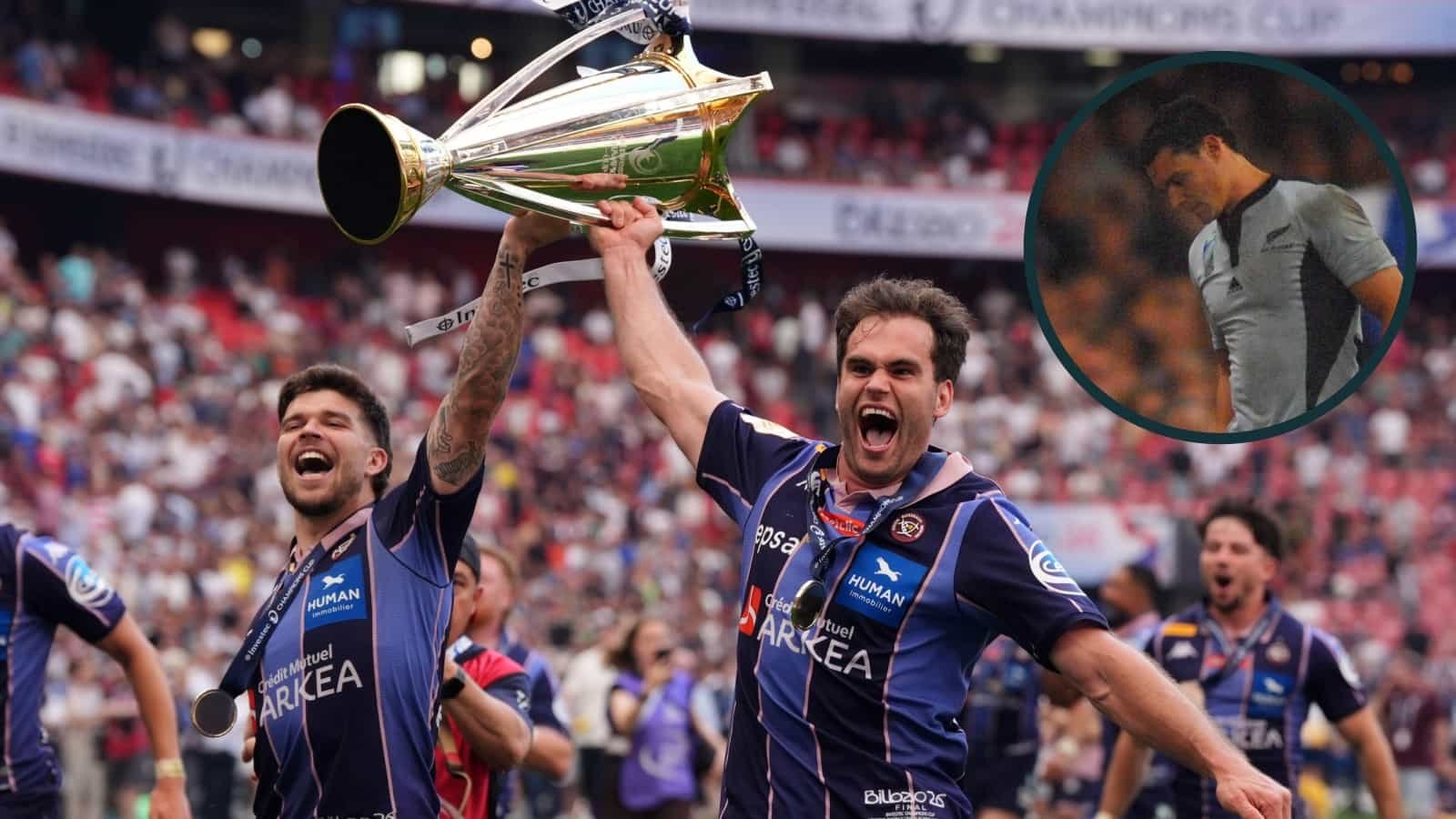

This week we will mostly be concerning ourselves with France’s hegemony in Europe and a couple of takes on it…
Two games of first halves paint a picture
One perhaps slightly tighter than the other at the break, but the weekend’s European Finals were marked by one thing: a clear and obvious winner already by the break.
If Ulster were within a stiff arm’s length of Montpellier at half-time on Friday, by minute 50 they had been unceremoniously handed off. Bordeaux’s 35-7 interval lead over Leinster was even more emphatic. The total of the two matches at the weekend read: French clubs 100-45 Irish provinces; at minute 50 of the two games, it was 75-24. French teams don’t always give it all at all moments in Europe, but it’s difficult to escape the realisation of just how far ahead the French clubs in general are beginning to be. If they want to be, of course.
French teams have won the last six top-tier titles, and four of the last six Challenge Cups too. The league is swinging its financial clout around and is starting to offer the sort of deal that can be an alternative to an international career. The national team continues to deepen its talent pool and although there was no Grand Slam this year, that was more down to an outlier-level of excellence by Scotland than French poorness.
So it was a curious take on it all from Stuart Barnes this week to accuse Fabien Galthie of squandering a golden generation, not least when this particular generation is about as close to that New Zealand class of 2007 in terms of world-class players right across the field as you are likely to get.
The truth is, as always, more layered. Naturally, there is the instant parallel in terms of World Cups, which New Zealand also took their sweet time in eventually winning, golden generation or not. But the All Blacks were undone by an outlier-level performance by France in 2007 as well (and nearly in 2011 for that matter), while it is hardly squandering a generation to lose by a point to the eventual champions, especially when that one point can be traced back to a charged-down conversion; the same way New Zealand’s defeat to France in 2007 was eventually (among other more controversial observations) put down to the team’s failure to consider dropping a goal.
Another argument made is that the French are not exactly drowning in Grand Slams, but neither was England’s golden generation back in 2003; it took them four attempts to finally put that one to bed, sandwiched by two French slams. Even Ireland’s greatest era ever has only managed three in the last 17 years, likewise Wales’ 4 in 18 years. Like a World Cup, it is a devilishly difficult thing to achieve, whatever the talent within your generation.
Victor Matfield’s weighs into Jacques Nienaber ‘talk’ as Springboks legend offers ‘physicality’ theory for Leinster’s defensive struggles
Springboks legend insists Ireland should be ‘worried’ as bold All Blacks claim made about Bordeaux-Begles
The argument that the players are playing better for their clubs than their national team is also flawed, and it’s nothing to do with the foreign player seam running through Top 14 squads either. The simple fact is, clubs are honed in their systems and structures over many weeks, months and years, while international sides are both facing a shortage of time and a higher collective level of opposition. The rugby is different, it is by necessity simpler in structure but there is far less margin for error. The significant part of this Bordeaux team has been together for the best part of four years, meaning it has played and trained for around 150 matches together (squad rotation notwithstanding). The French national team has played around a quarter of that number. Of course, the players are going to look better for their clubs. And Bordeaux are hardly flawless in that period – remember the shellacking inflicted upon them by Toulouse in the Top 14 two years ago?
Galthie’s embarrassment of riches
Mathieu Jalibert wasted for France? Also a simplistic view. Would Jalibert be the same player when served by Antoine Dupont, also clearly the best of his generation at his position until this season? No – this column has already noted in the past that the Toulouse half-backs and Bordeaux half-backs are not interchangeable because each pairing provides the perfect foil for each other. Damian Penaud has barely been missed, while he quietly reinvents himself as a centre for UBB, where he has played several times this season (and many more times in his youth). Given that France’s current starting wingers are 22 and 21 respectively, while Penaud turns 30 in September, that feels like potentially a sensible piece of forward planning and career prolongation.
Galthie currently faces an embarrassment of riches, good coaching headaches in almost every single position. You can call it squandering all you like, but any coach would like to have the choices he has. And French rugby continues to roll on. Most pertinently, the pace and derring-do of Bordeaux’s attack made Leinster’s look horribly stale and outdated. Bath and Northampton might both be able to live with Toulouse and Bordeaux but it’s debatable whether that would stretch to the quarter when the benches were emptied. As Sale discovered earlier this season, anything less than the top tier of players on the pitch is likely to be schooled.
Any hope against these fabulous French? Years ago, when Clermont were the – often almost – darlings of both the Top 14 and Europe and statistical analysis was making its first waves in the game, Saracens noticed that if you could stop Clermont opening up a lead early on, you had a far, far better chance of winning the long game. A few European Cups later the hypothesis had been robustly-tested and proven. Easier said than done, of course, but a similar pattern played out for the French national team this last Six Nations.
Does the same apply to Bordeaux and Toulouse? Difficult to prove so far, but until another team finds either a defence never before seen or captures a similar level of attacking je ne sais quoi a la Scotland, our French friends look certain to rule the European roost for a while yet.
READ MORE: Jordie Barrett’s verdict on Leinster’s Champions Cup defeat: ‘I might have to try to go back’
