

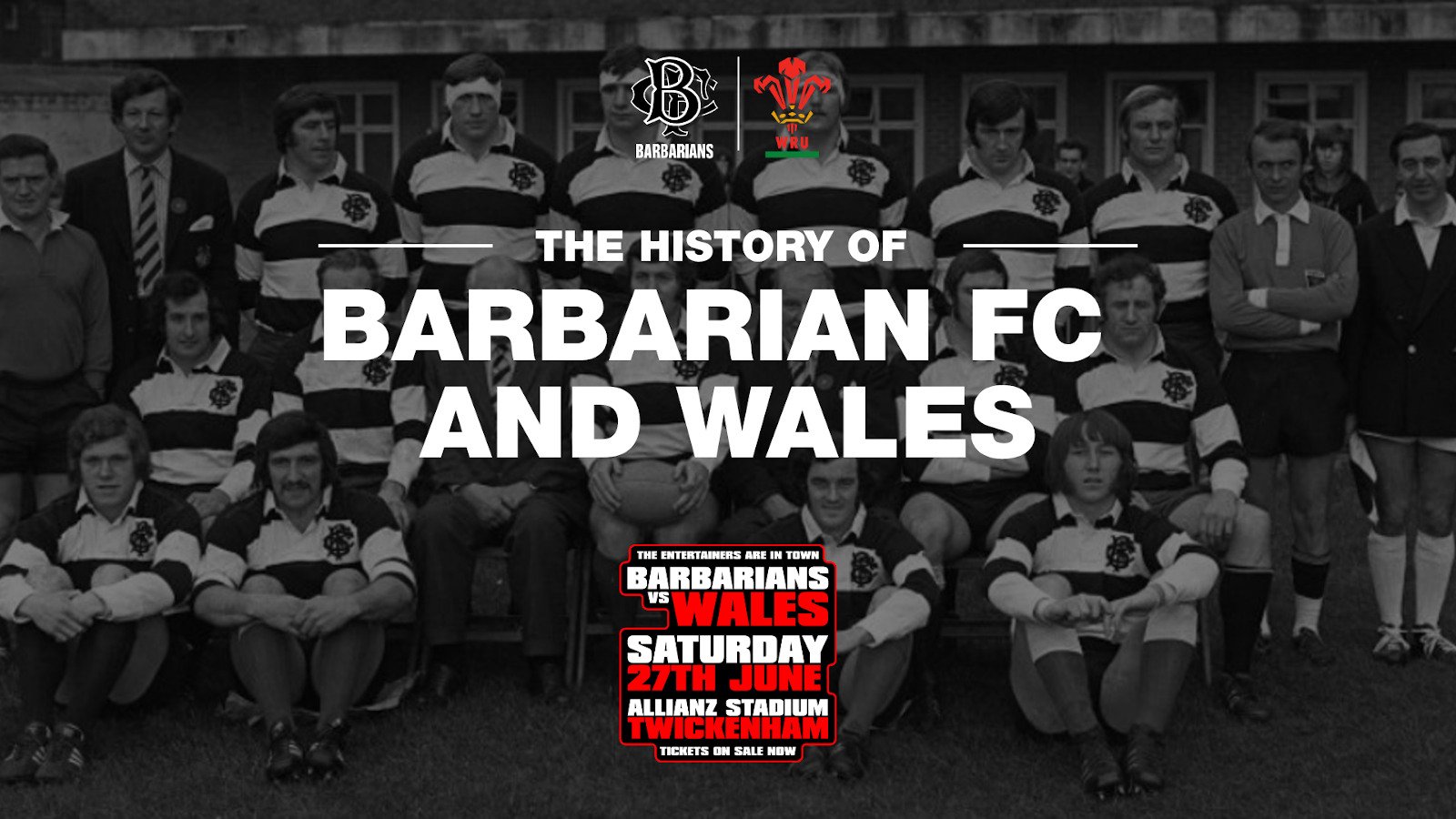

Ahead of the Barbarians v Wales fixture at Allianz Stadium, Twickenham on Saturday, June 27, here’s a deep dive of the history between the two teams.
Born in Bradford, raised in Cardiff
The Barbarians were conceived over oysters in Bradford in April 1889, one of the most preposterously Home Counties things ever to have happened in Yorkshire, when a Blackheath forward named WP “Tottie” Carpmael decided the rugby season was too short and the friendships across club lines too few. The club was formed in 1890, with its first match played on 27 December that year.
Out of that supper came the most romantic idea in the history of rugby union: a club with no ground, no league, no subscription, no home, and a motto written by the future Bishop of Bloemfontein, Walter Carey, that has outlasted every other line ever written about the game. Rugby football is a game for gentlemen in all classes, but for no bad sportsman in any class. The other rule of the club, written nowhere and binding everywhere, is that every player wears the socks of his own home club. Invitation rugby without erasing identity. From the second tour onwards, in March 1891, when Cardiff RFC became the first side ever to beat them, the place those black-and-white hoops have most belonged is Wales.
For 85 years from 1901 to 1986, the Easter Tour was the heart of it. Penarth on Good Friday, Cardiff on Holy Saturday, Swansea on Easter Monday, Newport on the Tuesday. The Esplanade Hotel on the Penarth seafront became the closest thing the club has ever had to a clubhouse, presided over by a Mrs King who, according to one 1920s recollection, did not mind noise, charged practically nothing, and was unperturbed when an Irishman drove cattle through the lobby.
In 1933, England’s Peter Cranmer and Wales’s Wilf Wooller climbed a ladder to a redhead maid’s window at the Esplanade, crashed feet-first through the cucumber frames below when the ladder broke, dusted themselves off, played for the Baa-Baas against Cardiff the following day, and won.
In 1962, R.A.W. Sharp recalled attending Llandaff Cathedral on Easter Sunday between fixtures, where the Bishop devoted his sermon to denouncing sportsmen who played on Good Friday, ending with the words: “Barbarians by name, barbarians by nature!” The Barbarians went to Swansea on the Easter Monday and won. The Cardiff fixture alone produced well over a hundred meetings before professionalism drew the line in 1996. No nation has ever housed the Baa-baas as Wales has.
No rugby culture has ever understood the Barbarians better than Wales, because Welsh rugby already believed the same things. That the game should be played ambitiously. That backs existed to attack, not to organise territory. That the crowd deserved imagination as repayment for the admission price. The Baa-baas were never treated as exhibition novelty in Wales. They were treated as rugby properly played. Cardiff Arms Park was, in every way that matters, the spiritual headquarters of Baa-baas rugby for the whole of the 20th century.
The big-match tradition
The Baa-baas’ first ever international fixture was played in Wales. In January 1948, the four home unions helped the Australian touring side with their onward journey home, and Cardiff Arms Park hosted a thank-you match between the Wallabies and the Baa-baas to mark it. The Barbarians won 9-6. The fixture established a tradition that became known as the fifth Test: tour-ending matches against the great Southern Hemisphere sides on British soil, with the Baa-baas as honorary hosts. The All Blacks have visited the Baa-baas more than a dozen times, the Wallabies almost as many, the Springboks on many major tours. No invitation in the game has ever carried more weight.
The most famous of those matches was played at the National Stadium on 27 January 1973. New Zealand had toured undefeated in Tests. The Baa-baas, packed with the British and Irish Lions players who had beaten the All Blacks in New Zealand two years earlier, won 23-11. Inside the opening two minutes, Phil Bennett counter-attacked from inside his own 22 with three sidesteps, the ball moved through six pairs of hands, and finished with Gareth Edwards diving over in the left corner. That is widely held to be the greatest try ever scored.
Felipe Contepomi determined to write ‘another story’ in Barbarians history against Springboks and reveals what it means to coach against Rassie Erasmus
The try’s soundtrack was almost as accidental as the try itself. Bill McLaren was due to commentate, fell ill the day before, and Cliff Morgan was called in late. Morgan, less than a year on from a stroke that had taken months of speech therapy to overcome, found the words that became inseparable from the moment. The greatest Barbarians try was made in Wales and given its voice by a Welshman who had spent the previous year learning to speak again.
The other tour-ending fixtures have produced their own legends, from the famous 1994 win over the Springboks to dozens of memorable contests across every era. The Baa-baas have made a habit of producing the kind of rugby everyone else thinks the era has lost.
The Welsh in Black and White
Every great Welsh generation has worn the hoops. From the 1950s and 60s, the magic of Jack Matthews, Bleddyn Williams and Morgan, the genius of Onllwyn Brace and Dewi Bebb. From the 70s golden era alone came Edwards, Barry John, Bennett, Gerald Davies, JPR Williams, JJ Williams, John Dawes, Mervyn Davies, Graham Price, Derek Quinnell and John Bevan. Through the 80s and 90s, Bob Norster, Robert Jones, Jonathan “Jiffy” Davies, Terry Holmes, Eddie Butler, Scott Gibbs, Ieuan Evans, Neil Jenkins, Rob Howley and Scott Quinnell. Into the modern era, Michael Owen, Dwayne Peel, Gareth Thomas, Shane Williams, James Hook, Adam Jones, Jamie Roberts, Leigh Halfpenny, Alun Wyn Jones, Martyn Williams, Richard Hibbard, Justin Tipuric, Alex Cuthbert and Ken Owens. And most recently, Rhys Webb, Aaron Wainwright, Gareth Anscombe and Jim Botham, the Cardiff flanker with a Welsh mother and grandson of Ian Botham. Welsh players have captained the club, won the great tour-ending fixtures in the hoops, and given the Baa-baas as much of their soul as any nation has. The black-and-white tie is awarded for life. There is no club in the game whose alumni list reads more like a roll-call of Welsh greatness.
Wales v Baa-baas: Festival rugby
The senior fixture between Wales and the Baa-baas has been festival rugby from the moment it returned in the modern era. The 1990 centenary of the Welsh Rugby Union saw Wales award caps as a mark of respect, and the visitors fielded a side worthy of them: David Campese, Jean-Baptiste Lafond, Denis Charvet, Jeremy Guscott, Joe Stanley, Stuart Barnes and Nick Farr-Jones in a backline, Mike Teague and Eric Rush in a back-row of frightening pace. The Baa-Baas won 31-24 in front of a packed Arms Park.
Barbarians v Wales: Everything you need to know about tickets for Allianz Stadium double header
The new century opened with four consecutive May fixtures, three at the Millennium Stadium and a fourth at Ashton Gate, in which the Baa-baas brought the most decorated names in the global game to Wales. The 2001, 2002 and 2003 matches alone produced more than 220 points, played in the spirit of the founding motto in front of big Millennium Stadium crowds who knew exactly what they were watching. In 2011 and 2012 Wales awarded caps for the fixture once more, with the Baa-baas taking the first 31-28 in a Rugby World Cup warm-up and Wales winning the rematch 30-21 under Sam Warburton’s captaincy.
On 30 November 2019, Warren Gatland walked back into the Principality Stadium for the first time since stepping down as Wales coach after 12 years of Grand Slams, a World Cup semi-final and the world number-one ranking. He brought a Baa-baas side that scored four tries in the second half. The pre-match ovation went on long enough to make grown coaches blink, and the day ended 43-33 to Wales in a six-tries-to-four shootout that felt like a party.
On 4 November 2023, Alun Wyn Jones played his final match at the Principality in Baa-baas hoops, scored a try, won Player of the Match, and embraced Halfpenny as the full-back too came off for the last time in a Welsh shirt. Hooper and Tipuric started together in the same back-row. 11 tries between them, 49-26 to Wales, and one of the great farewell occasions in Welsh rugby memory.
27 June 2026: The day at Allianz
On 27 June 2026, Wales and the Baa-baas meet at the Allianz Stadium in Twickenham, one of the great rugby stages in the Northern Hemisphere, in a fixture coached on the Baa-baas side by a triumvirate of world-class names. Scott Robertson, the former All Blacks head coach, won seven consecutive Super Rugby titles with the Crusaders between 2017 and 2023 before taking the New Zealand job after the World Cup. Robbie Deans, between Wallabies, Crusaders and Saitama Wild Knights posts, has won more major trophies than any coach of his generation; his Crusaders run between 2000 and 2008 remains the gold standard for sustained excellence in the professional era. Patrice Collazo is one of France’s most respected operators, with a coaching CV that takes in La Rochelle, Toulon and Stade Français at the top of the Top 14 and currently head coach of Racing 92. A coaching ticket of that calibre tells you exactly what the Baa-baas think of this fixture.
Want more from Planet Rugby? Add us as a preferred source on Google to your favourites list for world-class coverage you can trust.
It is also a double-header. The men’s match is paired with Barbarians Women in the same showcase event, the latest landmark afternoon for a Barbarians Women side whose recent run of high-profile fixtures has been one of the success stories of the modern game. The women are coached by Susie Appleby, head coach of Exeter Chiefs Women, and Sarah Hunter, England’s most-capped player of all time and one of the great back-row forwards of the modern era. World champion and Olympic Gold Medallist Ruby Tui was announced last week as the first player selected for the Barbarian F.C. Women’s squad to take on Wales next month. And on the form of recent Baa-baas Women squads, the other names will be worth waiting for.
What 27 June offers is exactly what the Baa-baas have always offered Wales: the most decorated touring side the modern game can assemble, in the hoops of the most romantic idea in rugby, playing against the country that gave the club its second home. The blue colours of Oxford and Cambridge Barbarian tie has been awarded to more than 2,800 players since 1890. On 27 June, a further 23 may join that number, if they have not represented the club previously. A summer Saturday at Allianz, a packed Welsh contingent, two coaching tickets between the squads that read like a global all-star line-up, and 135 years of one of the game’s oldest and most romantic rivalries on the programme. There are few better days in rugby than a Baa-Baas Saturday. This one will be the biggest of them all.
Secure your match tickets from £20* Adults & £10* (U16) for Barbarians v Wales double-header at Allianz Stadium on 27 June. Click here!
(*booking fees apply)
READ MORE: Robbie Deans lands new role ahead of Harlequins post as Scott Robertson link-up confirmed

1 Comment
Pingback: The history of matches between the two sides – Sports News UK