

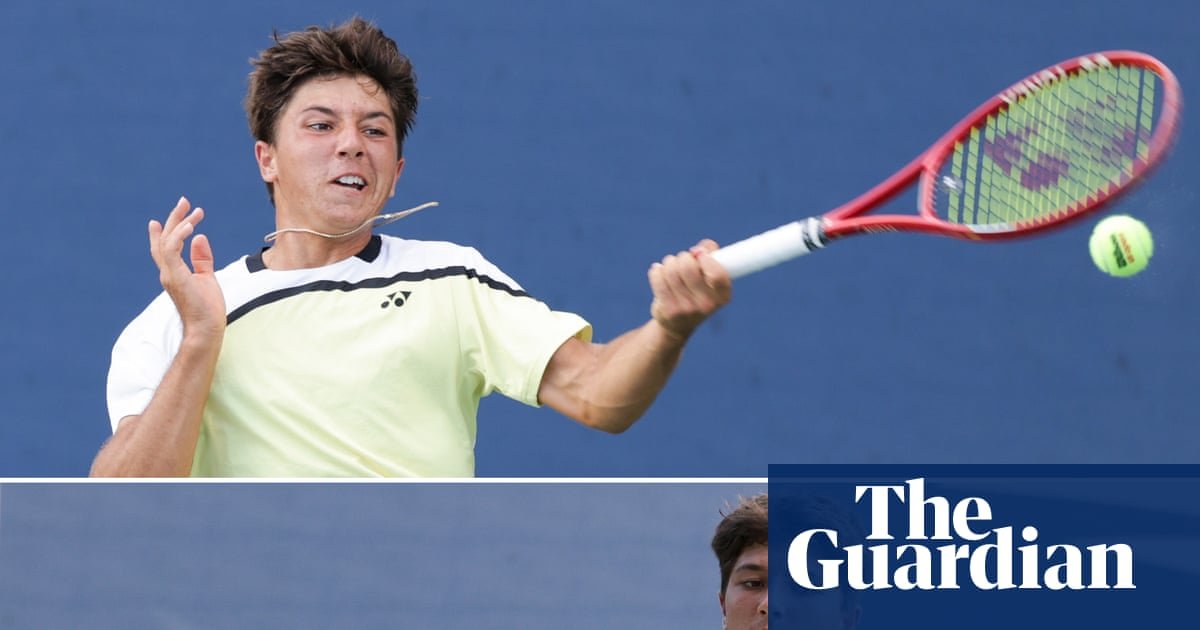
Teo Davidov always has the upper hands. An amiable junior prodigy from Denver, the 16-year-old was the oddest sight at this year’s US Open, the only player in the tournament – man, woman or junior – who hits only forehands. To be clear: it’s not that he doesn’t have a backhand or can’t hit a backhand. He’s ambidextrous and so he doesn’t bother with them.
It’s nothing personal. “To be honest, I like the traditional backhand-forehand,” he says. “I like the classiness of it. I like hitting backhands myself just to play around, just for fun.” He hits those from both wings, too.
Davidov has been a giddy curiosity for hardcore tennis fans for the past five years, with rubberneckers gaping at clips from his matches and training sessions that seem at a glance like AI. A four-year-old video of him flummoxing Carlos Alcaraz’s younger brother makes for especially tasty viewing. “I don’t really look at the comments or things like that,” Davidoff says. “But I’ve heard most people online just always have something they think might not work.”
Davidov’s internet clips don’t do him justice, though. You have to see him in person, especially now that he’s a 5ft 7in teenager. His second-round doubles match on Wednesday evening had hordes of wine and Honey Deuce-sipping casuals drifting over to Court 6 at sunset for a closer look – and whipping out their phones from the first warm-up ball. It really was the damnedest thing watching him alternate hitting groundstrokes with his right and left hand, lobs and volleys too.
But witnessing the kid serve was the trippiest experience by far, like watching AI in the wild. It’s always advantage Davidov. It doesn’t matter which side of the baseline he sets up on – if you’re returning, you’d better mind your backhand. “Obviously it depends on who I’m playing, but the general foundation is right hand on the deuce side and left hand on the ad,” he says. “I’ve been mixing it up a lot more, different spins, different looks, just making it as hard as possible.”
It all seems like parlor tricks, the sort of thing that could hinder him and his partner, fellow American Tyler Lee, as much as their opponents, Brazil’s Guto Miguel and Slovenian Ziga Sesko – the world’s No 1 and No 4 juniors in singles and the top-seeded boys’ doubles team in New York. But when it came to dictating pace, chasing down line drives or the rapid-fire exchanges at net, Davidov never fumbled his racquet.
There were times during his rallies when it was debatable whether a backhand would be easier for him to load or if switching forehand sides mid-rally took some of the edge off when he clearly just wanted to grip and rip. But the double-wing thing is ingrained for Davidov. “I’d say before the main speculation that people had with it, they’d say, I don’t have time to switch hands,” he says. “But I think now as time went on, they kind of see that it’s not a problem. It almost never happens where I’m late for a ball because something goes wrong with the switching.”
On Wednesday, it was a matter of running into a much stronger opponent. Davidov and Lee – wildcard entrants into this draw – had their moments, dazzling the crowd with a handful of pell-mell exchanges, but they were ultimately overwhelmed by Sesko’s punishing groundstrokes and Miguel’s feline reflexes. Sesko, the reigning Australian Open singles and Wimbledon doubles champion, is seriously impressive; Miguel, already a Futures-level title winner, has a real shot at the US Open boys’ singles crown.
For a few early points, Davidov’s unique style appeared to jar them. Occasionally, he can catch players who haven’t faced him before by surprise, “but most of the Americans know me,” he says. Eventually, though, Sesko and Miguel settled into a rhythm and served the Americans a 6-2, 6-2 loss that, while more competitive than the scoreline suggests, spanned 42 minutes nonetheless. “I felt like we were close,” Davidov says. “We just had some loose points, we got broken. I missed a few volleys. But overall it was really fun and really cool to hear the crowd roar after crazy points.”
For Davidov, this trip was about building match experience on the big stage, about properly field-testing his double-wing style. “I’d say the first two days and when I lost my singles, it was so hectic,” he says of his time in New York. “Everything felt like it was going wrong. But I’d say now, especially the last two, three days have been super enjoyable and I’ve gotten used to the courts, which are really fast compared to the ones I play on at home.”
Davidov hasn’t played a ton of juniors events but turned heads in spite of that, last year becoming the first player born in 2010 to pass the qualifying round of a professional M15-level ITF event; that achievement came after he captured the boys doubles title at the prestigious Les Petits As tournament in France. Earlier this year, Davidov reached the semi-finals of an M15 event in Naples to earn his first career ATP points. “To have a guy who can effectively serve left-handed and right-handed at the same level, that is potentially game-changing,” Andy Roddick said on a recent episode of his podcast. “The serving aspect is what really interests me. It’s like having a baseball pitcher who can throw equally well from both sides.” Karue Sell, a professional once ranked as high as No 258 in the world, wondered if he wasn’t looking at the future of tennis after playing Davidov in March.
Really, ever since he began swinging at a suspended ball at age two, Davidov – a Bulgaria native who immigrated to the US young – has been something of an athletic experiment presided over and fiercely protected by his father Kalin and mother Elena – both of whom have backgrounds in sports and holistic medicine. Kalin, a devotee of philosophy and Chinese medicine, devised Teo’s playing style with the goal of creating an athlete who was at one with himself.
“When Teo was about to turn eight years old, I decided he’s going to start playing left-handed, to affect his right hemisphere of the brain,” Kalin told the Guardian in 2021, when his son was 10. “He’s way too extroverted, too fiery, a little too imbalanced, so I just wanted to affect the right hemisphere of his brain, using the left part of his body.”
Many will wince at the routine he was put through while still a child: 30 to 40 hours of training a week, on and off the court – some of it as specialized as exercises focused on breathing through one nostril at a time. These days, Teo says he has added more cardio and weight training to build stamina and fill out a frame that remains a touch on the small side. “Before I was just a little kid, and everyone was twice the size of me and way stronger than me,” he says. “But now I’m kind of growing into my body a bit more.”
Ambidextrous players are the rarest sight in tennis. American Luke Jensen was the last to make a major impression, winning the 1993 French Open doubles title with his younger brother Murphy while ripping 130 mph serves from both wings. And Russia’s Evgenia Kulikovskaya was ranked in the top 100 in the early 2000s while playing tennis with two forehands. The Davidov experiment – he is not naturally ambidextrous – appears to be built on Toni Nadal’s gambit to convert his nephew Rafael from a righty to a leftie, and we all saw how that turned out.
Still, when it comes to the tactical blueprint for Davidov’s game, well, who could serve as a model for a player who is sui generis? “The idea was for the leftie forehand to be more like Rafa and righty to be more like Fed,” Davidov says. “It’s still a work in progress. I don’t know if we’re going to get there someday, but that’s the hope.”
But before you take Davidov for some kind of tennis lab rat, know that his parents have gone to pains to make their boy as well-rounded as those court legends, too. Besides skiing and hiking, Davidov enjoys basketball, American football and soccer. Golf’s the only sport he picked up with two hands. “I used to play left-handed, but I actually switched recently and started playing righty. On the range, it’s definitely going farther.”
After the Open, Davidov said he plans to play a 300-level juniors tournament in Texas before considering a few pro events. As for what lies beyond, he’s still undecided about whether he wants to follow his doubles partner Lee, who’s bound for Duke, and play on a university team (“College [tennis] has gotten so much better lately,” Davidov says) or skip it altogether and turn pro.
Wherever he goes, he’ll remain one to watch – especially if he winds up adding a backhand just to press home his advantage. “We were actually thinking about it, to have even more variety, playing like one point lefty,” he says. “But I think we’re kind of stuck to the two forehands. But we’ll see.”
