

Continuing to write about Arsenal while the World Cup is reaching its knockout stages feels a bit like watching Sky Sports News (for those unfamiliar, Sky do not have the rights to any international tournaments in the UK) while there is a big game on terrestrial TV. But if you are here, it is because Arsenal is still circling around your frontal lobe. Here are three thoughts that are preoccupying me ahead of next season.
How do Arsenal score more goals?

Arsenal scored 71 goals last season, six fewer than second placed Manchester City. That is the lowest for a Premier League champion since Leicester City’s 69 in 2015-16. It’s the fourth lowest for a Premier League champion since the division was revised down to 20 teams in the 1995-96 season.
While not unprecedented (Arsenal’s 1997-98 title winning team scored 68 league goals) it is atypical. Last season only represented an improvement of two goals compared to the 2024-25 season when Arsenal’s overall firepower was reduced by injuries. It was reduced by injuries last season too but the squad depth was, in theory, far better equipped to deal with it in 2025-26.
The Gunners conceded 27 goals last season compared to 34 in 2024-25, it was the defensive side that improved most notably. I won’t insult your intelligence by explaining why scoring more goals without sacrificing too much defensive stability would be a good idea but how it can be achieved is a different question. Ideally it would be achieved via the transfer market.
Unfortunately, the transfer market has been pretty dry in terms of ceiling raising attacking talent for a while now. Arsenal added Ebere Eze, Noni Madueke and Viktor Gyokeres last summer. In the absence of a clear and obvious gunslinger, Arsenal added a few more stones for their slingshot and took an aggregate approach to consolidating their attack.
That was a good choice in the context of last summer but it isn’t an approach you can repeat. It feels like Arsenal are still looking for that goldilocks attacker but needing that player and that player being available at an affordable price are poles that do not always attract. So how else can it be achieved if a unicorn doesn’t fall out of the sky?
Can Arsenal alter their style of play? Perhaps, but Arsenal already essentially camp their entire team on the edge of the opposition box. David Raya is often positioned so far forwards out of possession that he looks like a midfielder. Maybe Arsenal could start to play riskier passes but they would probably have to adjust their aggressive positioning to make the balance pay off.
Sometimes the quest for addition leads to subtraction. I honestly think the likeliest way for Arsenal’s attack to improve is for Bukayo Saka, Kai Havertz and Martin Odegaard to be healthier than they have been for the last two seasons. In 2023-24, Arsenal played in largely the same style that they do now. The aforementioned players were healthier and Arsenal scored 91 Premier League goals. It’s a good job then that those players are having a nice, restful summer. Oh, wait a minute…
How much physical damage will there be from last season and the World Cup?

That brings me neatly onto question two. There was no major international tournament last summer which meant Arsenal could get their transfer business done early. It also meant the team was fitter and fresher coming into the season and, hey presto! They won the title. In the summer of 2023, there was no major international tournament and Arsenal reached 89 points and scored 91 league goals.
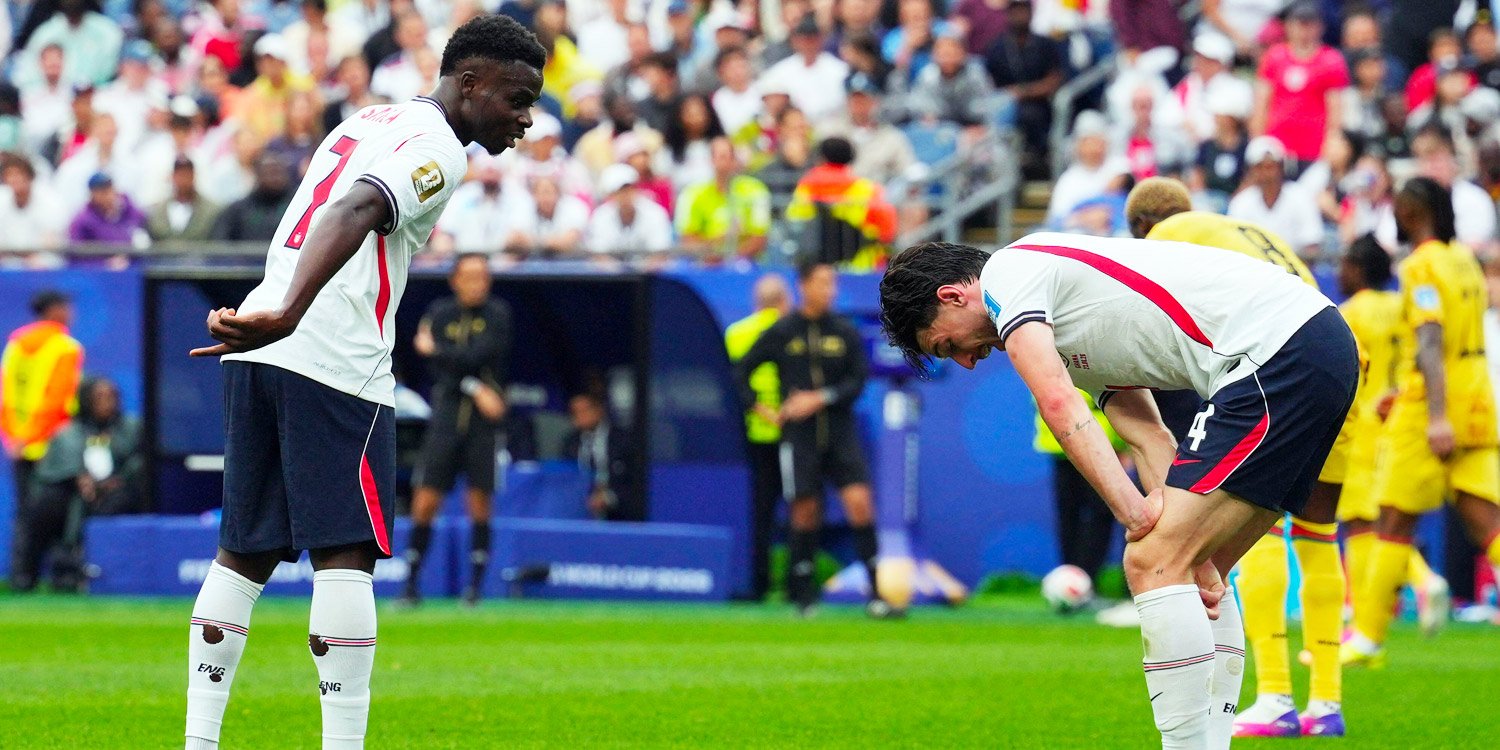
In the summer of 2024, there was a European Championship and a Copa America and Gabriel, Kai Havertz, Bukayo Saka, Gabriel Martinelli and Kieran Tierney all suffered significant injuries (so too did Martin Odegaard, though he didn’t play at the Euros). At time of writing, Thomas Tuchel still doesn’t feel comfortable enough to start Bukayo Saka in World Cup knockout games due to an achilles issue and Declan Rice is finishing games with enough ice on his hamstring to make a polar bear feel at home.
Martin Odegaard endured another stop start season with injury and his Norway side are still occupied in North America. William Saliba was spared France’s final group game due to an ongoing back complaint. I think we all knew that a few Arsenal players pushed themselves to the physical limit last season in an attempt to win the Premier League and Champions League.
Many of those players are now pushing their bodies in pursuit of international football’s greatest prize. The question is what toll that takes on Arsenal next season. Another season of the best attackers and creators becoming accustomed to the rehab facilities will almost certainly mean that significantly raising the goal total will be unlikely. In that event, how sustainable would it be to try to push the boulder up the hill with another endless series of tight games in 2026-27?
Do Arsenal play with greater freedom now they have won the league?

There are significant intangibles to consider ahead of next season too. I think Arsenal sacrificed some league points last season due to anxiety. I can’t prove that assertion, obviously. But when I think of the home defeat to Bournemouth, the late collapse at Wolves and the January defeat at home to Manchester United, I think nerves and tension were sizeable factors in dropped points.
Theoretically, having now won the league title, a lot of that anxiety ought to reduce- or at least the players should be able to harness it more effectively. However, you could flip the question a little and ask whether the hunger of the players may well suffer having now scaled the mountain. It is a phenomenon across most sports that dynasty teams and athletes find defending a title just as difficult as winning the first one, but for very different reasons. Arsenal have not defended a league title for 91 years.
Last season, Arsenal gritted out a lot of victories and some of that due to injuries to their best attackers. Does that superhuman desire to defend a one goal lead dip a little, even subconsciously? Does the fatigue of the World Cup set in and impact the ability for players to play at their limits for extended periods?
In my heart of hearts, I feel like the way that Arsenal won the league last season is not sustainable year on year. The attacking output has to increase just to relieve the pressure valve. A higher number of games that are comfortable in the closing stages is a must, especially if Arsenal want to conquer Europe as well as England.
I feel a little like Arsenal were an elastic band pulled to its extremes for long periods last season. They were far more durable than their competition and deserved title winners. But I don’t think it requires a large leap of imagination to envisage that band wearing thin. All three of my questions bleed into one another somewhat, Arsenal have to find a way to score more goals next season. If they do, I think there is a very good opportunity to win plenty of silverware in the next two to three seasons.
