

Ole Miss football enjoyed strong quarterback play in the 2000s with Super Bowl MVP Eli Manning and Jevan Snead, but in an era defined by bigger personnel and traditional drop-back passing, the Rebels struggled to find consistent production under center from year to year.
In the early 2010s, Ole Miss football wasn’t just stuck at the bottom of the SEC, but it was also buried in the cellar of all of Division I. That changed when Hugh Freeze arrived in Oxford, unleashing a high-tempo offense built to isolate big, physical receivers in one-on-one matchups.
He also landed a transfer quarterback from East Mississippi Community College, and the rest was history. The high-risk, high-reward gunslinger finally gave Ole Miss a signal-caller who understood an offense built on temp, spacing and making plays off-platform.
Freeze Era Quarterbacks

Arriving after Ole Miss wrapped up a 2011 season that included a winless run in conference play, Wallace brought a competitive edge that sparked an exciting rebuild in 2012.
He capped the rebuild with a New Year’s Six bowl berth and led Ole Miss to its first win over the Alabama Crimson Tide since 2003. And while Wallace struggled with turnovers at times, he showed that there was a blueprint to winning at Ole Miss.
Freeze again turned to the community college ranks to find his next quarterback for the up-tempo offense, landing Chad Kelly to lead the Rebels. Kelly built on the foundation Wallace laid, throwing for 4,042 yards and 31 touchdowns in 2015, then capped the season with a win over Oklahoma State in the 2016 Sugar Bowl.
The program had finally found a recipe for success: experienced transfer quarterbacks athletic enough to improvise in an off-rhythm, tempo-driven offense.
Unfortunately for Ole Miss, the program soon found itself in the crosshairs of an NCAA investigation and was hit with a two-year bowl ban in 2017 and 2018. The resulting restrictions felt like a hard reset for the Rebels, who managed to only keep their heads above water at the height of the sanctions.
Quarterback play grew more inconsistent; while Jordan Ta’amu and John Rhys Plumlee still operated in an up-tempo system that could move the ball in spurts, NCAA sanctions had gutted the roster around them, and the Rebels struggled to recapture the Freeze-era success they’d enjoyed just a few years earlier.
The Modern QB Model

When Lane Kiffin arrived in December 2019, one reason he took the job was the offense talent already on the depth chart, which convinced him Ole Miss was built to compete quickly. He wasn’t wrong, as Ole Miss had Matt Corral.
The strong-armed, quick-footed and ultra-competitive quarterback transformed Ole Miss almost immediately. After a 4-8 finish in 2019 left the program stuck in neutral, Corral helped turn the Rebels into one of the SEC’s most exciting offenses, leading them to a 10-2 record and a return to the Sugar Bowl stage in the 2021 season.
Kiffin and the Rebels again turned to the transfer portal and struck gold with Jaxson Dart, who became the winningest quarterback in school history with a school record 29 victories as a starter. Dart also guided Ole Miss to its first New Year’s Six bowl win since the 2016 Sugar Bowl, leading the Rebels past Penn State in the 2023 Peach Bowl.
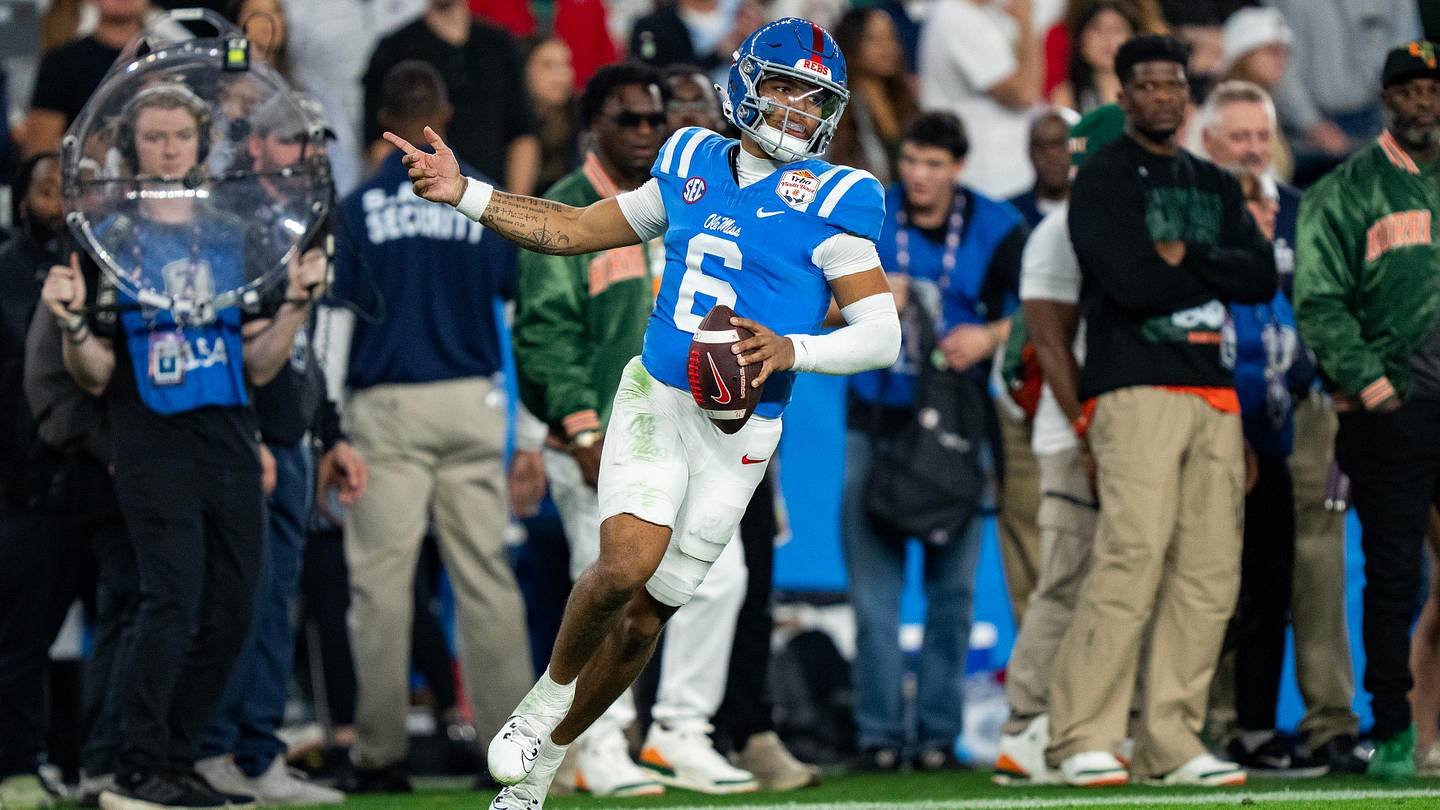
Now, Trinidad Chambliss has taken Ole Miss to new heights with a berth in the College Football Playoff. The evolution of the modern college offense, paired with the rise of the transfer portal, has completely raised the ceiling for the Rebels.
The portal has given Ole Miss the ability to target proven talent that fits its system, and the program has maximized that advantage.
Bo Wallace marked the beginning of Ole Miss’s shift toward speed and tempo.
Today, the program has built on that foundation with intentional roster construction designed to support its up-tempo offense.
By modernizing its approach to the quarterback position, Ole Miss has climbed into the upper tier of the SEC.
Sign up to our free newsletter and follow us on Facebook and X for the latest news.
 Add us as a preferred source on Google
1 Comment
Pingback: The Quarterback Blueprint That Changed Ole Miss Football Forever – Sports News UK