

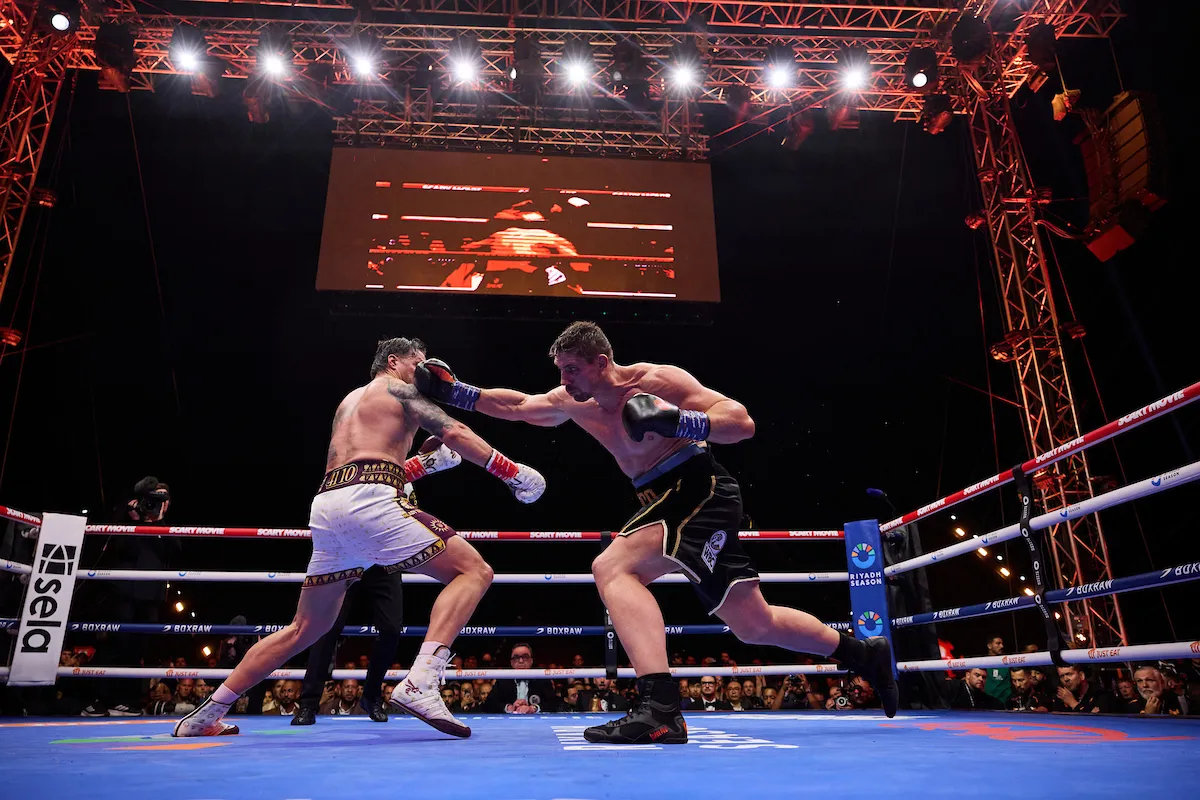
![Rico Verhoeven [right] clouts Oleksandr Usyk in Egypt on May 23, 2026 | Source: Mark Robinson/Matchroom Boxing](https://photo.boxingscene.com/uploads/Oleksandr-Usyk-Rico-Verhoeven-20.webp "Rico Verhoeven [right] clouts Oleksandr Usyk in Egypt on May 23, 2026 | Source: Mark Robinson/Matchroom Boxing")
On Saturday night I watched the best heavyweight boxer on the planet lose rounds, plenty of them, in a fight with a 37-year-old kickboxer and wondered which came first: his shock or mine.
Mine came early, triggered when seeing the second of two right hands Rico Verhoeven landed in round one slam into Oleksandr Usyk’s gut. That was the moment I started to shift uncomfortably in my seat and discovered my eyebrows were a few centimetres higher than usual. That was the moment I first muttered it: “What the f–”
Still, any concern for Usyk was assuaged somewhat by the fact that Usyk himself didn’t appear all that concerned to have lost the opening round. I understood then, when noticing this, that Usyk was nowhere near as shocked as me. Perhaps he knew something we observers did not, I thought. Perhaps, to him, it was all a game. A bit of fun.
Then came the next round and the one after that and still we waited for Usyk to wake up, dominate, do what he was supposed to do. If at all shocked by Verhoeven, Usyk did well to disguise it, so much so that the fight had now entered the realm of the surreal, with each of us questioning what it was we were even watching.
It had, of course, always been that way, Usyk-Verhoeven. From its very inception, in fact, the idea of Usyk, the world heavyweight boxing champion, sharing a ring with Verhoeven, a former world heavyweight kickboxing champion, seemed bonkers at best, and dangerous at worst. Stick it in Giza, Egypt, in front of the pyramids, and the sense of the absurd was only reinforced, making the match less an actual fight than a financier’s wet dream.
Even beforehand, during the excruciatingly long wait for the inevitable, we watched as a squad of pundits – too many, in truth – stood around and explored every conceivable variation of the same question: “Yeah, but does Verhoeven have a chance?” In the meantime, with our patience exhausted, we each asked ourselves: “What are we doing here exactly?”
By the time the fighters walked to the ring – at around 1am local time – all we had was that pervasive element of mystery to keep us awake. Anthems were next, about half a dozen of them, and the tired faces at ringside adequately enhanced the feeling of the uncanny. Jason Statham, the fight’s unofficial matchmaker, was there admiring his work in row A. So too was Steven Bartlett, that podcast bloke you see all over social media but still don’t know what he does besides lose the plot whenever he drinks a glass of red wine. Seeing him in Giza, I hoped for Bartlett’s sake that he had cut loose a little while waiting for the fight to begin. It seemed, at that stage, the most logical way of coming to terms with and making sense of it.
Because if Usyk-Verhoeven started off weird, it only became weirder once it got going. The action got weirder, the commentary got weirder, and the unofficial scorecards got weirder, leaving most of us bemused, incapable of describing the scene we were watching unfold. What was once meant to be an embarrassingly easy exhibition of sorts for Usyk had now, on account of Verhoeven’s size and courage, become one of Usyk’s toughest fights and nobody, in the ring or outside it, knew quite how to process this jarring turn of events.
Taking notes for a post-fight report, I mostly just sat in stunned silence, reminded once again of how little I really know when it comes to the act of two people trading punches in a ring. It was, I’ll admit, a rather humbling experience, to be so wrong. It was a welcome one, too, if only because the thrill of not knowing is, as far as I’m concerned, considerably more exciting than being proved correct. Here, in this instance, the whiplash of seeing Verhoeven be everything we didn’t expect him to be and see the fight warp accordingly had an invigorating effect on the observer. Maybe it’s just me, but sometimes it’s nice, liberating almost, to realise the extent of your ignorance.
As for Usyk, the one in control (or not), he must have looked at Verhoeven attempting to box that night and thought, “What is this shit?” It wasn’t boxing, we knew that, yet that’s not to say it wasn’t effective – because it was, clearly. In fact, for all his lack of boxing pedigree and technique, Verhoeven was doing to Usyk what Usyk was, for large parts of the fight, unable to do to him. He was landing scoring blows. He was winning rounds. He was winning hearts.
For someone like Usyk, this realisation would have been anything but invigorating. Like us, he would have now had reason to question everything he thought he knew – about boxing, about himself, about crossover fights. Thanks to a kickboxer, this had now become a fight different from all the others, and though Usyk would have known that going in, now he had proof of it. Now it felt different. The punches, the pressure, the panic. All of it.
This, whatever it was, was not the kind of boxing Oleksandr Usyk had learned and in time perfected. No, this was something unique, something alien. However long it took him to grasp that, by the time he did it was almost too late. He was being stalked, hit, at times bullied. Come round 11 he was in danger of suffering a humiliating upset loss, with the salt in the wound the fact that many were celebrating Verhoeven’s new way of doing something Usyk, 39, had for three decades tried to master.
Being the same age as Usyk, I wondered around the eighth if that had anything to do with it – the struggle, the humiliation. Some reckoned it did, but what do they know? Indeed, what do any of us know?
Unable to relate to Usyk’s mindset during the fight, I thought instead about how it feels to discover there are new methods of doing something you have spent most of your life trying to do a certain way; the supposedly good way, the right way, the hard way. I focused, in particular, on how reporting on boxing, or anything, is nowadays less about craft, insight and integrity and more about making noise and, alas, quantity over quality. These days, if the goal is attention, the consensus best and quickest way to achieve it is to post an unsolicited, unwanted opinion on social media, or switch on your webcam and spew empty words into the abyss. Meanwhile, the few rebels who persevere with words on a page now have the luxury of using programmes such as ChatGPT to conceal their lack of creativity, work ethic, and intelligence. Many of them do, too. You can easily smell it.
“What is this shit?” I often think when reading this stuff, though that doesn’t mean it isn’t being consumed; that doesn’t mean they aren’t winning rounds, or even the fight. In fact, to properly write about boxing in 2026 feels not unlike designing telescopes for the blind. It is not only a thankless task, but it is, perhaps, now a pointless one, given both the habits of the audience and the fast-food alternatives.
Can you ever really fight it? That is the question. It is a question I have asked myself with increasing regularity, soothed only by the reassurance of serious journalists, and it was a question Oleksandr Usyk may have pondered once Rico Verhoeven began breaking the rules to break new ground in Giza.
At one point, such is its pervasiveness, I even started to imagine that Saturday’s fight had somehow been the work of Artificial Intelligence. Sounds crazy, I know, but I had previously stumbled upon clips of fights between Eddie Hearn and Dana White and therefore it wasn’t beyond the realm of possibility that this, Usyk vs. Verhoeven, was an extension of that sad, depressing trend.
But we know, of course, that it wasn’t AI. It was real. It was really happening, it was really shocking, and for 10 rounds there was really nothing anyone, not even Usyk, could do about it. Verhoeven, the heroic interloper, was simply that bold, that strong, that relentless. Whether winning the fight or not, he had upset the status quo and become the very embodiment of boxing’s WTF era; a time when anything goes and is possible; a time when lawlessness governs and rules exist only to be broken.
“Expect the unexpected,” they now tell you when selling you things that shouldn’t be sold. Also: if it generates clicks or cash, remember that it makes sense; if it doesn’t, it doesn’t. Forget, too, your claims of declining standards and the death of discernment. Speak instead of inclusivity and how wonderful it is that anyone, irrespective of their qualifications or suitability, can now have a go, dare to be great.
In that respect Rico Verhoeven was both an inspiration and a warning on Saturday night. On the one hand, he will have convinced many that finding success in any pursuit lies in one’s ability to break the established rules and do something unexpected and different. Yet, on the other, it could be argued that Verhoeven’s success against Usyk – both in landing the fight, then nearly winning it – is, for the purist, as much a cautionary tale as a cause for celebration. After all, the Dutchman’s success versus Usyk suggests that no matter how hard you work on your craft, or how good you become, there is always someone capable of showing you an alternative way of doing it, even if for decades you considered there to be only one.
In the end, as often fights are, Verhoeven’s stirring performance against Usyk in Egypt was something of a life lesson. If it shocked you, it is perhaps because until now you had, like the heavyweight champion of the world, only feared it. Now you felt it.
