

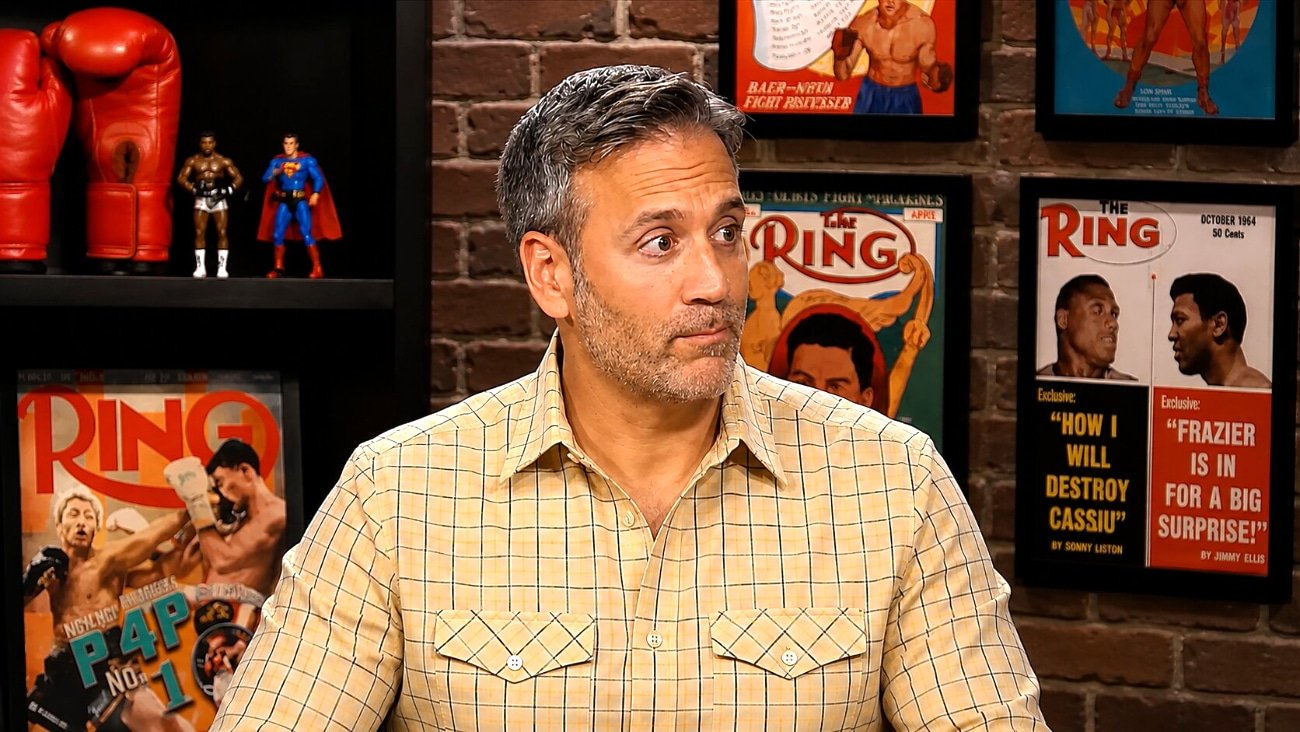


“He’s way past the back nine. He’s shot. I think that he has delusional tendencies,” Glaser said to Tru School Sports. “They pay him a lot of money.”
Glaser also rejected a viewer’s suggestion that Kellerman was simply delivering talking points supplied by Zuffa brass.
“I don’t believe that,” Glaser said. “I think they’re all coming out of Max’s mouth.”
That is where Glaser might be overlooking the obvious. Kellerman has spent decades covering boxing without pulling punches. His willingness to speak candidly has always defined his broadcasting persona. Yet his treatment of Zuffa’s featured prospects has been noticeably more generous.
No one should be shocked that a commentator working a Zuffa event isn’t spending the broadcast tearing down the talent the promotion wants to turn into headliners. Kellerman is part of the television product.
The real issue is just how far the promotional push goes.
Callum Walsh is not Roy Jones Jr. His recent outing against Tyler Denny exposed technical deficiencies that make the comparison unworkable. Walsh stays entirely too upright, pulls straight back in a straight line with his chin exposed, and lacks the fluid upper-body movement that made Jones virtually untouchable in his prime. Against Denny, Walsh got tagged repeatedly, suffered a knockdown, and was forced to grind out a full ten rounds against a domestic-level fighter he was supposed to blast out.
That performance is miles below what the elite fighters produce around those divisions. Match Denny against Jaron Ennis, Sebastian Fundora or Vergil Ortiz Jr., and it’s difficult to picture him surviving deep into the fight. At that level, Denny would have far less opportunity to exploit defensive holes and hang around long enough to score a knockdown.
Broadcasters regularly boost the home talent on their network. The problem starts when the praise becomes so extreme that it becomes difficult to take seriously.
Kellerman possesses the boxing recall to make nearly any historical parallel sound believable for a brief stretch. He pulls up names, styles and classic bouts faster than almost anyone in the business. That depth of knowledge is precisely why placing Walsh in the same sentence as Jones carries more significance coming from him.
Glaser views the commentary as evidence that Kellerman has lost his fastball. That assessment misses the mark. The sharper critique is that Kellerman is simply laying it on too thick.
Zuffa wants Walsh and its other featured fighters to become genuine attractions. There’s nothing unusual about Kellerman emphasizing their strengths. The trouble comes when showcasing a prospect’s upside turns into measuring him against Roy Jones Jr. before his ring work warrants anything close to that comparison.
Until Walsh starts destroying fighters he’s supposed to destroy, invoking Roy Jones does more to expose the distance between the two than elevate Walsh.

