

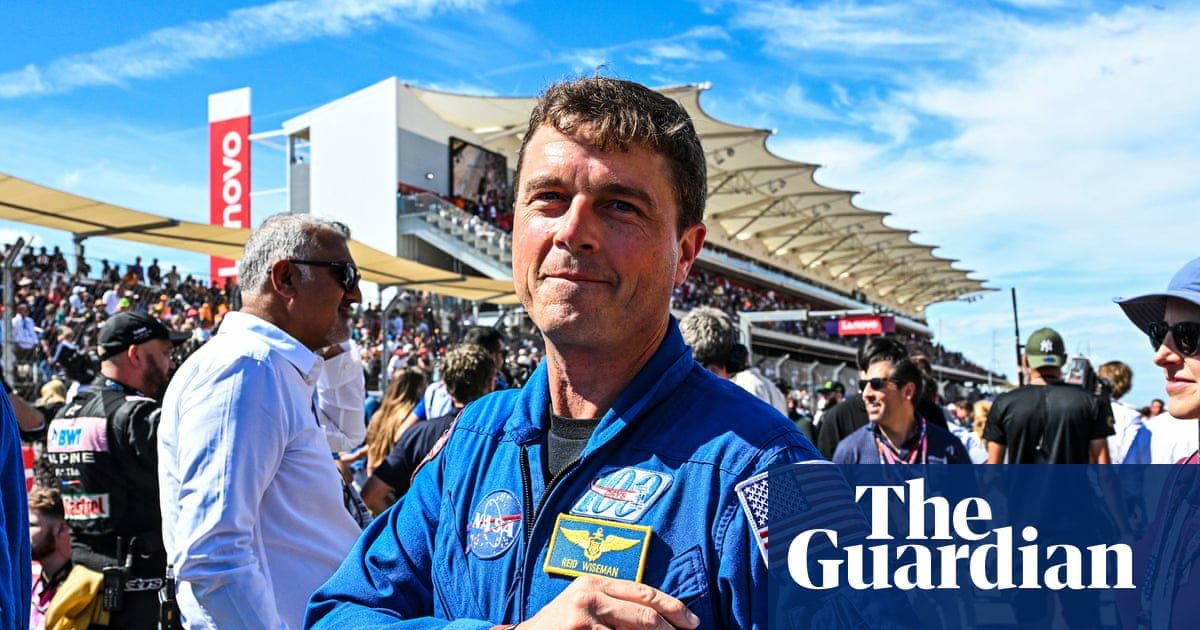
There are characters aplenty within Formula One, a sport that attracts the larger-than-life, and at the sharp end can be a parade ground for swaggering egos. Yet the newest addition to the paddock is a man whose quietly spoken, understated thoughtfulness and insight is compelling. Now part of the Mercedes team, Reid Wiseman has been to the moon and with it brings a perspective like no other.
Wiseman was one of four astronauts, alongside Victor Glover, Christina Koch and Jeremy Hansen, who completed the Artemis II lunar flyby in April. Last month Wiseman, the mission’s commander, became an ambassador for Mercedes’ F1 team, formalising a relationship that had been growing over several years, to the delight of his daughter Katey, a fan of newly crowned world champion Kimi Antonelli.
“I saw Kimi [at the US GP], I just put my arm around him and I said: ‘Your life is kind of crazy,’” says Wiseman. “He said: ‘Yeah, but it’s all joy.’ If he can keep that spirit going, I think it’s perfect.”
It is hard to equate the easy-going, engaging 51-year-old in the Silver Arrows top in Mercedes hospitality with the steely-eyed rocket man he most assuredly is, but Wiseman seems as at home in this environment as he is at Nasa. He brings a joyous enthusiasm to F1, informed by an experience shared between but a handful of people. He is one of only nine living humans to have seen the dark side of the moon.
“The four of us [Artemis astronauts] talk about it all the time. The thing that we most hoped that we would get again in our life is connection to our friends and family,” he says. “You understand how important it is to gather as humans, to do something with a shared vision greater than yourself, and to celebrate together these milestones in life.
“In F1 you look around and it’s parents with their kids, it’s youth getting excited about motorsports, about any sort of sports. They’re celebrating together, they’re sharing a bond. They’re with friends and family. It’s all the things that we wanted most to relate to from Artemis II.”
Wiseman, alongside his fellow Artemis astronauts, was the first to leave low-Earth orbit since 1972 and has travelled further into space – more than a quarter of a million miles – than any other human. He did not know what to expect or quite what a profound effect it would have on their lives.
“It actually enriched things like sport and life,” he says. “When you are looking back at this little, tiny Earth, truly the only thing you feel is hope, peace, joy. You feel lucky that that’s your planet.
“Watching the World Cup after coming back from Artemis II made me absolutely appreciate the different cultures of the world. You can get into these moments of division through sport but then at the end I think you can come together and you know you’re all humans, you’re all in the same place. So it actually brought it home, made it more important.”
That Wiseman has joined Mercedes is almost happenstance, almost but not quite. He grew up watching Nascar with his father in Delaware but had no connection to F1. In 2023 he was invited to the US GP and spent time with Mercedes and McLaren. A year later he met Antonelli, then Mercedes’ reserve driver, who was on a tour of the Johnson Space Center, but Wiseman already knew of the Italian prodigy.
Katey was a fan of the teenager before he even had a ride in F1. “She had been watching Kimi since he was a young driver in karting and she just loved the way he took all the corners,” Wiseman says. “Kids these days, they’re glued to the internet, they discover all the cool songs first and all the good drivers before any of us have heard of who they are. I’m not kidding. She found that kid a long time ago.”
Katey, who is backstage in hospitality completing her college work, certainly had an eye for talent, with Antonelli and Mercedes completing the drivers’ and constructors’ double this season. Wiseman opens stunning pictures on his phone from the Artemis mission of the moon and Earth with casual ease as if it were commonplace to harbour such treasures in a back pocket. Among them is a shot of him reading an email he received from his daughter while in space including a picture of Antonelli.
At Antonelli’s invitation Wiseman attended the Miami GP and spent time with the team last year – and they hit it off. “I never had an avenue to connect into Formula One until I met this team and then it was like a moth drawn to the light,” he explains. “I was completely impressed with the professionalism. There’s really no flash here, just a pursuit of excellence.”
There are obvious technological similarities between F1 and space flight but interestingly Wiseman notes that the former is far more cutting edge, constantly pushing the boundaries, while Nasa is, rightly, primarily occupied by meeting parameters to ensure the success and safety of the mission. However, they share structurally a huge number of people working together to a single goal, be it drivers or astronauts at the pointy end.
He highlights the importance of trust in the process, observing that it took a long time to build between the Artemis crew, a process they worked hard at and not without incident, as have Mercedes and Antonelli.
after newsletter promotion
“Leading up to launch I ‘killed’ the entire crew in a simulator because I made the wrong decision,” he says. “In the end, that actually earned trust because of the way we debriefed that, learned from it and we changed some of our operating principles as a crew.
“Kimi was a rookie last year and I think that was his year of developing trust with the team. Not every decision was great. But he developed that deep level of trust with the team and it’s paying off now when you watch him. Everybody trusts his decision-making, they trust what he’s going to do and they know all of his strengths and even though it’s probably hard to find them, they know his weaknesses, too.”
What then of that undefinable something that in early days of the space race set the astronauts apart – the right stuff? Does he see it in F1 drivers?
“When you’re a driver getting in a car, you are competing against yourself, probably more than anything else,” he says, after a pause to consider. “If I asked Kimi: ‘Who is he racing against?’ My guess is he’d say: ‘I’m racing against me. Everybody else is there but I’m racing against my own time.’
“In the astronaut world that’s how it started, that’s where the right stuff started. If you’re alone in a spacecraft, it’s you and the machine. When the drivers get in the cars, they’re joking around with people but you can see that focus in their eyes. Get in the car and get to the task at hand. I feel that, I recognise that.”
Wiseman has proved hugely popular with Mercedes and in his duties representing them and it is unsurprising that it is the team aspect to which he returns, with a pleasingly philosophical air he has surely earned as F1’s very own star man.
“I had Claude go and evaluate statements Apollo astronauts made after they came back and statements that Artemis II made after we came back,” he says. “Claude said our statements were almost identical with one exception. Apollo astronauts said “I”, and Artemis II astronauts said “we”. That’s the only difference.
“I don’t know if that’s a cultural thing or if that’s kind of the premium that we now put on small team skills. Maybe it’s a change in humanity, right? Maybe we’re more invested in each other now?”
