

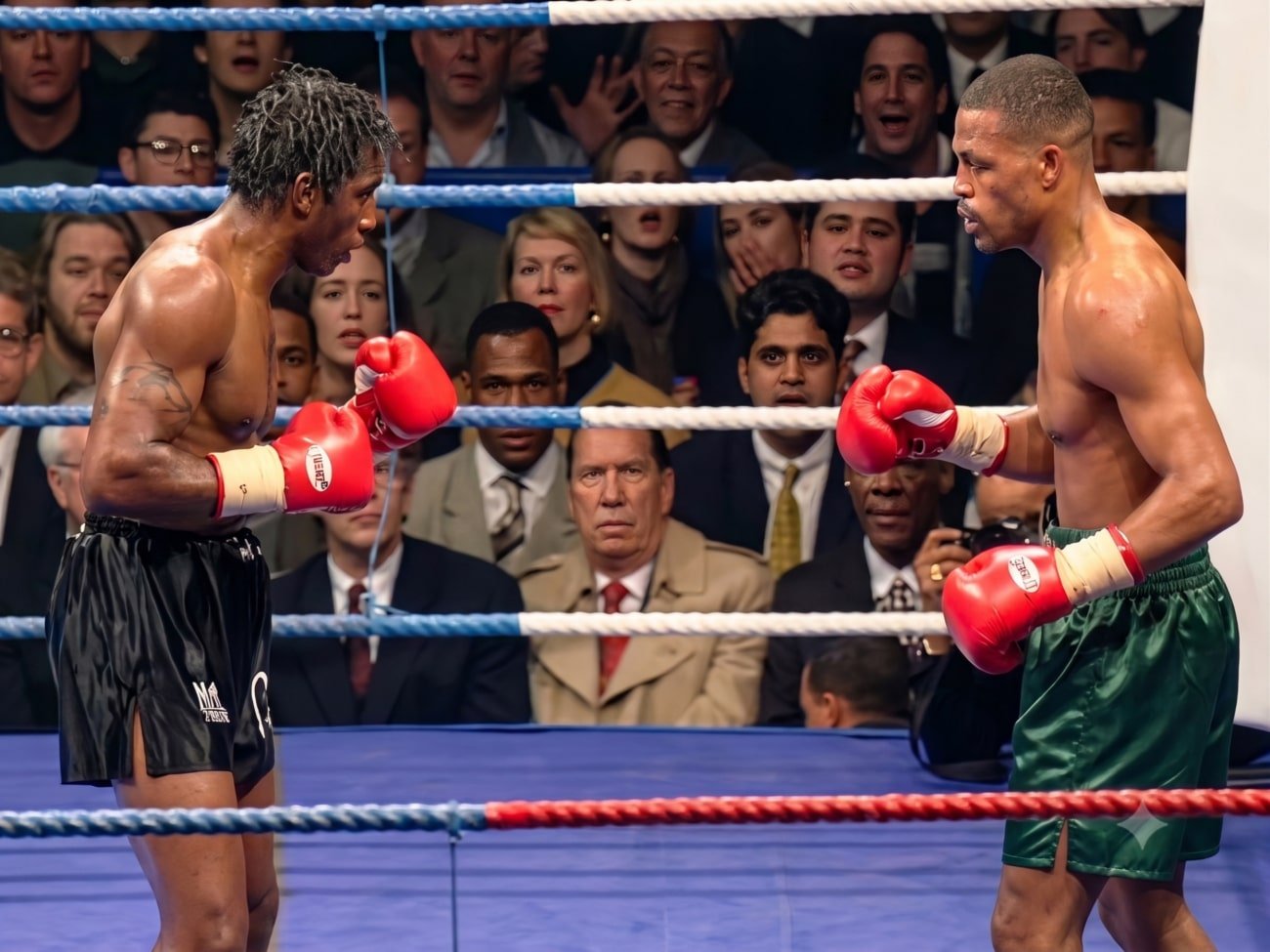


A fine pro career would follow, with plenty of ups and downs, and a whole lot of violent, brutal, and unforgettable fights going down. After going a reported 41-1, the sole loss coming against Rod Douglas, Benn turned pro. It wasn’t long before Benn was mowing down opponents in double-quick fashion, with him becoming a fighter with a growing reputation.
Back before the days of the internet, a fighter would get publicity in the magazines and by appearing on TV. And so it was that the name Nigel Benn became more and more frequent in trade paper Boxing News, and in Boxing Monthly here in the UK, with the savage slugger also building his profile with appearances, most of them brief, on sports shows like Midweek Sports Special.
By his 17th pro fight, Benn was the Commonwealth middleweight champion. It was in October of 1988 when Benn gave us his first classic. Facing the accomplished Anthony Logan at The Royal Albert Hall in London, Benn came desperately close to being stopped. In the second round, Benn was blasted by a torrent of over 20 blows. Seemingly headed for defeat, Benn instead gambled everything by launching a left hook counter at Logan. Had the shot missed, Benn would have hit the mat himself, but the bomb detonated on the on-top fighter’s jaw, and Benn pulled out one of the most astonishing comeback knockouts you will ever see.
But was Benn chinny? Benn was certainly less than gifted in the defensive side of the game; his wicked power, his sheer aggression, and his desire to lay a man out were his best assets as a fighter. And the young Benn was a fighter; he was not a boxer. And stamina shortcomings that Benn had, along with his defensive lapses and his less-than-granite chin, served to haunt him in May of 1989. Facing the skilled and experienced Michael Watson in another Commonwealth title defense, Benn fought recklessly, albeit thrillingly, until he punched himself out, with the savvy Watson, who had pulled his own version of the ‘rope-a-dope,’ dropping and stopping an exhausted Benn in round six. Plenty of people felt ‘hype job’ Benn was finished. Not a chance.
After relocating to the US, Benn came back, slowly at first, to reach the top. By April of 1990, Benn was the WBO middleweight champ, courtesy of his action-packed stoppage win of the teak-tough Doug DeWitt, the win coming in Atlantic City. Benn became the first Brit to win a version of the world middleweight title since Alan Minter.
A sizzling, controversial one-round win over Iran Barkley followed, also in the US, Benn famously tearing up his British license after his win over “The Blade,” and promoter Bob Arum was now talking about possible fights between Benn and Sugar Ray Leonard and Thomas Hearns. Instead, Benn fought a relative unknown named Chris Eubank, in November of 1990. A genuinely hate-filled rivalry was born, and Eubank struck first blood, stopping Benn in a great fight.
Now campaigning up at super-middleweight, Benn notched up solid comeback wins over Robbie Simms (Marvin Hagler’s half-brother) and Kid Milo, with Benn also scraping a close, debatable points win over Sugar Boy Malinga. Then, in October of 1992, in Italy, Benn stopped Mauro Galvano to win the WBC belt. A return fight with Galvano, in Glasgow, saw Benn’s shaky chin survive a late scare, with Benn going on to win a wide decision. Benn’s most famous and most savage and damaging fight was still to come.
After boxing to a draw with Eubank in their huge return fight, Benn, looking like the winner to most fans, the now 30-year-old “Dark Destroyer” notched up two additional title defenses, before he signed to fight “Mini Mike Tyson” (Don King’s nickname) Gerald McClellan. The fight of February 1995 is known to all fight fans; the war ultimately ended in a near-fatality, with upset loser McClellan suffering irreversible injuries, his eyesight, hearing, short-term memory, and ability to walk without aid being monstrously compromised. Benn suffered a blow to the head himself, the fight being so sickeningly punishing.
But with the tenth round stoppage win he scored, Benn had forever proven himself as a great; his heroics in taking McClellan’s bombs and in coming back from two knockdowns, one on the opening round, earned Benn all the respect in the world. In hindsight, the McClellan fight should have been Benn’s last. But on he soldiered, making five more ring appearances. Benn was past his best, but he won two of these fights before he lost his final three bouts to Malinga in a return and to Steve Collins, who stopped him twice.
Benn had his tough times out of the ring during this time, with him even contemplating suicide at one point, but Benn then found religion, and he became a born-again Christian. A true fan-favorite who holds a special place in the hearts and minds of British fans, Benn is now, finally, where he belongs: in the Hall of Fame.
