

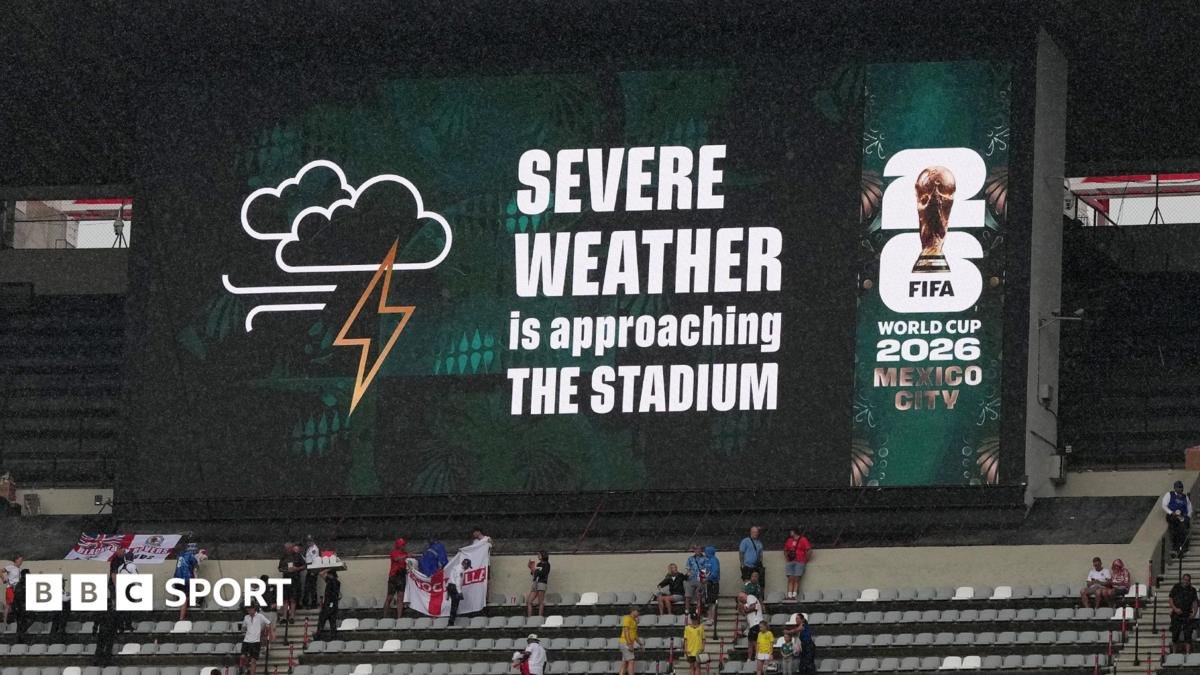
Big screens inside the Azteca alerted people that an electrical storm was approaching and to remain in their seats, though many sought cover from the rain.
Play cannot begin until 30 minutes have passed since lightning was last detected within an eight-mile radius of the stadium.
With regards to delays caused by severe weather, Fifa has no power to make its own rules – it must adhere to the advice of local authorities.
In the United States, recommendations of the National Oceanic and Atmospheric Administration (NOAA) are used.
The NOAA says if any lightning strike is detected within eight miles of a stadium the game has to be stopped. The rules are the same in Mexico.
When there is an increased risk of lightning strikes, the safety of players and supporters is given paramount importance.
All players must leave the pitch, and fans must seek shelter away from their seats.
A mandatory 30-minute countdown begins. Each time there is a lightning strike inside the distance, the countdown clock resets to 30 minutes.
If a full 30 minutes has elapsed, the supporters can go back to their seats and players will have a short warm-up.
Sources told BBC Sport on Saturday that world governing body Fifa had been set to reschedule the fixture, and confirm in a statement, but news of the proposal angered both English and Mexican officials.
The English Football Association (FA) requested time to review the weather forecast in more detail.
As talks went on, concerns over the impact on player preparation, fan travel and the logistics around moving the staging of such a huge game were discussed.
The proposed change was first reported by local media in Mexico.
Fifa maintained no decision had been made and – after pushback from both associations – it was decided to keep the tie at its original kick-off time.
