

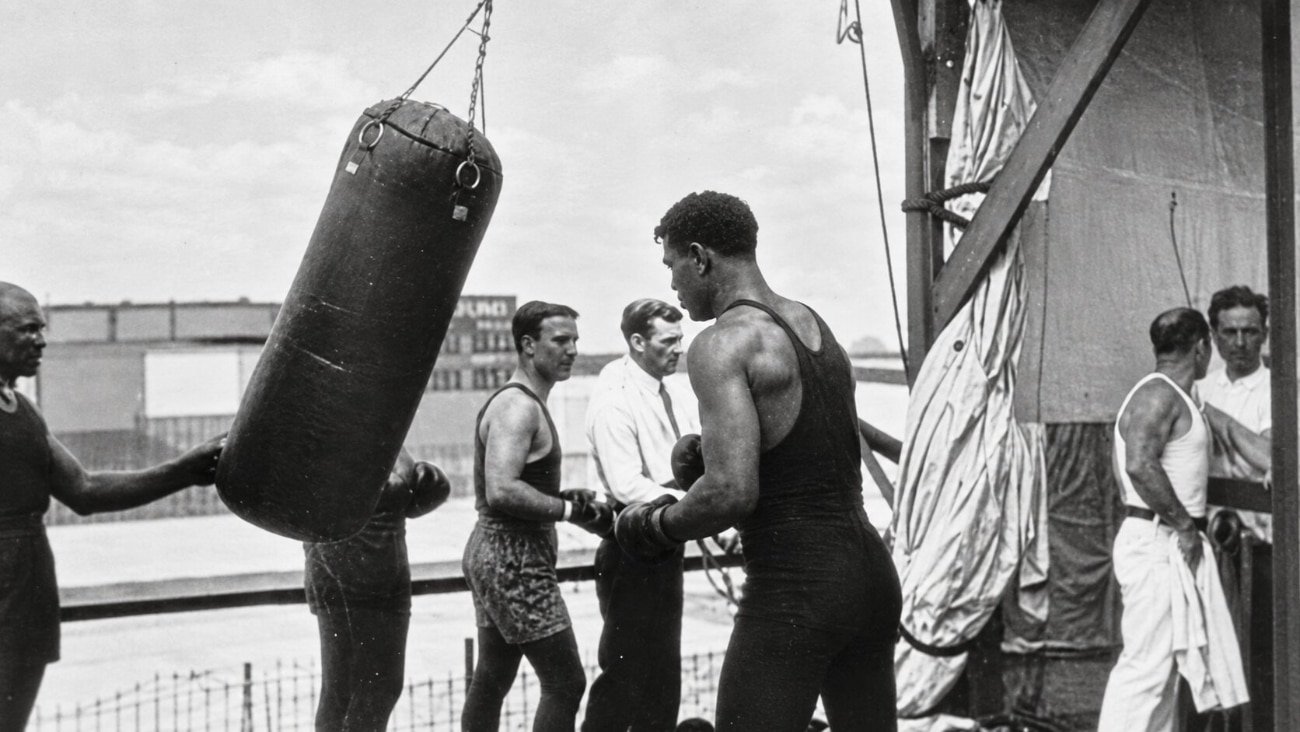


At 22 years of age, Dempsey was tearing through the heavyweight division with his aggressive style and crushing left hook. Miske, 24, had the benefit of fighting before his hometown supporters, but he was far more than a protected local attraction.
Dempsey weighed 187½ pounds, while Miske came in at 182.
Known as the “St. Paul Thunderbolt,” Miske was a fast, clever boxer who understood how to block punches, smother attacks, and work at close range. Those skills gave Dempsey one of his hardest tests during his climb toward Jess Willard’s heavyweight championship.
The local favorite supplied a tactical lesson for smaller fighters facing dangerous punchers. Instead of continually backing away, he stepped into Dempsey’s punching range and crowded him. Retreating would have given Dempsey space to drive forward, build speed, and launch his leaping left hook. Miske took away that leverage by getting close, controlling Dempsey’s arms and preventing him from completing his punches.
The rolling movement associated with Dempsey’s attacks depended upon momentum. He bobbed his upper body from side to side, shifted his weight, and sprang forward with hooks from changing angles. An opponent who backed away gave that attack time to gather force.
Meeting Dempsey chest to chest changed the exchanges into an arm wrestle. His long swings lost much of their force as Miske blocked the hook, jammed the punching arm, and answered with short shots before tying him up.
Quick punches inside prevented the younger man from finding a steady rhythm. Dempsey had productive stretches in the second and third rounds, but Miske answered with a hard right cross in the third.
Years later, Dempsey admitted that Miske was landing more punches and building what looked like a lead. He also recalled being hurt during one exchange and struggling to remain upright until the bell.
“Miske had landed more telling blows than I had,” Dempsey recalled. “He suddenly came at me with a volley that nearly put me out.”
It was a revealing admission from a fighter remembered for overwhelming opponents. Raw aggression had run into a boxer who understood distance, timing and leverage. The visiting fighter finally produced his strongest attack in the seventh. A heavy left to the body followed by a right to the jaw troubled Miske and helped Dempsey recover ground. Neither man scored a knockdown, leaving the newspapers to decide which work they valued more.
Miske’s approach was almost the opposite of the one Jess Willard used against Dempsey in Toledo the following year. The 6’6″ champion tried to control the challenger from long range but remained too upright and stationary.
That distance allowed Dempsey to leap forward with hooks and overhand punches. Willard became an easy target once the challenger closed the distance, leading to seven knockdowns during the savage opening round.
Such a runway was never available against Miske. He moved toward the danger, shortened the punches, and forced Dempsey to work without full leverage. Willard waited at the end of Dempsey’s forward rush, while Miske intercepted it before the punches reached full speed.
The St. Paul fight showed that smothering Dempsey was safer than surrendering the ring and waiting for him to attack. Gene Tunney receives credit for solving Dempsey in 1926 and repeating the result one year later. Miske had exposed several of the same weaknesses eight years earlier. Their tactics were not identical. Tunney relied more heavily on footwork, his jab, and movement at long range. Miske was more willing to hold his position, work inside, and smother Dempsey physically.
Both remained composed when Dempsey attacked. They refused to become stationary targets at his preferred distance and punished him when his forward movement became predictable.
Before their first fight, Tunney studied films of Dempsey and brought former opponents and sparring partners into camp. There is no firm evidence that Miske personally supplied Tunney’s plan, but the St. Paul contest had established the central principle: Dempsey became less effective when an opponent denied him momentum and forced him to restart his attacks.
Miske supplied the early evidence that denying Dempsey momentum made him less effective, and Tunney later produced the polished championship version.
The St. Paul Pioneer Press surveyed eight writers at ringside. Four favored Dempsey, one selected Miske and three scored the fight even. The newspaper published the bout as a draw, although other reports awarded Dempsey a narrow newspaper decision based on his aggression and heavier punches.
A later collection drawing upon additional newspaper sources produced seven verdicts for Dempsey, four draws and one for Miske. That broader tally included reports beyond the eight writers questioned in St. Paul.
Such disagreement exposed the weakness of the no decision era. A boxer’s official record remained untouched after a distance fight, even when most observers believed he had lost. Local sports editors became unofficial judges without a uniform scoring system or any requirement to agree.
Reports from St. Paul do not support the claim that hometown writers simply protected Miske. Four of the eight surveyed writers favored the visiting Dempsey, while only one selected Miske. Regional loyalty may have influenced individual accounts, but the split also reflected a genuinely close fight.
Miske landed more often and controlled long portions of the contest, while Dempsey delivered the harder individual blows. Some writers valued activity and craft; others favored aggression and damage.
Promoters benefited from the uncertainty. Dempsey survived a difficult night without receiving an official loss, allowing his handlers to continue selling him as the next threat to Willard. Miske also avoided a formal defeat and remained a leading heavyweight attraction in Minnesota. Jack Kearns wanted knockouts that would sell Dempsey to a national audience. Taking him into Miske’s hometown against a fast, experienced boxer was a serious gamble.
The no decision format reduced the danger because only a knockout placed an official loss on the record. It did not remove the promotional risk. A decisive beating reported across the country still would have damaged Dempsey’s growing reputation.
Kearns learned that clever defensive fighters presented a different challenge from the large, slower heavyweights Dempsey destroyed. His fighter continued facing dangerous opposition, including Fred Fulton, Battling Levinsky, Bill Brennan and Miske himself, but the first fight supplied a warning. Dempsey’s power did not automatically solve every style.
The pair met again in Philadelphia on November 28, 1918, with most newspapers favoring Dempsey after six rounds. By then, the future champion had gained more experience against Miske’s troublesome methods.
Their third fight came on September 6, 1920, after Dempsey had taken the heavyweight championship from Willard. Miske was suffering from Bright’s disease and was knocked out in the third round of Dempsey’s first title defense.
His illness was not common public knowledge, so there is no basis for claiming Kearns selected Miske because he knew the challenger was dying. In hindsight, the physical decline made the title fight far less dangerous than their first meeting had been.
That knockout became the lasting image of their rivalry. Miske is now remembered primarily as the sick challenger who needed money, while Dempsey remains one of boxing’s most recognizable champions.
The familiar family story belongs mainly to the end of Miske’s life, not the 1920 title fight. A gravely ill Miske returned against Bill Brennan in November 1923, scored a fourth-round knockout, and used the money to give his family a memorable Christmas. He died on January 1, 1924.
Remembering only the tragedy reduces Miske to a sympathetic opponent in Dempsey’s championship story. Reports from 1918 present the fuller picture.
At that time, the St. Paul Thunderbolt was one of the sharpest technical boxers in the heavyweight division, possessing the timing, defense, and composure to frustrate Dempsey near his physical peak. He survived 10 rounds and forced the future champion to abandon many of his preferred attacks. The press left St. Paul unable to agree on a winner.
