

The job of a sports television broadcast is to show the action on the floor or field. But capturing the magic that brings it to life on any screen, of any size, in any random place across the world? That’s the real goal.
How do you transport the audience into the scene from the TV in their living room or their phone on the train?
Sam Flood could see the answer as he scouted his return to the NBA, looking both to the past and to what’s in front of him.
Flood is the executive producer and president of production for NBC Sports, overseeing everything from “Football Night in America” to the Premier League broadcast. He’s the one in charge of bringing the NBA back to NBC in the first year of the league’s comprehensive new 11-year, $76 billion media rights deal.
NBC’s return to the NBA came with a need to balance the nostalgia of its past and the sport’s evolution into the future. NBC is most closely associated with the Michael Jordan era of the 1990s, a period that launched the NBA on a path of global expansion that continues today. Now, San Antonio Spurs star Victor Wembanyama has arrived as a product of that growth and as the potential face of its next era.
As the league and network try to understand what Wembanyama’s ascension will mean for their futures, they are looking through a lens that Jordan first calibrated. It hasn’t been perfect. MJ himself was hyped up as a part of NBC’s return, but it turned out to be only a few brief interviews sprinkled into segments early in the season. The drone cam to start halves in the conference finals has been polarizing, to say the least.
But overall, the return of the NBA on NBC has been a success. The network put analysts on each bench courtside during the regular season to bring a different aspect to the game experience. It has the visiting players introduce themselves a la Sunday Night Football. NBC even did retro nights that went beyond the graphics bringing back the commentators from 20 years ago like Bob Costas, Doug Collins, Mike Fratello and Hannah Storm.
And it has leaned heavily into the budding fascination that is Wembanyama, flexing in several Spurs games throughout the season and treating this Western Conference finals clash with the Oklahoma City Thunder like something grander than a matchup of two excellent basketball teams.
“We think of our vision as we make musicals,” Flood says. “We make a bigger story and we tell a bigger story to get people engaged differently than going to the theater for a drama. A musical has different notes that are welcoming to all.”
The biggest thing missing from watching a game remotely is the immersion of sound. In the arena, you exist within the game environment. Your senses are overwhelmed by it. The broadcast is a vignette into that world, so Flood took a distinct approach to shaping the program.
Flood saw the gateway into the heart of the viewer just before tip-off. In the ‘90s, you would hear John Tesh’s “Roundball Rock” NBA on NBC theme song, the Pavlovian “duh-nuh-nuh-nuh-nuh-nuh-nuh-nuh,” and start building up the adrenal response to some hardwood heroics. There was this feeling that a journey was beginning.
“You’d hear that music, and you’re ready for basketball,” Flood says. “So we all knew that was an important element to growing and returning to the NBA.”
Beyond that, NBA games never start at the time they say. Pregame events, from the anthem to the intros to the actual tip itself, require between seven and 12 minutes to sift through. Broadcasters use this space to do the “open,” a tight, colorful mini-show full of reports, analysis, highlights and hype.
But Flood remembered the magic of the Chicago Bulls introductions, with Jordan emerging from the darkness as the intensity of “Sirius” by The Alan Parsons Project built up into a thunderous explosion from the crowd. That out-of-body experience only exists in a few places on earth. So when the NBA on NBC broadcast returned, it chipped away a few extra frills and ads just before the game to broadcast the arena’s player introductions, bringing the viewers through the screen and into the energy of the arena.
The broadcasters don’t try to talk over it. It’s not the moment for analysis or depth. They just let the moment wash over them and get lost in it. It is the antithesis to the way the game, and just about all forms of entertainment, have been broken up into bite-sized pieces of content.
“We just think being at the NBA arena is a special experience, and every building does it their own way, and we love the fact that we can lean into that,” Flood says. “We then stole from Sunday Night Football with the talking head lineups and created this hybrid model where the visiting team gets the talking head lineups and the home team gets the intros with the PA announcer and with a little bit of the video thrown in of that home team video that hypes up the folks in the arena.”
The narrator of all of this is Mike Tirico, NBC’s do-it-all play-by-play announcer. He cut his NBA teeth from 2002-2016 with ESPN/ABC, serving as a play-by-play announcer alongside Hall of Famer Hubie Brown, a studio host for ESPN’s NBA coverage and even doing the NBA Finals radio call. He left for NBC in 2016, taking on a wide variety of roles that include being the voice of Sunday Night Football and the Olympics. Now he’s the voice of NBA on NBC as well, and he just won the Sports Emmy for outstanding play-by-play personality on Tuesday.
“I remember the ground floor of LeBron and what that was like, and I think Victor has some of that feel to it,” Tirico says. “Because when you sit and talk to individual people on this side of the table, they talk about him in the most glowing of terms, the most impactful of terms.”
But more than anything, Tirico remembers being wowed by the sensations he felt when calling his first Wembanyama game in February.
“It’s almost impossible to say this, but TV doesn’t do him justice,” Tirico says. “It’s the Augusta factor. Anytime somebody goes to (The Masters course at) Augusta (National) for the first time and sees it in person, you’re like, ‘Oh my God, that’s so different than TV.’ And on TV, it’s amazing. He’s the same way.”
How do you somehow do justice to that reality through the broadcast, to bring the audience into Wemby’s Augusta? That’s the task for Tirico, and the NBA on NBC crew that has been calling the West finals.
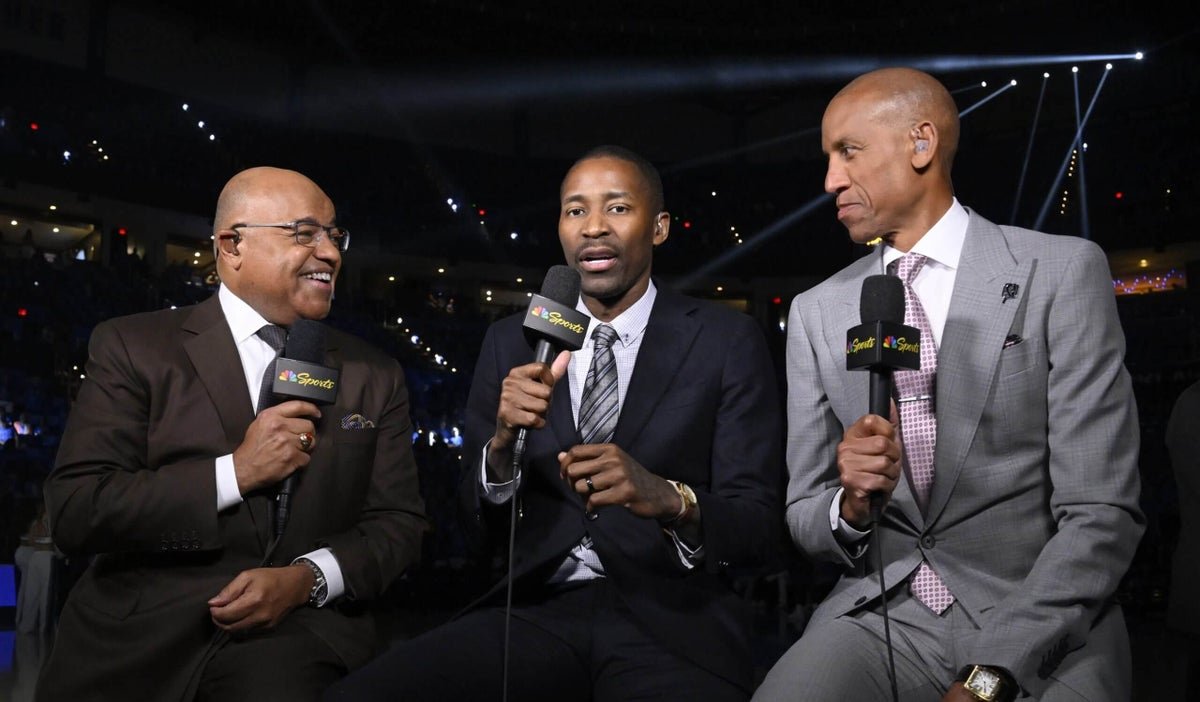
Throughout the series, Tirico has been flanked by three-time Sixth Man of the Year winner Jamal Crawford and Hall of Famer Reggie Miller, with a unique approach in the NBA of dual sideline reporters Ashley ShahAhmadi and Zora Stephenson. The analysts are shooters from two different eras, products of how the game has evolved since the original NBC days. Crawford’s handles inspired a generation of asphalt dwellers in neighborhoods across the country. Miller was the great shooting guard of the ‘90s, the harbinger of the 3-point era. His only curse was that he was born too soon.
“At times, I curse my mom and dad like, ‘Why did they have me so early with the way the game is played today? Damn you, Saul and Carrie!’” Miller says with a facetious shaking of the fist to the sky. “But I am excited where the game is headed and how the players have evolved and the fundamentals of the game.”
Miller is the bridge between NBC’s two eras with the sports. He has a short list of players in his time around the league that could make him jump out of his seat. There’s Steph Curry (“As soon he got out of his car in the arena, he’s live ball. You don’t know where he’s going to shoot it from.”) There’s, Jordan (“A guy that walked on air. We had never seen it before. Some people have come close, but we’ve never seen a guy have that type of aura.”) There’s Magic Johnson, (“On a fast break, was like a God.”) There’s Allen Iverson (“You couldn’t take your eyes off of him.”)
Now, there’s Wembanyama.
The sensation reminds Miller of the first time he sat down with Curry.
“You just got a sense that there was greatness on the horizon,” Miller says. “You couldn’t see it but you could sense it. And I sensed it in him because his conviction was so strong. Fast forward to today, he’s the greatest shooter of our game and the records that he holds. But I could sense it then very much in the way I’m sensing it with Victor now.”
Just as Curry was an evolution of him, Miller sees Wembanyama as an evolution of the bigs that came before. Miller now hopes that, as part of the NBC revival in his second career as a broadcaster, the players who leave their mark will remember that he was a part of the journey, too.
“I’m honored that — something I’m going to tell my kids — I called Victor Wembanayama’s first playoff game,” Miller says. “What’s going to be cool is some of my best moments as a basketball player were on NBC. I hope that five, 10, 15, 20 years from now, when I’m long gone from my broadcasting days, Victor Wembanyama, Stephon Castle, those guys will remember their first game on NBC and hopefully they’ll be like, ‘Oh s—, Reggie Miller was calling our game!’ I hope I have that type of longevity.”
NBC has done well to capture the drama of this series. When Wembanyama bumped Chet Holmgren and Jaylen Williams had a hilarious reaction, they gave it to us in slo-mo. An impassioned speech in the huddle? Got it. Shai Gilgeous-Alexander trying to level his teammates? Right up close.
NBC’s approach is certainly paying dividends. The double overtime classic of Game 1 of Thunder vs. Spurs had a total audience delivery of 9.2 million viewers on NBC’s platforms, based on official Nielsen Big Data + Panel and digital data from Adobe Analytics. That would make it the most-watched Game 1 of the West finals on record, per NBC.
In the end, for Wembanyama to help build an NBA television era as revered as Jordan’s, there is one thing he has to do: win. He and the Spurs are down 3-2 with a trip to the finals on the line, the kind of moment that shapes his legacy’s path. This will be a chapter in his story, for better or for worse.
“We can’t make a star at NBC. We can’t say, ‘This is the person you’ve got to care about. This is the star of the NBA.’ You have to earn that,” Flood says. “What Wemby does on the court is giving him the opportunity to be the face of the league. He’s got to keep doing it. But the level he’s doing it at, his passion for the game, that’s the golden ticket. Now it’s a question of staying at it, winning a championship, winning another championship.
“No pressure, but that’s how the game works.”
