

Sir Donald Bradman needs little introduction.
Cricket – and possibly world sport’s – most dominant figure, “The Don” is known for his staggering batting feats, including a scarcely believable batting average of 99.94, and his leadership of Australia’s 1948 team nicknamed the “Invincibles”.
However, few would know Bradman was a key figure behind cricket’s transformation from time-consuming five-day matches to the chaotic world of one-day and Twenty20 (T20) games that dominate the sport’s calendar, broadcasts and finances today.
And it was all sparked by Melbourne’s oft-criticised weather, some worried bean-counters, and a bright idea.

Jeff Chiu/AP, Andrew Cornaga/AAP, Petros Kardijias/AP
Sports can change dramatically in the blink of an eye. Sometimes, these moments create immediate shockwaves. Other times, it’s not until much later that their impact become obvious. This is the first story in a rolling series that explores key (and sometimes long forgotten) moments in sports history.
Read more:
Game changers: how soccer’s mega-money era was sparked by a little-known Belgian athlete
The first one-day international
Domestic one-day matches of between 40 and 60 overs a side had been played in India and England since the 1950s.
These shorter, more dynamic games were aimed at attracting new spectators.
However, they had not been considered for international matches.
The first one-day international (ODI) in 1971 was an accident: an unscheduled match played as a last-minute replacement for a Test abandoned due to heavy rain.
According to Australia’s captain Bill Lawry, the match was conceived by Bradman for financial reasons. Facing heavy financial losses the English and Australian cricket boards agreed to play a game on what would have been the last day of the Test.
Around 46,000 spectators saw Australia win after each side was allotted 40 eight-ball overs.
It was a financial hit, popular with spectators and deemed an “overwhelming success” by the media.
But growth of this format was slow, mainly due to the conservative nature of international boards.
The next ODI did not happen until August 1972, and other countries did not start playing them until 1973.
Remarkably, considering the amateur status of women athletes at the time, the first limited-overs World Cup was a women’s tournament in England in 1973 – two years before the maiden men’s World Cup was played.
One-day cricket’s popularity soon soared, especially after the men’s World Cup in 1975.
Kerry Packer’s World Series Cricket, launched in 1977, confirmed its place on the international cricketing calendar and played a huge role in the shorter format’s popularity.
The media baron was desperate to showcase cricket on Channel Nine but his TV rights bid was rejected by the Australian Cricket Board. Aggrieved, Packer instead set up a breakaway competition, signing many of the world’s best players.
The new-look competition featured brightly coloured team kits, white balls, games under lights and batters wearing helmets – all of which are still in place today.
How ODIs changed cricket
Test cricket was, and often still is, criticised for being too slow and boring.
The limited number of overs in ODIs increased the speed of the game: batters looked to score more quickly and take more risks, which resulted in more boundaries.
Clive Lloyd, who captained the West Indies to two World Cup wins, called limited-overs cricket the greatest innovation for the sport. He specifically referred to improved standards of fielding and tactical awareness.
ODIs have greatly increased athleticism: batters need to be stronger to hit more boundaries and quicker to ensure they are fast enough when running between wickets.
Fielders need to be faster and more athletic to stop boundaries and extra runs. They also need stronger arms to throw the ball faster.
In 1992, fielding restrictions were introduced for the first 15 overs, only allowing two fielders outside of a 30-yard circle. This promoted early aggressive batting.
These fielding restrictions forced captains to rethink field placements and bowling rotations.
While Australia scored 191 runs to win the first ODI, current teams regularly surpass 300.
Scoring has increased because of power hitting, bigger bats, specific training and better running between wickets.
Boundary ropes introduced for player safety also reduced the distance required to hit a boundary.
Bowlers have had to develop more variations, such as slower balls, to make it harder for them to score runs.
In this shorter format, the importance of all-rounders (players who can bat and bowl competently) has increased greatly.
Wicketkeepers are also expected to be better batters. Former Australian wicketkeeper Adam Gilchrist had success opening the batting, which gave his team more flexibility to include other batters and all-rounders.
Player uniforms also evolved.
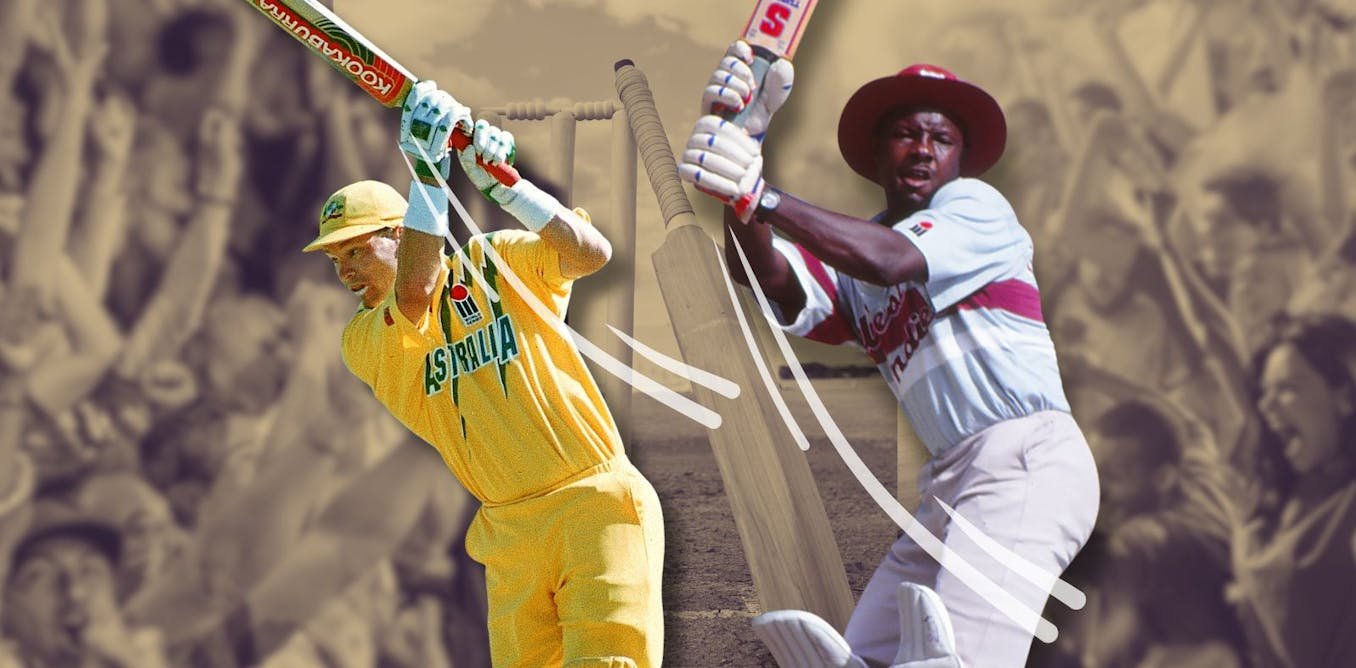
One-day clashes originally used traditional white clothing, but colour uniforms introduced a new dimension for televised cricket. They have been used permanently since the 1992 World Cup.
As the format evolved, player names and then numbers were gradually added to playing tops, making identification easier for commentators and spectators.
Read more:
Game changers: how one team’s dominance transformed rugby league forever
Continuing relevance
Limited-overs cricket laid the platform for even shorter formats such as T20s, the Hundred and even ten over games.
Ironically, these innovative formats now threaten the continued relevance of 50-over cricket.
Analysis of more than 340 ODI matches played in Australia between 1985 and 2015 shows average attendances have declined over time. In the 1980s, games in Australia regularly drew crowds of more than 35,000, but in recent years attendance has struggled to regularly reach 25,000 per match.
However, major events like World Cups can still draw large crowds. The 2023 tournament was attended by a record 1.25 million people and made Australian captain Pat Cummins “fall in love with ODI cricket again”.
ODIs have given fans decades of drama and achievement.
Older fans still remember classic games such as Australia’s tied 1999 World Cup semifinal against South Africa, and Michael Bevan’s last-ball four to beat the West Indies on New Year’s Day in 1996.
But 50-over cricket now faces a challenge to stay relevant alongside more exciting and more profitable T20 tournaments.
If ODIs are to keep their place in a busy cricket calendar, they must continue evolving to ensure they maintain player and audience interest.
