


Just over a decade ago, things were so heated between Bob Arum’s established Top Rank promotion and Al Haymon’s new, well-funded Premier Boxing Champions, Arum sued over alleged monopolistic practices, wanting to find out “where the bodies are buried.”
The tension was even fiercer between Golden Boy Promotions head Oscar De La Hoya and Haymon, after the powerful manager took all of his best fighters from Golden Boy to launch the new company.
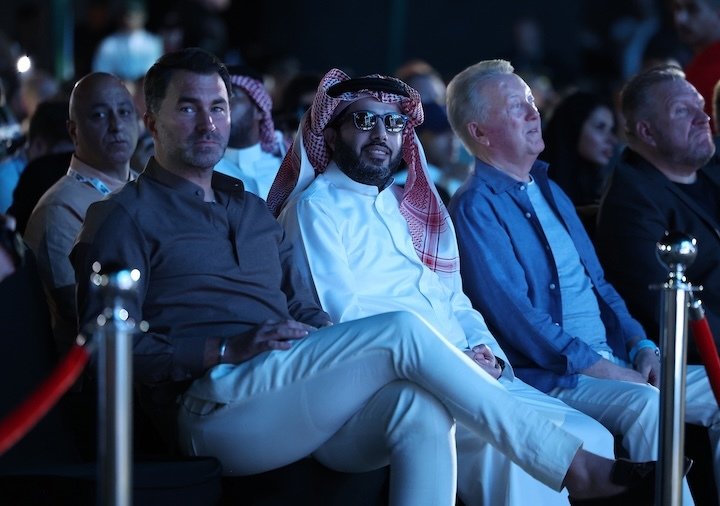
How ironic, then, that on the same week a new bitter divide between new powers – the Nick Khan and Dana White-run Zuffa Boxing, Eddie Hearn’s Matchroom Boxing, and Frank Warren’s Queensberry – prompted a London summit organized by mutual business partner Turki Alalshikh that Haymon, Arum and De La Hoya seem to be getting along swimmingly.
As the important debut of the new TNT-DAZN monthly boxing series, The Fight, launches Saturday, Top Rank found itself in a pinch recently when Matchroom’s Joe Cordina, the opponent for Top Rank’s WBO lightweight champion Abdullah Mason, was denied a travel visa.
A promising talent, the 22-year-old Mason, 20-0 (17 KOs), is being showcased in a homecoming fight in Cleveland on America’s 250th birthday.
Into the void stepped PBC/TGB Promotions’ fighter Albert Bell, 28-0 (9 KOs), an awkward 6ft veteran from Toledo, Ohio, who is both saving the show and hopeful his style can compromise Mason.
“We’ll work with anyone,” one PBC official said.
The proof comes on the heels of the co-promoted May 2 card pitting PBC’s two-division champion versus Golden Boy’s then-unified cruiserweight champion Gilberto “Zurdo” Ramirez – a joint pay-per-view from PBC streaming partner Prime Video and Golden Boy’s, DAZN.
The second edition of The Fight features another PBC-Golden Boy match featuring former junior lightweight champion Lamont Roach Jnr versus Mexico’s William Zepeda for the vacant WBC lightweight title August 1 in Las Vegas.
PBC/TGB could potentially claim two lightweight belts on a show and platforms it’s not exclusively tied to.
In these cases, cooperation has helped and advanced the sport from the days when the respective sides were more interested in hogging and protecting their own talent, denying or delaying co-promoted fights that made perfect sense.
When people would time and again say boxing is dying, the primary reason was nearly always the lack of co-promotion.
Some of these alliances have happened thanks to the financial entry of Saudi Arabia money, via Alalshikh, and the ability to make fights that would’ve otherwise been unreachable in years past.
But now, in Alalshikh’s deep-pocketed support as a 60 per cent owner of Zuffa Boxing, he’s heard White speak of taking over the sport and being resistant to working with others.
At the summit, Alalshikh had to confront the friction of that mindset and the fact Hearn has a signed contract with his two-time heavyweight champion Anthony Joshua to fight two-time heavyweight champion Tyson Fury in England while White is saying he and Zuffa will be connected to the super-fight.
The choice is clear: Stay bullish with the attempted takeover or take the path to cooperation.
Boxing history has provided a timely lesson. It’s just a matter now if the right people are paying attention to it.
