

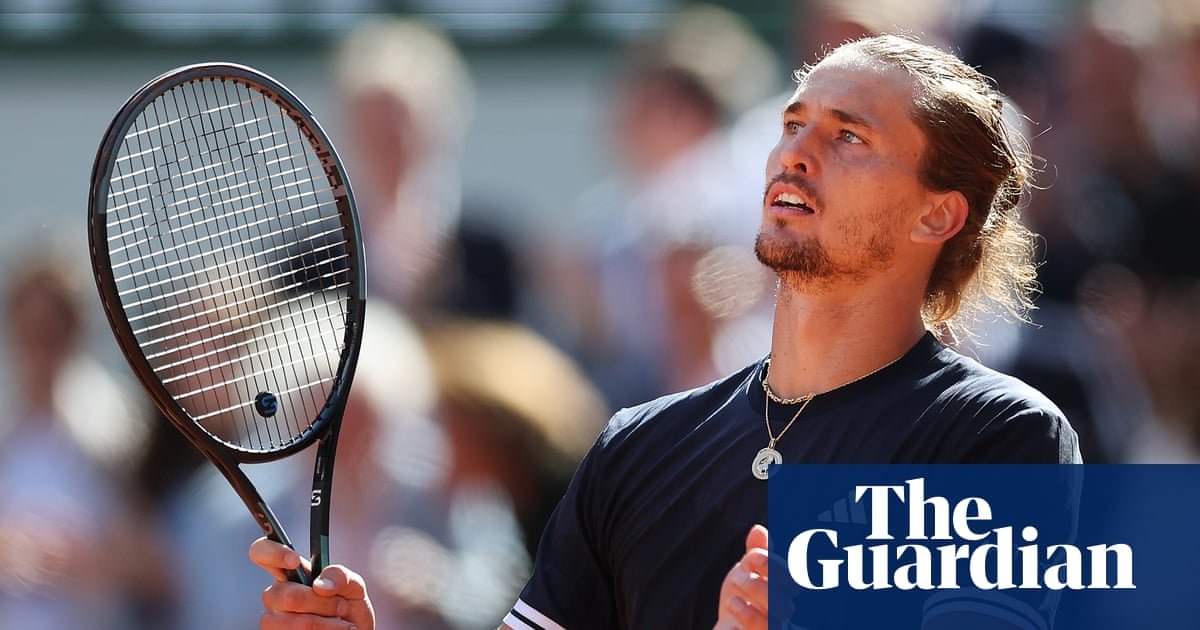
Alexander Zverev moved to within one match of a long-awaited first grand slam title as he defeated the Czech 26th seed Jakub Mensik 7-5, 6-2, 3-6, 6-3 to reach the French Open final for the second time in his career.
Zverev, the second seed and ATP No 3, will contest his fourth career grand slam final on Sunday. The German player lost his first grand slam final at the 2020 US Open in a fifth set tie-break against Dominic Thiem having led by two sets and served for the match in the fifth. He was then defeated by Carlos Alcaraz here in 2024 and Jannik Sinner in the 2025 Australian Open final.
From the moment Sinner, the No 1 and heavy favourite, and the 24-time champion Novak Djokovic were bounced out of this tournament, all eyes shifted to Zverev. He has won titles at all other levels, including Masters 1000 titles, the ATP Finals and an Olympic gold medal, but in the most important moments of the majors has often been punished for his lack of courage.
The surprise upsets at Roland Garros showed clearly that there is no such thing as an easy draw, but Zverev had been dealt the most merciful draw he could have hoped for. At No 27, Mensik was the highest ranked opponent the 29-year-old has faced so far. Felix Auger-Aliassime’s defeat on Wednesday meant that he will not face a top 10 opponent in his seven matches.
Still, Mensik is a generational talent who will likely compete in the latter rounds of grand slam draws for many years to come. Alongside one of the most destructive serves in the game, the Czech has an impressively complete game; he is an excellent mover with great feel, net play and a sweet two-handed backhand. Mensik’s physicality and toughness have been issues in his young career and his weaker forehand has often been his one glaring technical weakness in this forehand-dominated sport.
“Amazing the way he played these last two weeks,” said Zverev of his opponent. “He beat so many unbelievable players and I knew it was going to be the toughest challenge that I had so far. I managed, I won. I’m happy.”
It was Mensik who created the first clear opportunity in the opening set by generating three break points on his opponent’s serve. After Zverev saved the first break point with an unreturned first serve, Mensik was too passive with his forehand on his second break point, allowing Zverev to step in and attack his own forehand. In an attempt to rectify his defensiveness on the third opportunity, Mensik badly shanked a forehand long and Zverev found enough first serves to hold.
That missed opportunity at 4-3 was followed by a catastrophic service game from Mensik at 5-5 as the 20-year-old, one of the best servers in the world, struck two double faults in the game and then a poor drop shot on set point to hand over the decisive break. Zverev, for his part, carried himself as he has done throughout the tournament, finding big first serves on big points, attacking his forehand far more readily than in previous years and breaking opponents down with his intensity on each point.
Although Mensik has been impressive throughout the tournament this year, his straight sets quarter-final win over Joao Fonseca being a statement victory against a fellow youngster, he has not been efficient. He navigated two tight five-set matches en route to the final and the Czech collapsed on the court in suffocating heat after his second-round win over Mariano Navone, where he was taken to the locker room in a wheelchair. His physical recovery after that episode showed that he is making necessary physical improvements, but his efforts throughout the week clearly caught up with him here. Mensik focused all of his remaining energy into a brief third set fightback, but after losing his serve at the beginning of the fourth set he did not have much more to give.
At the same time that the men’s draw has been a site of total carnage, top seeds falling in the early rounds and the remaining players battling through energy-sapping marathon matches just to hang on, Zverev has used his wealth of experience to take care of business and maintain his momentum. His focus has rarely wavered over the past 12 days. He knows more than anyone that this is an opportunity he cannot afford to miss, one that may never come again, and it seems increasingly likely that he will take it.
