

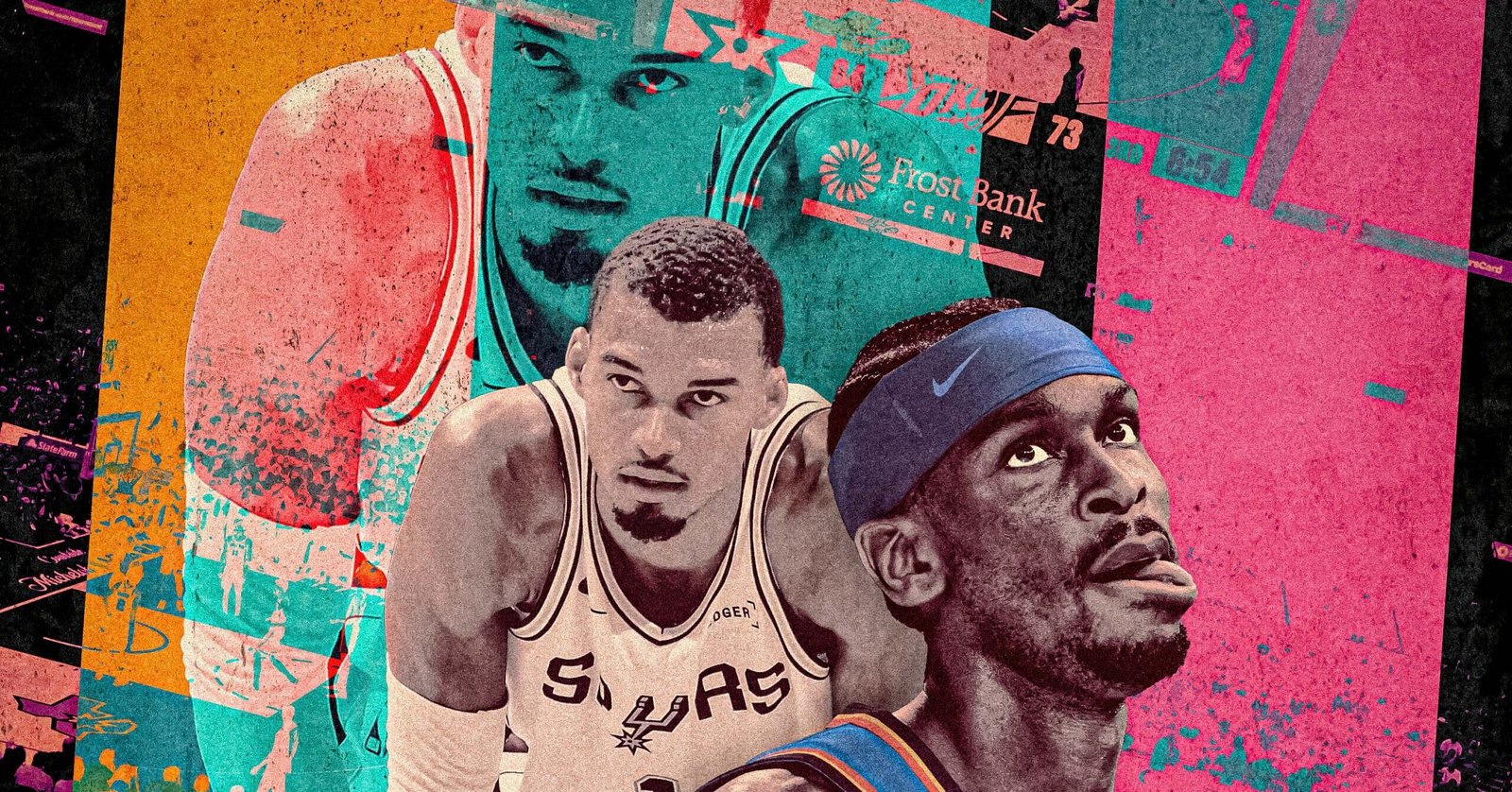
How inept were the Oklahoma City Thunder in Game 4 of the Western Conference finals? It was their worst offensive performance since December 2, 2021, when the Memphis Grizzlies won by 73 points
Down Jalen Williams and Ajay Mitchell on Sunday night, OKC was an ice cube, making only 18.2 percent of its 3s and 48.3 percent of its attempts at the rim. Shai Gilgeous-Alexander scored just 19 points on 6-for-15 shooting. He turned the ball over four times, too, and was hounded all night by Stephon Castle, Dylan Harper, Devin Vassell, and that huge dude in the middle who single-handedly turns the paint into a no-fly zone.
The series is now tied 2-2, with the San Antonio Spurs needing to win at least one more time in OKC to reach their first NBA Finals in over a decade. It’s more than possible, and maybe even borderline likely. Why? After four games, San Antonio has turned Oklahoma City into a team that may not be able to beat it without knocking down an incredible number of 3s. This is a problem.
The Thunder don’t typically rely on outside shooting to win. It’s not how they were built. During the regular season, they finished 19th in 3-point differential and 24th in opponent 3-point percentage … and still won 64 games. More directly, their winning percentage in 19 regular-season games where they shot below 30 percent from behind the 3-point line was still 68.4. That’s insane. Pretty much every other team finished below .500 when that happened.
To boot, last year the Thunder won the freaking title despite finishing 13th out of 16 playoff teams in 3-point percentage. Then and now, their identity has revolved around having arguably the greatest defense of all time, accentuated by a back-to-back MVP who efficiently averages over 30 points per game. They typically get stops, force turnovers, and generate more advantageous looks than their opponents. What Victor Wembanyama and the Spurs have done, though, is line the paint with an electric fence, force outside jumpers, and—now that De’Aaron Fox is back—take care of the ball. In other words, they’ve forced the Thunder outside their comfort zone.
The Thunder can obviously still win by getting hot from deep: In the first three games of this series, they knocked down a whopping 49.4 percent of their wide-open 3s. But a vast majority of those looks were shots the Spurs were willing to live with. Most were launched by whoever Wembanyama was assigned to help off of, be it Alex Caruso or Cason Wallace.
During the regular season, the Thunder went 42-2 whenever they scored at least 50 points in the paint. When they scored fewer than 43, they went 9-8. In the conference finals games so far, they’ve scored 36, 38, 42, and 42 points in the paint—their four lowest totals of the postseason. This is Wemby’s brilliance. The Thunder are banged up, yes, but even if they were healthy, there’s a very good chance the unanimous Defensive Player of the Year would still influence their configuration.
It might sound obvious (and it is), but scoring efficiently against Wembanyama is pretty much impossible unless you have five respectable shooters on the court. Mark Daigneault knows that. It’s why he’s leaning into offensive-minded lineups that can space the floor for SGA without offering Wemby an obvious place to roam.
It’s why Jaylin Williams (who went 1-for-7 from deep in Game 4 but went scorched earth with a 5-for-6 outing in Game 3) has shared the floor with Wembanyama quite a bit. It’s why lineups that include Jared McCain and Isaiah Joe are suddenly popping up all over the place. It’s why Kenrich Williams got some burn in Game 4. It’s why Lu Dort is a bigger liability than ever. And it’s why OKC’s typically formidable double-big units have been useless.
If you’re the Thunder, what’s really scary about Game 4 is that the Spurs didn’t just have Wemby walling off the paint—their frenetic defense also wasn’t content allowing OKC to tee off from deep. From the start, they stayed home on the perimeter—which was why SGA’s first half dozen pick-and-rolls resulted in one Isaiah Hartenstein floater after another.
At the same time, San Antonio also found ways to shrink the floor and swarm SGA whenever he got below the free throw line. It was a master class.
Attacking Wembanyama with smaller groups can come back to haunt you, too. By deploying lineups that skew toward offense, the Thunder have apparently been willing to expose themselves a bit on the other end. Here’s one example from Game 4, when Vassell blew by McCain, skipped a pass to the weakside corner, and triggered the type of ball movement that wins championships:
Again, just because OKC is uncomfortable doesn’t mean it can’t win. This is a battle-tested defending champion that can light it up on any given night with an ungodly defense. In a low-scoring slugfest, it still has Gilgeous-Alexander and may even get J-Dub or Mitchell back sooner rather than later.
But if you’re the Spurs, getting to write the rules of engagement for the next few games has to make you feel pretty confident. Dethroning the Thunder won’t be easy. But the Spurs can get them to play under strained conditions, which is why they should be favored to win this series.
Three Things I Can’t Stop Thinking About

1. The Cleveland Cavaliers, Perpetually 0.5 Players Away
You can chalk up Cleveland’s disappointing appearance in the Eastern Conference finals to any number of reasons—poor coaching, putrid 3-point shooting, inexcusable turnovers, a buzz saw of an opponent—but to me, the primary issue is more existential. Almost every playoff team lives with a marrow-deep fatal flaw that eventually reveals itself in defeat.
For as long as Cleveland has been competitive since LeBron James left, and for all the talent that’s rolled through town since Donovan Mitchell arrived, the Cavaliers have always been half a player away from a complete team.
Their recent history of fifth men has been a graveyard of combo guards, wings, and forwards who couldn’t fill one bucket without spilling another: De’Andre Hunter, Lonzo Ball, Ty Jerome, Isaac Okoro, and Caris LeVert were each appealing in their own way. None could even out lineups that were burdened by positional overlap. In these playoffs, the part has mostly fallen to Dean Wade or Max Strus, two fine role players who would be the answer to all of Cleveland’s problems if they could somehow just be the same person.
Now they’re on the brink of being swept Monday night, and the Cavs’ opportunity to find that missing piece might have already passed. Change is inevitable this summer. Maybe it’s trading Jarrett Allen for a more versatile two-way player? Allen and two first-round picks for Trey Murphy III sounds ridiculous and definitely is, but you can’t rule anything out when it comes to the New Orleans Pelicans. What about reuniting him with Darius Garland in a trade that would send back Derrick Jones Jr. and Brook Lopez? A straight-up swap with the Hawks for Jonathan Kuminga? No? Is this thing still on?
Despite a recent report indicating that Cleveland doesn’t want to lose Evan Mobley, perhaps it could cave for Giannis Antetokounmpo? Or deal Mitchell and reset around Mobley’s timeline without initiating a full-on rebuild? (How about shipping Mitchell to Houston for Alperen Sengun and Reed Sheppard?) Maybe it’s a coaching change? (This would be unfortunate and would probably change nothing, but Kenny Atkinson didn’t exactly have the greatest postseason showing.)
Whatever happens, it probably won’t be additive. The Cavaliers made a valiant run to the final four with the highest payroll in league history. But, evidently, they weren’t anywhere close to being the championship contender they originally sought to be. Something, or someone, was missing. Yet again.

2. Jalen Brunson’s Greatest Gift
Clinking Champagne glasses sound less celebratory than the uproar that follows Brunson’s jumper when it slips through the net anytime you watch a playoff game in Madison Square Garden, But, despite all the ways he’s reassuring and irreplaceable, none of New York’s success at this level would be possible if he hadn’t signed one of the most team-friendly contracts in the league. It’s one of the most important and underdiscussed reasons why the Knicks are five wins away from their first Finals appearance in 27 years.
Brunson is a top-10 player who’s less fazed by pressure than almost any guard I’ve ever seen. The fact that he’s smack-dab in the middle of his prime with a contract that will account for only 23 percent of his team’s cap next season is a singular gift; in an era when financial constraints are an obstacle, Brunson is currently the third-highest-paid player on the Knicks and made less than Jalen Suggs and Desmond Bane this season. It’s the result of an extension he signed in 2024 that effectively saved New York $113 million. (According to Steph Noh’s salary model, Brunson’s true value is $44.3 million more than what he’s guaranteed to earn over the next three years. Not a bad deal for the Knicks!)
Now, this isn’t to say that the Knicks haven’t spent an arm and a leg to build their roster. Only the Cavaliers and Golden State Warriors have a higher tax bill. But ducking the second apron with Brunson, Karl-Anthony Towns, OG Anunoby, Mikal Bridges, Josh Hart, and Mitchell Robinson (more on this later) on the roster is kind of ridiculous, and it will make potentially leaping over it next season a much easier pill to swallow.
The most fascinating question about this contract, though, is its legacy. Should New York win it all, is Brunson’s sacrifice imitable? “Obviously this is no guarantee that we win a championship, right?” he said at a 2024 press conference announcing the extension. “This is just me wanting to do my part to help this team try and get one.”
On one hand, people really love money. Good luck getting someone to take nine figures less of it than they deserve. On the other hand, winners draw blueprints that are followed by the rest of the league. If the CBA’s restrictive nature, coupled with Brunson’s success, convinces another All-NBA player to accept less than the max, it may kick-start a trend that highlights just how unserious this CBA really is—another gut punch to a players union that already sports two black eyes.
Brunson is eligible for an extension next summer. He’ll be on the other side of 30, and there’s a chance that deal will be an overpay. If so, he’s earned it.

3. Who Wants a (Very Good) Center?
We’re smack-dab in the middle of the conference finals, but, thanks to the very cool CBA that everyone loves and nobody ever complains about I can’t help but consider how free agency will affect two of the four frontcourts that are still alive.
The first conundrum will be with Robinson in New York. Injury concerns and Hack-a-Shaq parody aside, he’s a starting-caliber center who’s been vital backing up Towns. His virtually unstoppable offensive rebounds are a backbreaker. His vertical spacing is a looming threat. His rim protection is a weighted blanket, and he made 72.3 percent of his shots this season. Bottom line: Robinson is a bully (complimentary) with size and physicality, which is back in vogue for teams that want to control the possession game.
Not to bury the lede, but it also must be said that any team seriously interested in winning any of the next 10 championships must consider loading up on this exact type of player if it wants to physically wear Wembanyama down.
Robinson is only 28 years old. His contributions are increasingly coveted, and, as someone who should be seeking a raise from the $12.9 he’ll make this season, he has market value at a price that will shove the Knicks into the second apron. Maybe James Dolan will be fine with that (especially if they win the title). If not, there are teams that would love to invest in a big man who impacts winning without needing any plays called for him. The Los Angeles Lakers, Boston Celtics, Atlanta Hawks, and Los Angeles Clippers should be interested.
All those teams could use some size, which is why they’ll also be in the mix if and when the next center I want to talk about becomes available. Hartenstein holds a $28 million team option on his contract, and the Thunder are about to be saddled with a luxury tax bill that rivals the GDP of a Caribbean island. It sounds crazy for a roster this deep and talented, but Hartenstein might be their second-most essential player. He ranks second overall in defensive daily plus-minus and has a damn near singular ability to rebound, pass, and shoot roughly 135 percent on that signature push shot. Take all that away, and the defending champs are vulnerable against any team that can flex in the paint. (Among them out West are the San Antonio Spurs, Denver Nuggets, Houston Rockets, and Utah Jazz.)
How many centers not named Nikola Jokic are better playmakers from the high post or are able to make a quick decision out of the pocket? The guy is a certifiable hub. It’s a borderline indispensable luxury. But is Hartenstein as good as gone? Or will Sam Presti get creative by, say, declining Lu Dort’s team option and then dumping Aaron Wiggins and Isaiah Joe so that OKC can duck the second apron without losing its starting center? Or if they become the first team in nearly a decade to repeat as champs, will the Thunder simply bite the bullet and pay an exorbitant tax bill?
Odds are that the Thunder will look different next season. If that means Hartenstein is no longer around, the rest of the NBA will be doing backflips to celebrate.

(Random and Hot) Take of the Day
I’m not going to say that Giannis Antetokounmpo’s trade landscape is irrelevant, but it is anticlimactic and, honestly, just a little sad. How many teams watching these conference finals truly believe in their heart of hearts that they could give up a bunch of valuable stuff, add Giannis, and win it all? This problem isn’t news. But serious suitors are desperate. A prediction: This is Miami’s race to lose. It can offer Tyler Herro, Kel’el Ware, Davion Mitchell, and up to four first-pound picks. If that looks underwhelming, well, it is. It’s also a realistically acceptable package in the unfortunate aftermath of Milwaukee’s costly misread of its relationship with Antetokounmpo.
Assuming that Norm Powell is re-signed at a number that lets them stay under the tax and they don’t suffer any consequential injuries, the Heat’s leftovers, plus Giannis, should guarantee a top-six seed. Bam Adebayo, Andrew Wiggins, Jaime Jaquez Jr., Pelle Larsson, Kasparas Jakucionis, and whoever they sign with the mid-level exception (Collin Sexton, Luke Kennard, Kristaps Porzingis, Tim Hardaway Jr., or Landry Shamet would be helpful additions) is a pretty formidable rotation. Depending on how they fill out the roster, spacing might be an issue in the playoffs. But underestimate two-way brute force and Erik Spoelstra’s tactical genius at your own peril.

Michael Pina
Michael Pina is a senior staff writer at The Ringer who covers the NBA.
