

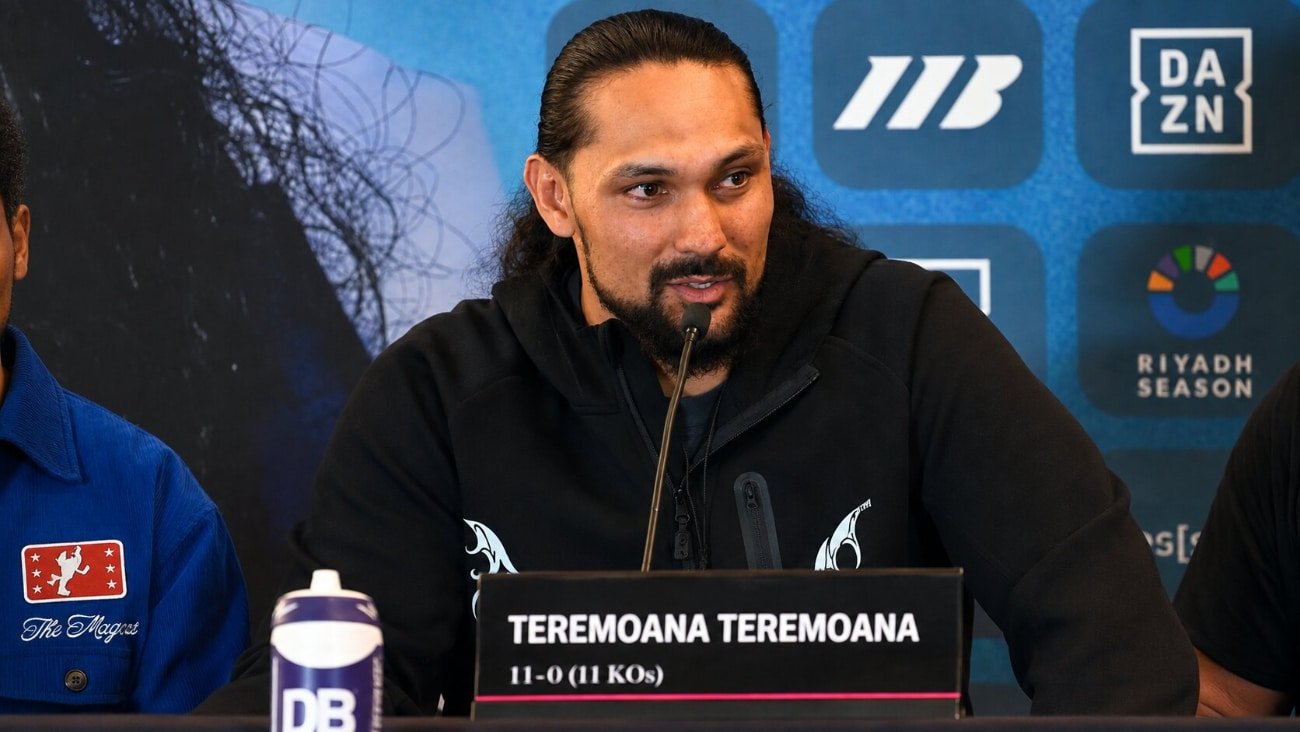


Teremoana faces DeAndre Savage on Wednesday, August 12, in a 10-round heavyweight main event on the Gold Coast in Australia. Eddie Hearn described Savage at the press conference as the Australian’s first significant test.
The problem is that this test should have come years ago.
Savage is 35 with a 10-1 record. Brandon Moore beat him over 10 rounds last year, making him a reasonable opponent to provide Teremoana with something his recent fights haven’t: resistance.
Since returning from the 2024 Olympics, Teremoana has knocked out seven consecutive opponents, six in the first round. He’s 11-0 with 11 knockouts, but those fights have done little to answer basic questions about a heavyweight who is nearly 29.
Tony Harrison, Savage’s trainer, brought up one of them at the press conference. He questioned what happens when Teremoana reaches the fifth round because previous opponents haven’t lasted long enough to find out.
After six years, why is that still unknown?
Teremoana already had extensive amateur experience before beginning his latest professional run. He reached the quarterfinals at the 2024 Olympics, losing to 6-foot-7 Bakhodir Jalolov. The three-round format didn’t suit Teremoana’s pressure-heavy, slugging style, yet he still made Jalolov work while continually trying to close the distance.
It’s easy to imagine Teremoana giving Jalolov serious trouble over the longer distance of a professional fight. He’s a huge, aggressive heavyweight who uses his size, pressure and punching power to overwhelm opponents. Nothing about his Olympic performance suggested he needed years against fighters incapable of testing those qualities.
Teremoana explained at the press conference that returning to the amateurs after turning professional allowed him to develop his skills and transform his body. He said he once weighed around 300 pounds before dropping roughly 40.
That amateur development should have allowed his handlers to move him faster once he returned to the professional ranks.
Savage may finally provide some rounds. He completed 10 against Moore, and Teremoana praised his movement and ability to pace himself over that distance.
But if Teremoana blows through Savage in a round or two like most of his recent opponents, it won’t prove he’s ready for the elite. It will mean another training camp was spent preparing for someone who couldn’t test him.
Savage is a benchmark for what comes next. If Teremoana handles him without difficulty, there should be no reason to keep him at this level. Hearn believes Australia may have a future heavyweight world champion. It’s time to start matching Teremoana like one.
At nearly 29, Teremoana has spent long enough fighting developmental opposition.