

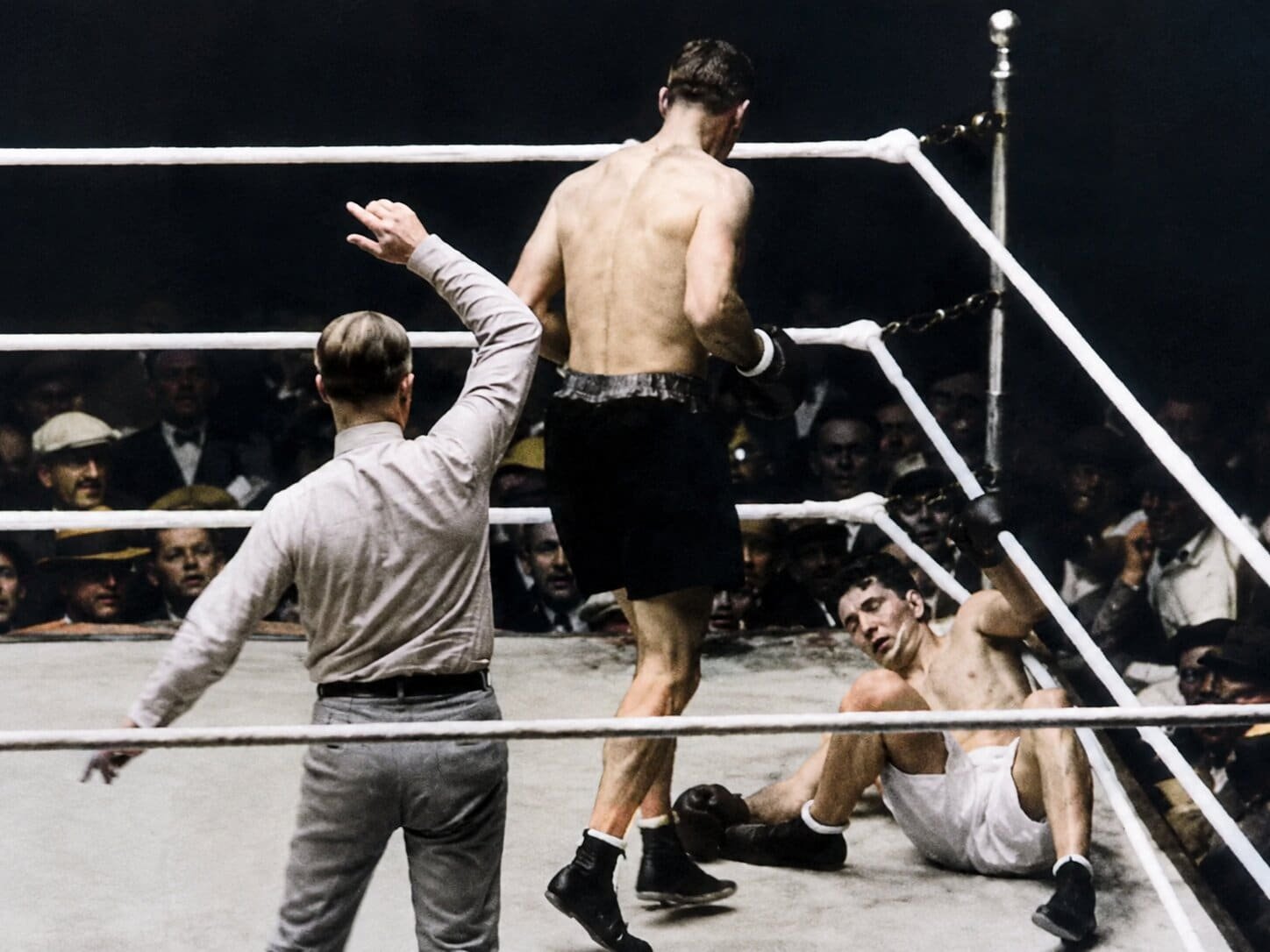


Instead of going directly to a neutral corner, Dempsey remained near his fallen opponent, waiting for the opportunity to strike again. Barry repeatedly directed him away before beginning the count. Under the rules in effect that night, the referee could not start counting until the standing boxer reached a neutral corner. Ironically, Dempsey’s own camp had requested that specific rule before the rematch.
Film of the bout later showed Tunney remained on the canvas for roughly 13 to 14 seconds from the moment he fell until he got back to his feet at Barry’s count of nine. Those images have kept the controversy alive for generations. Supporters of Dempsey maintain a standard count would have ended the fight and returned the heavyweight championship to the former champion.
Tunney always rejected that conclusion, insisting he remained fully aware after the knockdown, picked up Barry’s count at “two,” and deliberately waited until nine before standing to give himself as much recovery time as possible. He later said he could have risen much sooner if necessary. Dempsey eventually accepted that explanation, even if many fans never did.
The debate expanded one round later when Tunney dropped Dempsey in the eighth. Barry immediately started counting instead of waiting for Tunney to move to a neutral corner. Critics viewed the different application of the rule as evidence of inconsistency, while others argued the sequence happened too quickly to alter the outcome.
Removing the seventh-round controversy from the equation, Tunney boxed brilliantly for most of the night. His footwork, jab, and movement inside the large ring repeatedly frustrated Dempsey before and after the knockdown.
After surviving the seventh-round scare, he quickly regained control, scored a knockdown of his own, and closed out a unanimous decision victory.
No replay or modern analysis has settled the argument because evidence supports both sides. One camp believes Dempsey lost the heavyweight championship by hesitating for only a few seconds. The other points to the rule book, Tunney’s own account, and the champion’s performance across the rest of the fight. Nearly 100 years later, boxing’s most famous long count remains one of the sport’s greatest unanswered questions.

