
Bettinardi putters are premium, hand-milled and beloved by a very specific kind of golfer. The kind who appreciates what it means to have a single block of 303 stainless steel shaped and finished in Tinley Park, Ill. Premium craftsmanship and real-world performance aren’t always the same thing, though.
Our 2026 Most Wanted mallet test had something to say about that.
When the results came in from 29 putters scrutinized by 20 testers, Bettinardi’s BB 6.0 finished first overall and the BB 7.0 finished second. If you dig into the numbers, you can start to understand how it happened. The answer points directly to the face.
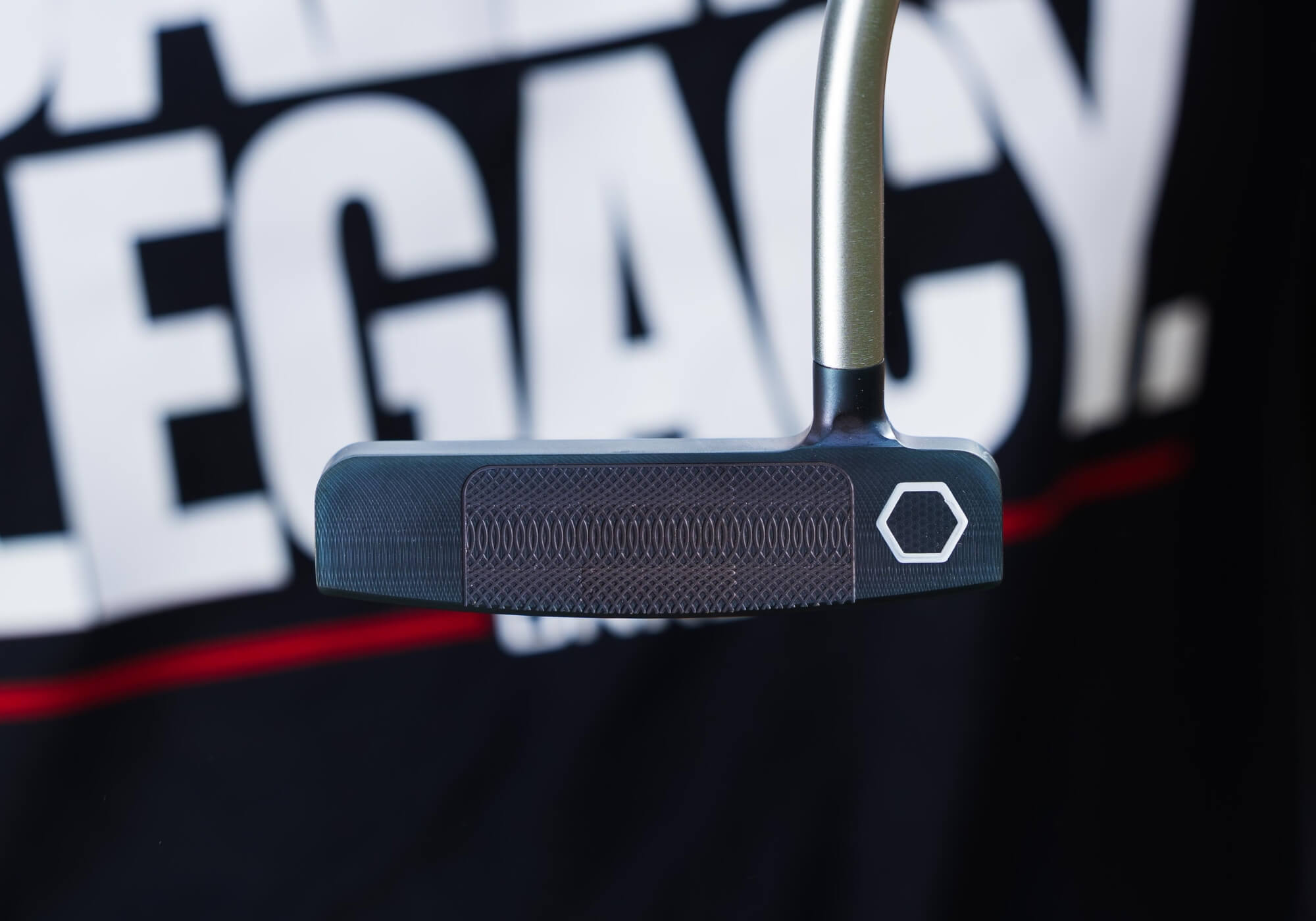
For the 2026 BB line, Bettinardi introduced Variable Depth Flymill (VDF) face milling. Nine individually milled zones each are engineered to normalize energy transfer regardless of where the ball contacts the face. The claim was a 30 percent improvement in distance consistency. We didn’t design our test to evaluate that specific claim. But what we measured lines up with what face technology like the VDF should be able to do.
What VDF face milling does
Every putter face has a sweet spot. Strike it there and the ball rolls predictably. Catch it slightly off-center and the energy transfer changes which means the distance changes.
VDF divides the Bettinardi face into nine individual zones. Each zone is milled to a different geometry, calibrated so the energy transferred to the ball is normalized across the face. Toe-side contact. High on the face. The geometry adjusts to compensate. In Bettinardi’s internal testing with Quintic, the VDF face produced approximately 30 percent less variation in effective distance and more than 40 percent less variation in topspin across the face compared to a traditional flymill design.
What’s notable about Bettinardi’s approach is that they accomplished the VDF Face technology while maintaining 100 percent milled construction, the thing that’s defined the brand for 25 years. Bettinardi said the VDF face would improve distance consistency. The 2026 Most Wanted results won’t settle that argument. But proximity held up across both tests, at nearly every distance, in two different putter formats.
What the mallet test showed
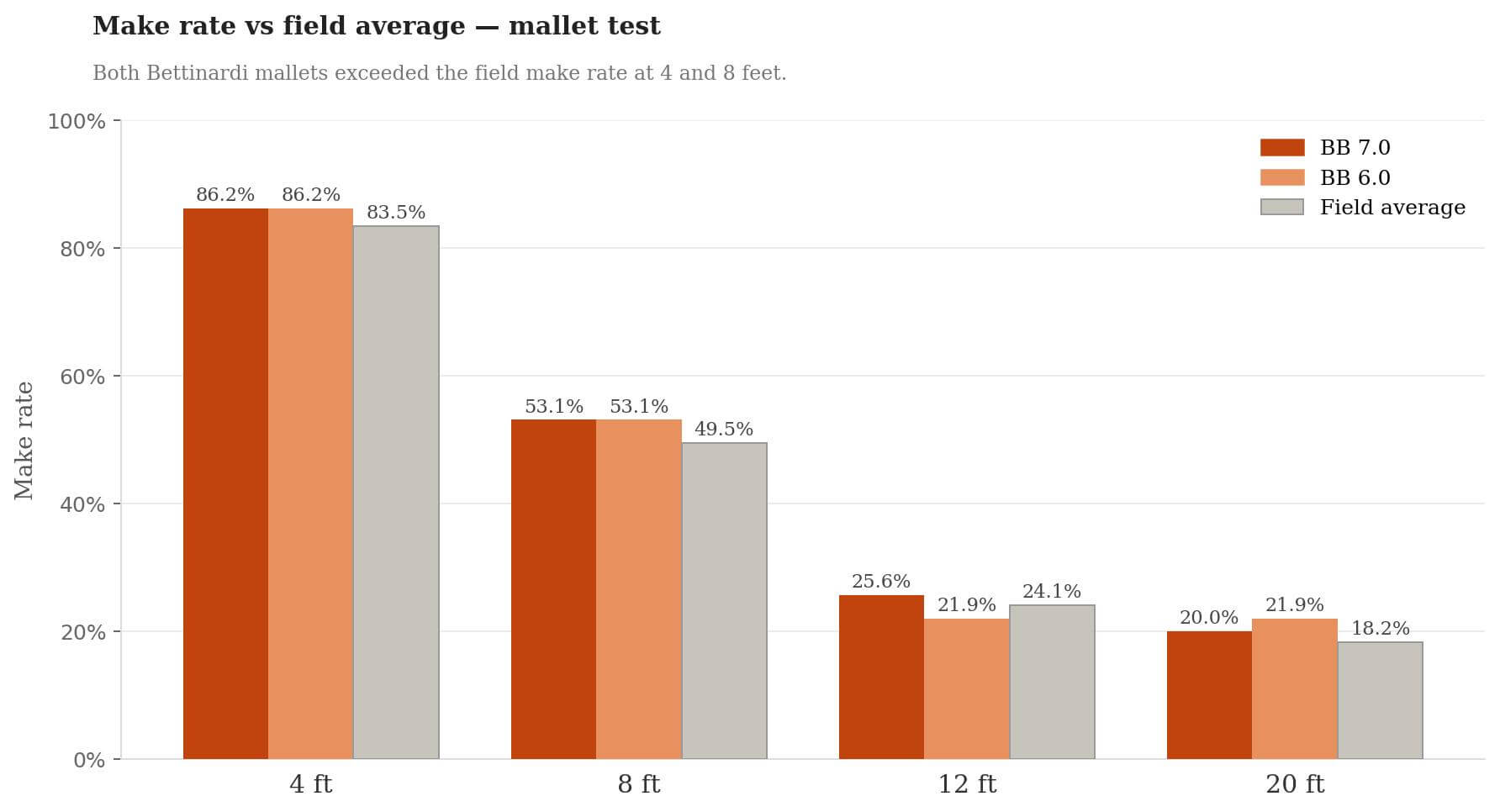
The 2026 Most Wanted mallet test ran 29 putters through four distances—4, 8, 12 and 20 feet—with 20 testers on a PuttView system. Every putt was tracked.
4 and 8 feet — the most important range
The 4- to 8-foot range is where face technology has the most measurable influence on scoring. At these distances, the ball is close enough that face quality directly determines the outcome. Green reading and line judgment matter less. What matters is whether the putter consistently delivers the ball toward the hole and, when it misses, how close it misses.
4-foot results
| Putter | Make % | Avg miss (in) | SG | Range (in) | Spray (in) |
|---|---|---|---|---|---|
| BB 7.0 | 86.2% | 13.2 | 0.175 | 5.8 | 8.8 |
| BB 6.0 | 86.2% | 16.0 | 0.172 | 6.7 | 9.8 |
| Field average | 83.5% | 17.9 | 0.145 | 8.1 | 11.3 |
Range = depth spread of misses. Spray = lateral spread. Lower is better for all miss metrics.
8-foot results
| Putter | Make % | Avg miss (in) | SG | Range (in) | Spray (in) |
|---|---|---|---|---|---|
| BB 7.0 | 53.1% | 11.7 | 0.184 | 10.5 | 14.3 |
| BB 6.0 | 53.1% | 13.4 | 0.182 | 11.9 | 21.5 |
| Field average | 49.5% | 15.1 | 0.144 | 12.5 | 18.2 |
BB 7.0 ranked #1 for both proximity and spray at this distance.
The BB 7.0 ranked #1 for proximity at both 4 and 8 feet, the only putter in a 29-putter field to do that at both distances. It also ranked #2 for Range at both distances, meaning the depth consistency of its miss pattern was among the tightest tested.
Proximity and Range together describe a putter that not only misses close but misses close with consistency. That’s what a face technology designed to normalize energy transfer across the face should produce.
12 and 20 feet
At longer distances, the story becomes more nuanced, which is worth being straightforward about. At 12 feet, the two Bettinardi models diverged. The BB 6.0 posted strong distance control with a Range of 21.1 inches ranked #4 of 29 against a field average of 24.5 while the BB 7.0 slipped on Range but held up better on Strokes Gained (#9 vs #19). Neither putter dominated this distance. Both were competitive.
12-foot results
| Putter | Make % | Avg miss (in) | SG | Range (in) | Spray (in) |
|---|---|---|---|---|---|
| BB 7.0 | 25.6% | 16.9 | 0.008 | 26.3 | 30.4 |
| BB 6.0 | 21.9% | 16.0 | -0.034 | 21.1 | 34.3 |
| Field average | 24.1% | 17.0 | -0.014 | 24.5 | 32.0 |
At 20 feet, the BB 6.0 came back strong, ranking #5 for make rate (21.9% versus 18.2% field average) and #3 for proximity. Its Strokes Gained of 0.137 ranked #4. Even at a distance where most differences between putters flatten out, Bettinardi’s distance control advantage remained measurable.
20-foot results
| Putter | Make % | Avg miss (in) | SG | Range (in) | Spray (in) |
|---|---|---|---|---|---|
| BB 6.0 | 21.9% | 18.1 | 0.137 | 21.7 | 47.5 |
| BB 7.0 | 20.0% | 19.4 | 0.112 | 21.4 | 50.8 |
| Field average | 18.2% | 20.2 | 0.091 | 22.4 | 45.6 |
What the blade test added
The 2026 blade test ran 24 putters through the same protocol. The two Bettinardi blades in the test were the BB-8W and the BB-1. The overall standings tell a different story than the mallet. The BB-8W finished 10th and the BB-1 21st.
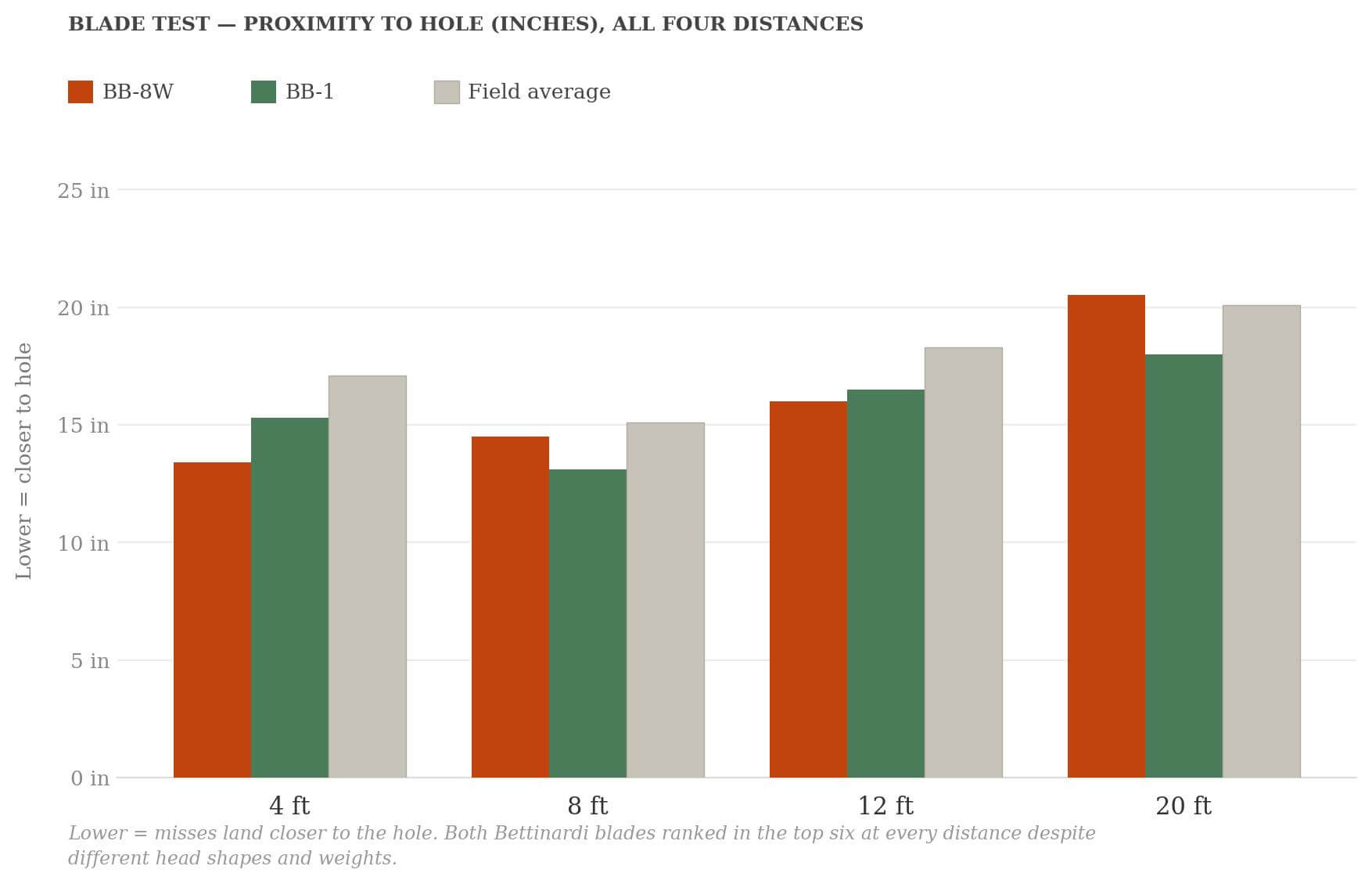
What the blade test did add is a specific data point that’s hard to dismiss. At every distance in the 24-putter blade field, at least one Bettinardi model ranked #1 for proximity to the hole.
Blade test proximity rankings
| Distance | Top Bettinardi blade | Proximity (in) | Field avg (in) | Rank of 24 |
|---|---|---|---|---|
| 4 ft | BB-8W | 13.4 | 17.1 | #1 |
| 8 ft | BB-1 | 13.1 | 15.1 | #1 |
| 12 ft | BB-8W | 16.0 | 18.3 | #1 |
| 20 ft | BB-1 | 18.0 | 20.1 | #1 |
Proximity is the metric most directly influenced by what the face is doing. It measures where the ball stops relative to the hole, capturing speed consistency, energy transfer and roll quality. You can miss the read and still have good proximity. You can’t fake consistent energy transfer to the ball.
The case for the Bettinardi face technology
The BB-1, BB-8W, BB 6.0 and BB 7.0 are meaningfully different putters. Different head geometries, different weights, different MOI characteristics. Two blades and two mallets. What they share is the VDF milled face.
High-MOI mallets and low-MOI blades typically produce different performance profiles in our testing. That’s not what happened here. The proximity advantage showed up across both test formats, at nearly every distance, across four different head designs.
VDF milling was designed to reduce distance variation on off-center strikes. Tighter proximity numbers and stronger Range rankings are exactly what you’d expect to see if that technology is working. The data doesn’t prove causation. But it’s consistent with the claim.
Final thoughts
Bettinardi said the VDF face would improve distance consistency. The 2026 Most Wanted results won’t settle that argument. But proximity held up across both tests, at nearly every distance, in two different putter formats. The data leans in their direction.
The post The 2026 Most Wanted Putter Data Has A Lot To Say About Bettinardi’s Face Technology appeared first on MyGolfSpy.

